Trying to motivate your co-workers, staff, or even friends to perform at their best? If things aren’t working as well as you hoped, it could be because you’re using the wrong approach. In the book, Why Motivating People Doesn’t Work and What Does, author and coach Susan Fowler Regetti says this: Efforts to motivate others often don’t work because people are already motivated. True motivation comes from understanding how people get motivated, then working from there. We explain this concept further in this Why Motivating People Doesn’t Work summary and book review.
We also go through top insights for getting breakthrough results by helping people to feel more energized and engaged. As a book summary service that has reviewed hundreds of self-help book titles, we also assess whether this book is helpful and who should be reading it. In summary, this article covers:
- Why Motivating People Doesn’t Work Book Summary & Key Ideas
- Why Motivating People Doesn’t Work Review
- Who Should Read Why Motivating People Doesn’t Work?
- Other Recommended Sources
- About Susan Fowler Rigetti
- Why Motivating People Doesn’t Work Quotes
Let’s get straight into it.
Why Motivating People Doesn’t Work Book Summary & Key Ideas
Ever tried to motivate someone and they seemed irritated by your effort? Or perhaps you tried to motivate a team but didn’t get any improvements on productivity and performance? Well, it’s often because:
- We assume that people aren’t initially motivated, and
- We rely on outdated motivational techniques like carrot-and-stick techniques. The carrot and stick approach is a method that uses external rewards and penalties to encourage people to meet certain objectives.
Here’s more on why they fail.
Why Traditional Motivation Methods Fail (Bonuses, Praise & Pressure)
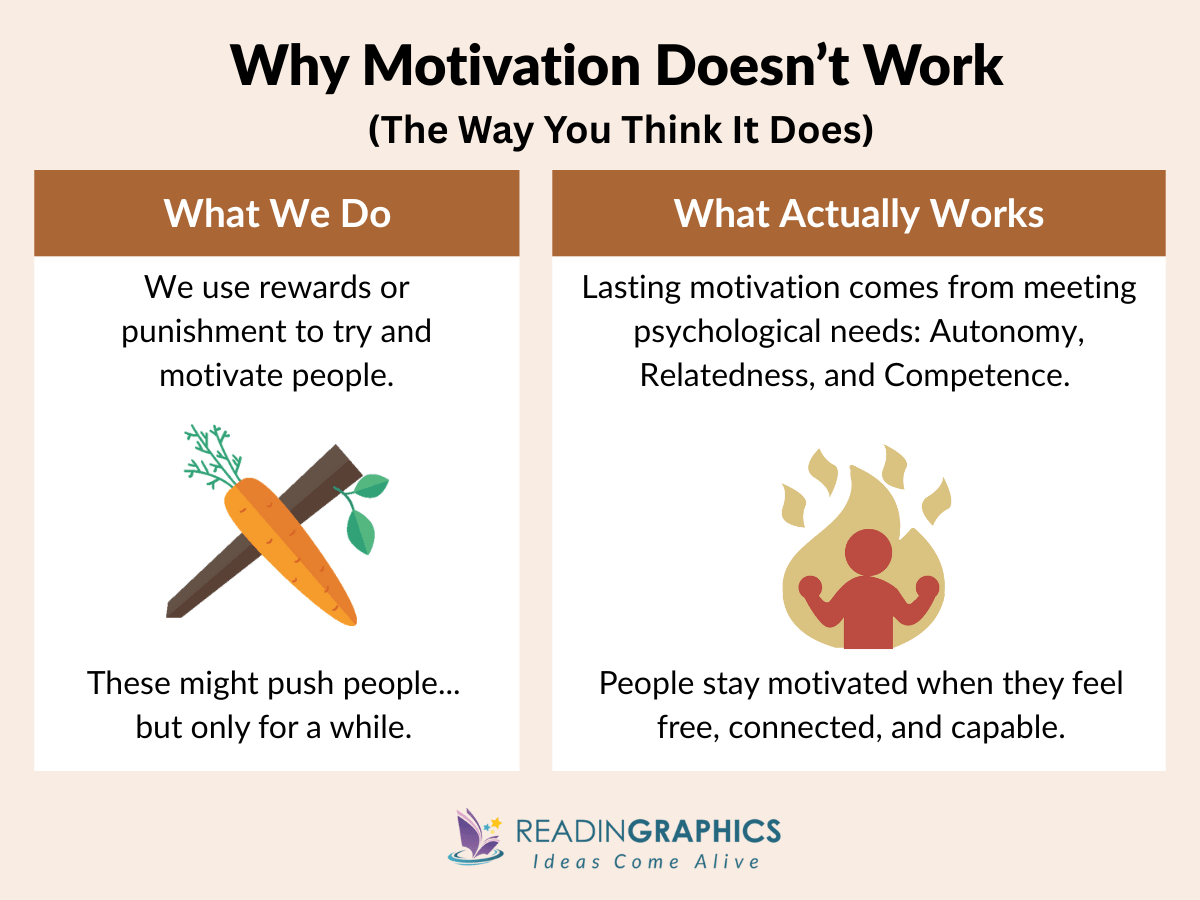
We often try to use rewards or punishment to motivate people. According to Susan Fowler, this fails because we don’t understand why people are motivated in the first place.
If a salesperson is motivated by happy customers, a manager cannot keep them motivated with monetary rewards. Instead, a better approach would be to highlight the impact of their work – like sharing how many customers they’ve helped.
Also, in addition to not understanding why people are motivated, these methods of motivation, i.e. bonuses, praise or pressure, are usually short-term motivators. A study found that if you offer someone money to lose weight, it will only work temporarily. After a few months, they often return to their old habits.
Fowler explains three needs to keep good motivation: autonomy, relatedness, and competence. She also says we must know a person’s why.
- Autonomy – People are more motivated when they feel they have some level of control and influence on the work that they do.
- Relatedness – This is the sense of connection we feel to others and a greater purpose. We are more motivated when we feel that we are contributing to something greater.
- Competence – We are more motivated when we feel that we are achieving growth and flourishing.
Why Motivational Quotes Don’t Work (or any other surface-level inspiration)
Often, motivational quotes function the same way as external motivators. They stimulate emotion by offering a quick burst of inspiration or energy, but they rarely address deeper psychological needs like purpose, autonomy, or a sense of growth. Because they often bypass these psychological needs, their effect is usually short-lived. Like most external rewards, they may feel good in the moment, but they don’t create lasting change.
While Fowler doesn’t directly talk about motivational quotes, she points out why outside validation, praise, or rewards are ineffective as surface-level inspiration. They might give a temporary boost, but they don’t address what we need deep down, nor fuel lasting drive.
The Illusion of Surface-Level Inspiration
In many cases, we mistake surface-level inspiration or drive for true motivation. For example, if you’ve ever felt driven to please someone, chase money, seek rewards, or avoid shame, these are all external motivators. Extrinsic rewards can give you a quick dopamine hit, but the effects don’t last. That’s because they fail to address our deeper psychological needs, like autonomy, relatedness, and competence.
The science of self-determination research shows that we don’t thrive on pressure or praise alone. We thrive when we feel a sense of personal empowerment, when we’re connected to something that matters. In other words, sustained motivation comes when we act from internal drive, not just external validation. Without that, we stay stuck on the motivation spectrum in a cycle of highs and lows, never tapping into our full energy or untapped potential.
It’s the difference between chasing a goal and being pulled toward it by purpose. Intrinsic rewards—like growth, contribution, and meaning—fuel what Fowler calls the optimal motivation process. It’s the kind of motivation that sustains you, even when no one’s watching.
Without Autonomy and Meaning, Motivators Are Empty
People really want to feel like what they do has a purpose, not just hear nice words. Sure, you can offer benefits, compliments, and good pay, but if they don’t have the freedom to make choices and don’t feel like their work actually matters, those things just don’t hit the mark.
Drive theory may suggest people are wired to move toward rewards and away from pain, but that’s only part of the picture. Real motivation kicks in when people feel they’re doing something that matches who they are, not just because someone is pushing them into it. Without that connection, even the best rewards end up feeling meaningless.
What Actually Motivates People (Backed by Science)
We know that everyone is already motivated because we innately have a desire to thrive. The tricky part is that our motivation levels can change. According to the self-determination theory, how motivated you are depends a lot on whether your internal needs are being met. As mentioned earlier, those psychological needs include things like autonomy, connection, and growth. When people feel they have autonomy, feel supported in meaningful relationships, and see growth opportunities, they naturally move toward what Fowler calls optimal motivation.
This is the difference between chasing rewards (external motivational outlook) and feeling like your work is actually part of who you are (integrated motivational outlook). When you’re driven by internal motivators, you have the energy and enthusiasm to stick with goals and achievements over the long haul.
Fowler uses the Spectrum of Motivation model to explain different types of motivation that drive human behavior—from suboptimal to optimal.
Suboptimal Motivational Outlooks (Less effective)
- Disinterested motivation – You lack energy or interest in the task; you’re mentally or emotionally checked out.
- External motivation – You’re doing something to gain a reward or avoid punishment (e.g. money, recognition, pressure).
- Imposed motivation – You feel forced or guilted into doing something due to pressure, obligation, or shame.
Optimal Motivational Outlooks (More effective)
- Aligned motivation – You do something because it matches your personal values, even if it’s not enjoyable.
- Integrated motivation– You fully accept and internalize the value of the task; it becomes part of your identity.
- Inherent motivation – You’re motivated simply because the task is enjoyable or interesting in itself.
The shift from suboptimal to optimal leads to deeper engagement, better performance, and lasting motivation.
Why Is It Hard to Motivate Others at Work (Or at Home)?
People often lose focus on their main needs: autonomy, relatedness, and competence. Fowler calls these strong motivators. Instead, we mistakenly rely on external motivators like rewards or the desire to please others, assuming these are what drive us to aim higher. This confusion doesn’t just affect how we see ourselves; it also shapes how we try to motivate others. We project these same assumptions onto them, using praise, incentives, or pressure, thinking that’s what will work. But both we and those we’re trying to motivate are often misguided, chasing motivators that only deliver short bursts of energy.
The result is fleeting: our drive quickly fades, and we return to a state of low-quality motivation. The book also highlights that we live in a culture that struggles with self-regulation, the ability to manage our thoughts, actions, purpose, and values in ways that support both immediate and lasting motivation. Without it, we become vulnerable to what Fowler calls “low-quality motivation” – quick fixes that feel good in the moment but never truly sustain us.
Why Leaders Must Change Unhelpful Beliefs First to Lead Others
We mustn’t ignore the fact that our own beliefs could be influencing or even sabotaging our approach to motivation. Research shows many leaders accept wrong beliefs without asking questions. These beliefs change how they try to motivate people. These beliefs are
- It’s not personal. It’s just business – This belief totally ignores the human side of work. It forgets that people’s feelings, values, and sense of purpose play a huge role in how well they perform.
- The purpose of business is to make money – Focusing only on profit misses the bigger picture. It’s important to consider things like purpose, making a difference, and taking care of employees to really succeed in the long run.
- Leaders are in a position of power – If they see leadership as control, they may manipulate people instead of inspiring them.
- The only thing that really matters is results – Just zeroing in on results can score some quick wins, but it might hurt long-term motivation, engagement, and even ethics down the line.
- If you can’t measure it. It doesn’t matter – This idea downplays the importance of things you can’t really measure, like trust, a sense of purpose, or feeling mentally safe.
If you know that these are some of your beliefs, Fowler encourages you to change them as it can affect the quality of your leadership.
How Should Leaders Motivate their Employees?
Fowler says leaders must stop focusing only on results. They should start caring about their people to motivate them well. They should focus on their well-being, help them grow, and connect their work to something meaningful. When people feel valued and supported, good results will follow naturally.
The Shift from “Managing Behavior” to “Activating Potential”
In a workshop, Fowler asked a group of leaders what they wanted from their employees. Many of them gave answers like: to listen more, to be more focused, or to increase productivity. Then she shifted the question and asked what they wanted for their employees. That subtle change led to very different responses, things like happiness, growth, and a sense of connectedness.
Fowler asked these questions to make a point: instead of fixating on the performance outputs we want from people, we should focus on their overall well-being. When we support well-being by helping people grow and find purpose, good results like productivity follow.
Old Models of Leadership Don’t Work Anymore
Many old leadership practices don’t work anymore.. Telling people what to do and offering rewards does not motivate them; it actually hurts their drive. People want to feel valued, not just managed.
Motivation Conversations vs. Performance Conversations
It shouldn’t be all about checking off tasks; instead, leaders should encourage finding real meaning in what their team does. Talking motivation helps folks understand why their work actually counts, while performance talks are just about whether they hit the deadline. There’s a huge difference.
Why Motivating People Doesn’t Work Review
This book hits the nail on the head when explaining how motivation works and challenging widely used methods of motivating people. What makes it even more compelling is how it combines science and real-life examples to substantiate the author’s arguments. Although it’s rooted in scientific research, the writing is easy to understand, making it accessible to everyone.
While the book focuses on leaders, readers from various backgrounds, like managers, co-workers, and even friends and family – find it relatable. If you want to learn more about the science of leading, the spectrum of motivation, myths about motivation, and effective ways to address them, this book is a great choice.
Who Should Read Why Motivating People Doesn’t Work?
If you lead a team, guide a group, parent a child, or coach others, this book, Why Motivating People Doesn’t Work and What Does, is for you. It helps those who feel frustrated when rewards, praise, or even pressure fail to inspire real and lasting change. This book is also useful for anyone who wants to build deeper motivation in themselves or in others.
Other Recommended Sources
Here’s a selection of other great reads if you found value in Why Motivating People Doesn’t Work… and What Does.
- Drive by Daniel H. Pink dives deep into what really fuels motivation, autonomy, mastery, and purpose, and why traditional carrot-and-stick tactics fall flat. It’s a perfect companion to Fowler’s ARC framework.
- Leaders Eat Last by Simon Sinek focuses on how creating environments of trust and safety leads to stronger, more motivated teams, mirroring Fowler’s call for relatedness and personal empowerment..
- In The War of Art, Steven Pressfield discusses overcoming the inner voice that holds you back, so that you can tap into your creative side and do meaningful work. This concept is connected to Susan Fowler’s work, as both emphasize that internal motivators and having personal goals are more important than chasing outside rewards or pressure.
Subscribe to access these along with 300+ best-selling book summaries, to begin your own journey to personal and professional growth!

You can purchase the book here.
Chapter Index
See All Chapters (Click to expand)
Our summaries are reworded and reorganized for clarity and conciseness. Here’s the full chapter listing from Why Motivating People Doesn’t Work… and What Does by Susan Fowler, to give an overview of the original content structure in the book.
Introduction: Stop Beating Your People with Carrots
- The Motivation Dilemma
- What Motivates People: The Real Story
- Shifting Out of Overdrive
- If Motivating People Doesn’t Work . . .What Does?
- Rethinking Leadership Now That Everything Else Has Changed
- Leader, Heal Thyself
- Are Your Beliefs Eroding People’s Optimal Motivation?
- The Promise of Optimal Motivation
About Susan Fowler Rigetti
Why Motivating People Doesn’t Work… and What Does is written by Susan Fowler. She’s an American leadership expert, keynote speaker, and author best known for her work on motivation science and employee engagement. She has served as a senior consulting partner with The Ken Blanchard Companies and is a co-creator of the company’s Self Leadership and Optimal Motivation programs. She’s also co-authored three books with Ken Blanchard, including Self Leadership And The One-Minute Manager, Leading At A Higher Level, and Empowerment. With decades of experience in leadership development, Susan also teaches at the University of San Diego and has contributed to several bestselling books on personal and organizational effectiveness.
Why Motivating People Doesn’t Work Quotes
“A great irony of leadership is that motivating your people doesn’t work because people are already motivated.”
“The role you play as a leader is helping people experience relatedness at work: caring about and feeling cared about, feeling connected without ulterior motives, and contributing to something greater than oneself.”
“Empowerment may often be considered a cliché, but if people don’t have a sense of empowerment, their sense of autonomy suffers and so do their productivity and performance.”
“There are significant implications for the organization when people experience high-quality motivation.”
“One of the great opportunities you have as a leader is to help your people find meaning, contribute to a social purpose, and experience healthy interpersonal relationships at work.”
“Outdated terminology—such as driving for results or incentivizing behavior—leads you down the wrong path if you are looking for motivation that generates productivity without compromising positive and enduring energy, vitality, and well-being for the people you lead.”