Top performers achieve exceptional results not because of talent, but how they approach learning. In this book, chess prodigy and martial arts champion Josh Waitzkin distills his approach to performance psychology and personal growth. In this free version of The Art of Learning summary, we’ve distilled the book’s key insights on self-mastery. Whether you’re an athlete, professional, entrepreneur, or lifelong learner, you’ll find practical lessons to support you on your inner journey to optimal performance through deliberate practice and resilience.
How to Master the Art of Learning?
Josh Waitzkin is best known as the chess prodigy portrayed in Searching for Bobby Fischer. What’s more remarkable is that he became world-class twice—first as a national chess champion, then as a world champion in Tai Chi push hands.
His real advantage came from a blend of technical know-how and personal growth from the inside-out. He developed the ability to learn with an open mind, stay calm under pressure, adapt to changes, grow through discomfort, and build on his personal strengths and style.
In this book, Josh shares personal stories from both chess and martial arts to reveal the frameworks, habits, and mental tools that helped him continuously transform himself and develop his learning process to pursue mastery, inner growth, and alignment.
In this free version of The Art of Learning summary, we present the key ideas in 2 parts:
- Highlights of Josh Waitzkin’s journey from chess prodigy to martial arts champion.
- Principles of mastery: The mental frameworks, strategies, and habits that helped him thrive under pressure and learn deeply.
From Chess Prodigy to Martial Arts Champion
Let’s start by understanding the learning process that led Josh to becoming world-class in 2 different areas.
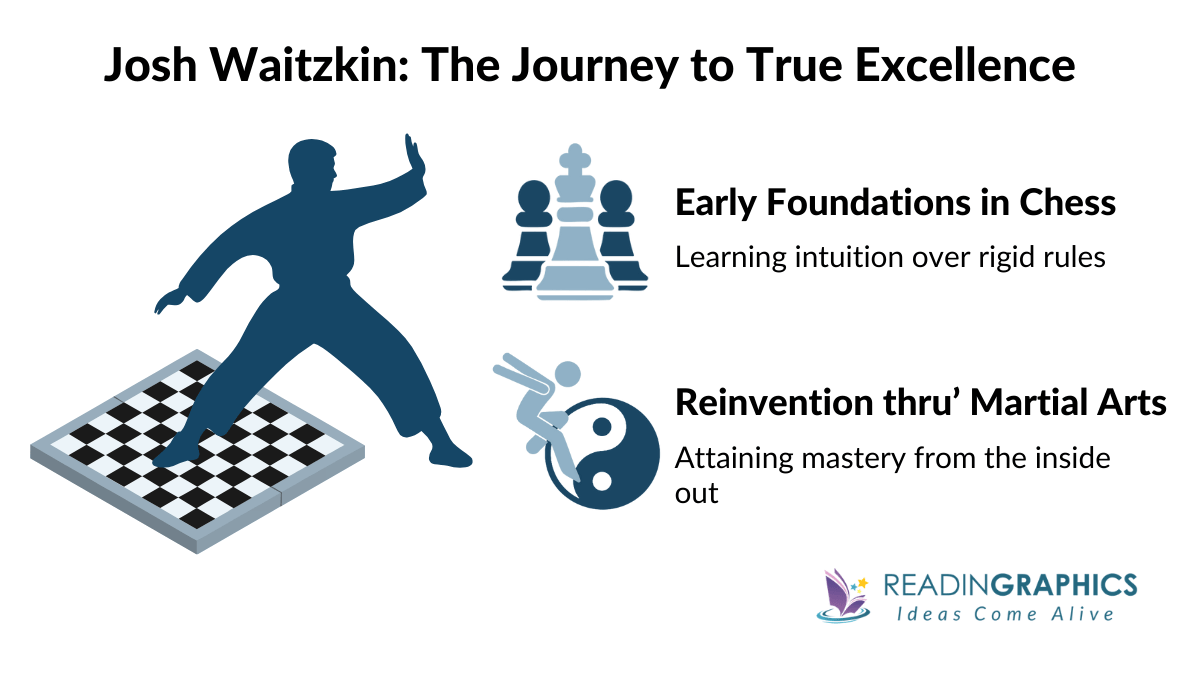
EARLY FOUNDATIONS IN CHESS
Josh was discovered playing chess in Washington Square Park at the age of six. Soon after, he was introduced to Bruce Pandolfini, a renowned chess teacher who became his first formal mentor.
Unlike many traditional coaches, Pandolfini avoided rigid instruction or harsh discipline. Instead, he emphasized flexible learning through internalization of core principles.
Instead of trying to force Josh into a fixed mold or approach, Pandolfini encouraged Josh to express himself, nurturing his love for chess. This approach to learning earned Josh’s trust, and helped shape Josh’s early style—which was more aggressive, fluid, and improvisational. This unusual foundation also taught Josh to trust his instincts and engage deeply with uncertainty, a habit that would later shape his learning philosophy.
Josh quickly rose through the ranks to win at national championships, he was featured in media, and was even portrayed in the movie Searching for Bobby Fischer. During tournaments, he’d often enter a deep state of flow, making intuitive moves that felt effortless (yet often led to victory). However, the fame and pressure also led to deep personal conflict. He was increasingly “performing” for others rather than playing for the love of the game.
This worsened when he started working with new coaches who tried to overhaul his natural style, pushing for mechanical execution over feel, intuition, and inner connection. On the outside, he was still winning. But on the inside, he was burning out. By the age of 19, Josh walked away from competitive chess. He spent time traveling, exploring Eastern philosophy, reconnecting with himself, and rediscovering learning.
REINVENTION THROUGH MARTIAL ARTS
After leaving the chess world, Josh began studying Tai Chi under Grandmaster William C.C. Chen, drawn to its emphasis on balance and internal power. He eventually entered push hands competitions, where he rose again to world-class levels—this time by mastering breathwork, sensitivity, presence, and intentionality.
Despite repeated defeats during sparring, Josh refused to fight back with force or get frustrated. Instead, he learned to yield, absorb pressure, and maintain internal structure, thereby retraining himself to stay relaxed, rooted, and aware.
He learned important principles like investment in loss and deliberately trained with more experienced martial artist partners to expose his weaknesses and accelerate growth.
Weeks before the 2002 Nationals, Josh broke his right hand. Rather than withdraw, he began training exclusively with his left side—writing, eating, and training with it. This forced him to refine his techniques and activate new neural pathways.
He called this process adversity training—turning constraints into growth opportunities. His left hand became more responsive, freeing his right side for more creative attacks once it healed.
He also began internalizing his movements—reducing large, visible motions into subtle, precise micro-movements. Over time, even a small weight shift or breath could disrupt an opponent’s balance. This laid the foundation for what he later called “making smaller circles.”
Besides physical training, Josh also began building mental resilience and working on his emotional triggers. In our complete 15-pages summary, we zoom in on how Josh learned to master himself which led to him becoming an International World Champion in Tai Chi Chuan, despite the adversity he faced in the 2004 World Championship in Taiwan.
Josh is clearly not someone who’s willing to get stuck in safe mediocrity. Learn how you too, can become a high-achiever and attain mastery in your desired field(s) by checking out our Mastery summary.
Core Principles for Peak Performance and Mastery
In this section, we’ll dive deeper into the specific mindset and learning strategies that helped Josh Waitzkin become world-class in 2 entirely different fields. These inner tools and habits were developed through years of experimentation, reflection, and deliberate practice.
For a step-by-step guide to each of these strategies, get our full 15-page book summary with infographic, text and audio formats. 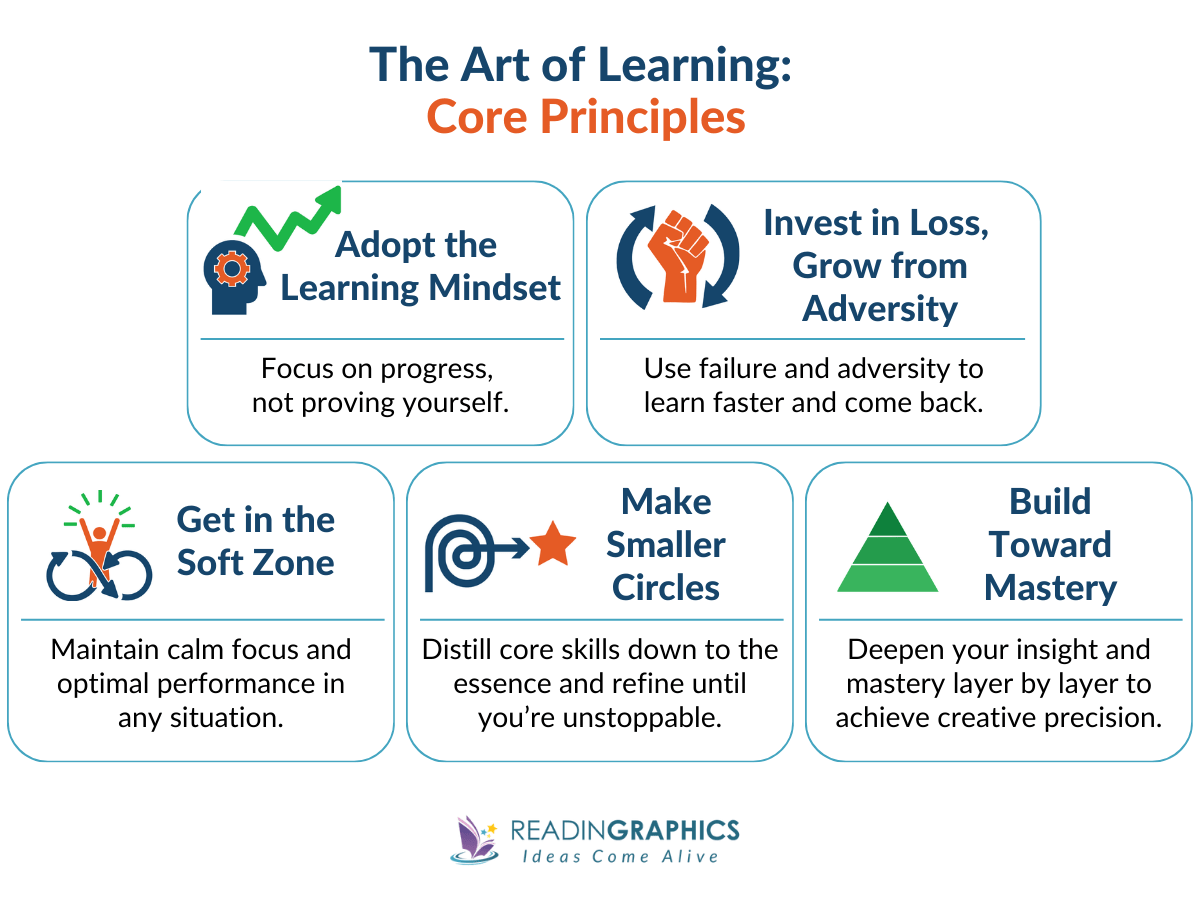
THE LEARNING MINDSET
As a zealous learner, Josh often reflected on his growth journey. He believed that there are 2 fundamentally different beliefs that shape a person’s ability to learn. In the our complete summary, you will learn:
- The difference between Incremental theory (growth mindset) and Entity Theory (fixed mindset);
- How you can adopt these mindsets to create an organic, long-term learning process.
To learn how you can shape your mindset for better outcomes, also check out our Mindset summary.
INVEST IN LOSS AND GROW FROM ADVERSITY
Our complete summary for The Art of Learning covers:
- How to use investment in loss to grow through adversity (a term dubbed by Tai Chi Grandmaster Chen);
- How top performers bounce back quickly after failure, and use setbacks (or even injuries) to keep pushing at the outer reaches of their ability.
You too can overcome various obstacles to transform mind, body and spirit, check out our Can’t Hurt Me summary.
THE SOFT ZONE
We enter peak performance when we’re in the zone—a state of deep focus, clarity, and flow. In our full book summary, you’ll learn:
- The difference between the “Hard Zone” (which is forced and fragile) and the “Soft Zone” (an ideal state of relaxed alertness);
- How to achieve optimal performance by being able to enter the soft zone at will (hint: Josh has developed a repeatable, step-by-step guide for that); and
- Practical tips to maintain a state of peak performance (e.g. taking deep breaths, doing quick reset, having a rhythm of stress and recovery, and more).
To learn more about the benefits of the soft zone (also known as being “in flow”) check out our Finding Flow summary.
MAKING SMALLER CIRCLES
In our complete 15-page summary, we take a deep dive into:
- How you can improve by focusing on fundamentals to identify the core and cultivate a sense of interconnectedness;
- How “chunking” works, and how you can use this process to deepen your mastery in any domain. By compressing vast, complex knowledge into usable units, was able to sharpen his mental process in chess and develop powerful, intuitive moves in martial arts
- Find out how Josh used this approach to progressively make “smaller circles” until he cultivated a deep sense of interconnectedness, grasped profound Tai Chi teachings, and developed the Anaconda Strategy—allowing him to predict and counter an opponent’s move before they even execute it.
BUILD TOWARD MASTERY
True mastery doesn’t happen overnight. It takes years of effort, life experiences and all critical components we’ve discussed so far: a growth mindset, investing in loss, growing from mistakes and adversity, pushing boundaries in the Soft Zone, and making smaller circles. It’s like building a pyramid of mastery from bottom up.
Getting the Most from The Art of Learning
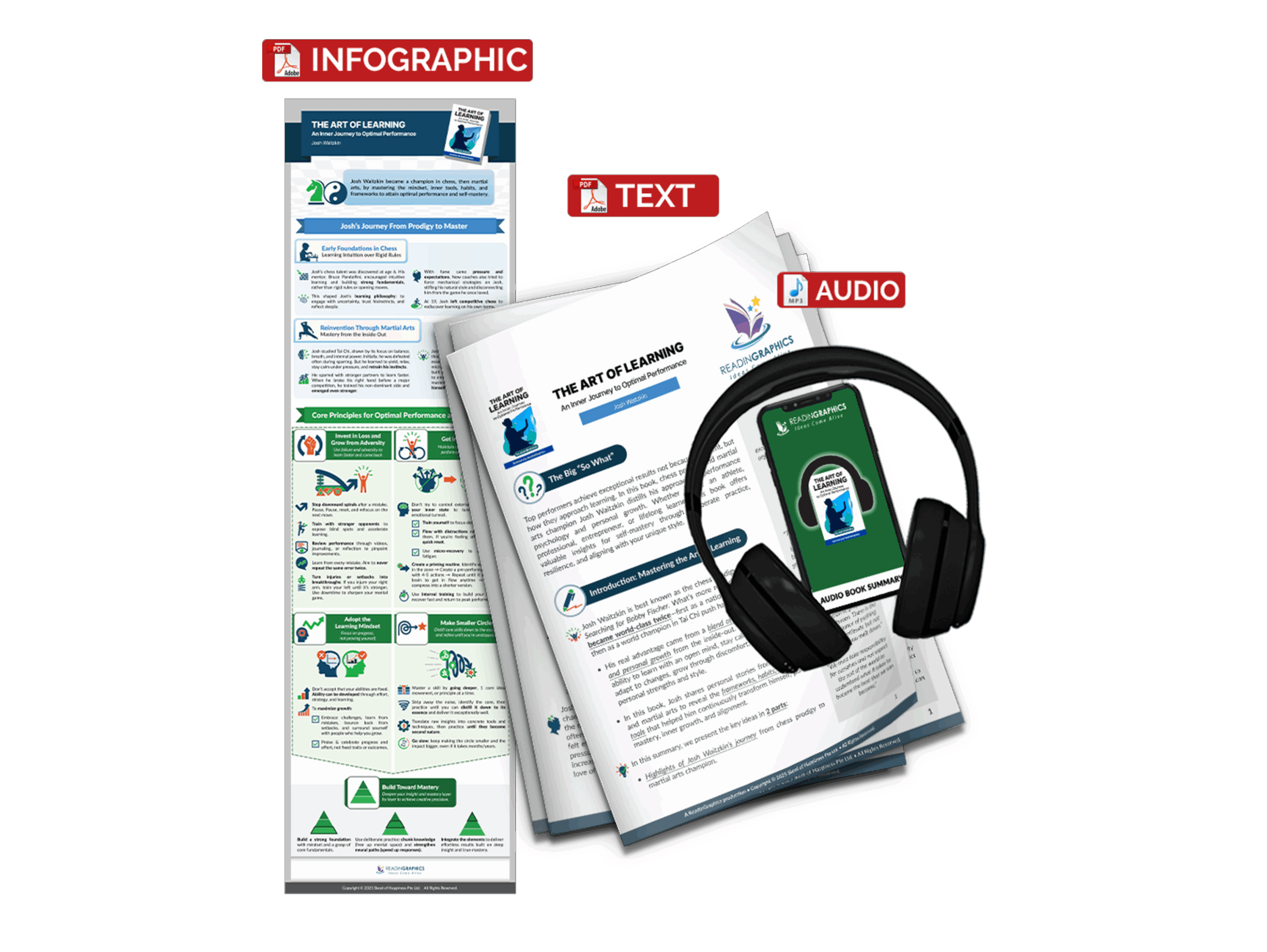
Ultimately, greatness is about how you learn, adapt, and evolve under pressure. True mastery comes from aligning your inner world—your mindset, emotions, and instincts—with your outer performance. Josh based his entire approach to learning on breaking down the artificial barriers between diverse life experiences. If you’d like to zoom in on the ideas above and get more detailed insights, examples and actionable tips, do check out our full book summary bundle that includes an infographic, 15-page text summary, and a 30-minute audio summary.
Whether you’re playing chess, launching a product, or handling high-stakes negotiations, the same principles apply: Start with a growth mindset, seek out challenges and feedback, and relentlessly explore ways to deepen your mastery until you’ve fully internalized your craft. You can purchase the book here or for more details and resources, visit joshwaitzkin.com.
Who Should Read This Book
- Athletes, high performers, executives, creatives, or entrepreneurs who want to master performance psychology and achieve peak performance in high-stakes situations.
- Coaches, educators, and mentors who want practical tools and frameworks to teach mastery and nurturing growth mindsets.
- Lifelong learners and growth-driven individuals who want to learn faster, build resilience, and develop self-mastery.

The Art of Learning Chapters
Our summaries are reworded and reorganized for clarity and conciseness. Here’s the full chapter listing from The Art of Learning by Josh Waitzkin, to give an overview of the original content structure in the book.
See All Chapters (Click to expand)
Introduction
Part I – The Foundation
1. Innocent Moves
2. Losing to Win
3. Two Approaches to Learning
4. Loving the Game
5. The Soft Zone
6. The Downward Spiral
7. Changing Voice
8. Breaking Stallions
Part II – My Second Art
9. Beginner’s Mind
10. Investment in Loss
11. Making Smaller Circles
12. Using Adversity
13. Slowing Down Time
14. The Illusion of the Mystical
Part III – Bringing It All Together
15. The Power of Presence
16. Searching for the Zone
17. Building Your Trigger
18. Making Sandals
19. Bringing It All Together
20. Taiwan
About the Author of The Art of Learning
The Art of Learning: An Inner Journey to Optimal Performance by Josh Waitzkin, who is a former chess prodigy and martial arts world champion, best known as the inspiration for Searching for Bobby Fischer. After retiring from competitive chess, he went on to win multiple national and international titles in Tai Chi Push Hands. Josh Waitzkin is also the founder of the Art of Learning Project.
Today, Josh coaches elite performers in business, sports, and the arts, helping them cultivate presence, resilience, and mastery. One such perform was Tim Ferriss who not only had Josh on his podcast a few times but also attempted to learn Brazilian Jiu Jitsu under his guidance in one of the episodes of his TV show, The Tim Ferriss Experiment.
The Art of Learning Quotes
“The fields of learning and performance are an exploration of greyness of the in-between. There is the careful balance of pushing yourself relentlessly, but not so hard that you melt down.”
“In every discipline, the ability to be clearheaded, present, cool under fire is much of what separates the best from the mediocre.”
“If we have any hope of attaining excellence, let alone of showing what we’ve got under pressure, we have to be prepared by a lifestyle of reinforcement. Presence must be like breathing.
“Usually, growth comes at the expense of previous comfort or safety.”
“If a student…could avoid ever repeating the same mistake twice—both technical and psychological—he or she would skyrocket to the top of their field…the aim is to minimize repetition as much as possible.”
“Mental resilience is arguably the most critical trait of a world-class performer, and it should be nurtured continuously.”
“In performance training, first we learn to flow with whatever comes. Then we learn to use whatever comes to our advantage. Finally, we learn to be completely self-sufficient and create our own earthquakes.”
“The unconscious mind is a powerful tool, and learning how to relax under pressure is a key first step to tapping into its potential.”
“The theme is depth over breadth. The learning principle is to plunge into the detailed mystery of the micro in order to understand what makes the macro tick.”
“We have to be able to do something slowly before we can have any hope of doing it correctly with speed.”
Click here to download the The Art of Learning infographic & summary