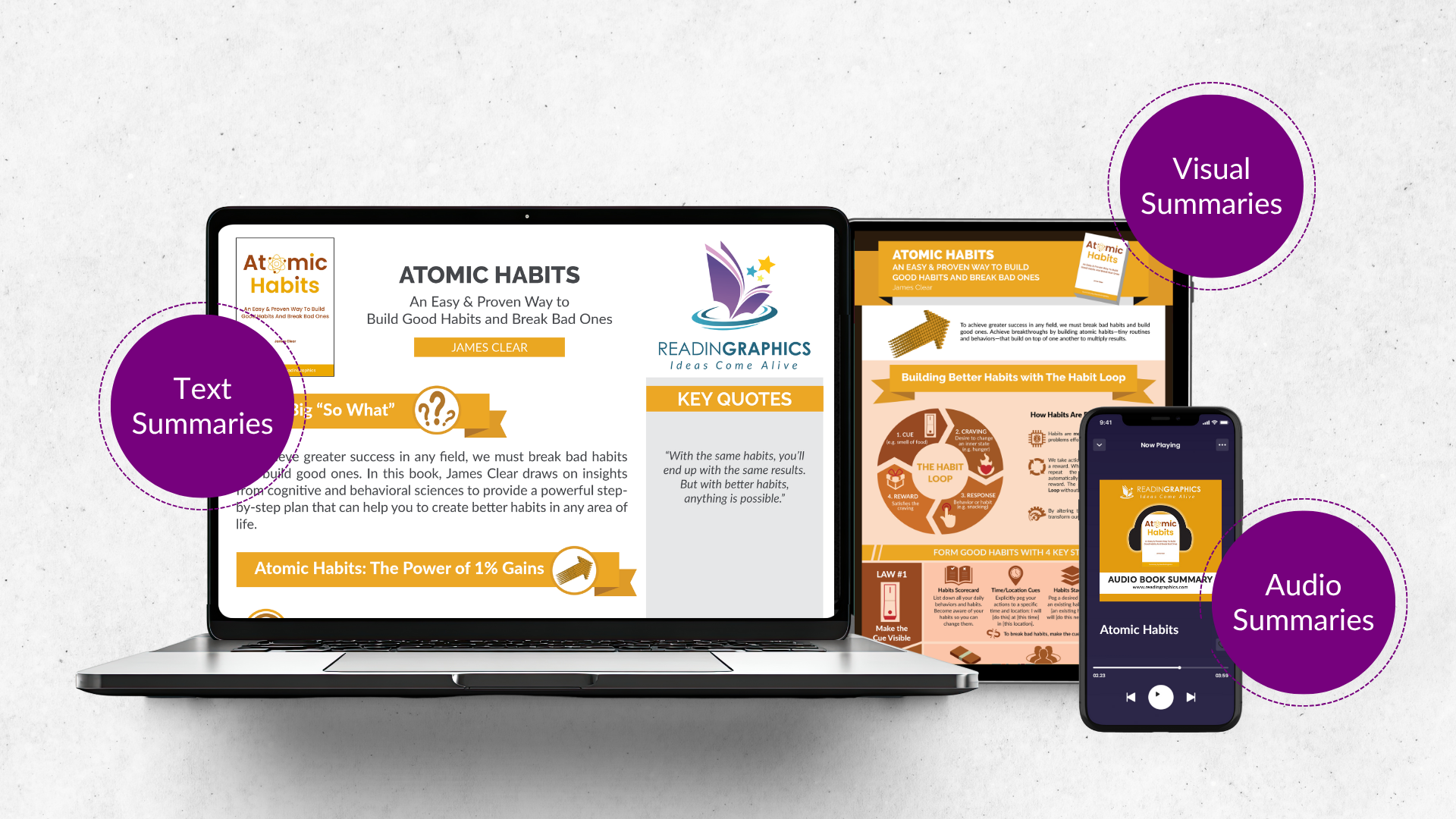
Why do so many events and get-togethers fail to leave a lasting impression? In The Art of Gathering summary, you’ll learn Priya Parker’s tried and tested ways to design truly meaningful gatherings that connect and inspire people, whether it’s a meeting, dinner, or celebration.
This summary will cover:
- What is the Art of Gathering About?
- Part 1: Define a Clear Purpose for Your Gathering
- Part 2: Design Everything Around Your Purpose
- Part 3: Bring your Gathering to Life
- Getting the Most from The Art of Gathering
- The Art of Gathering Chapters
- About The Author of The Art of Gathering
- The Art of Gathering Quotes
Let’s dive straight into it!
What is the Art of Gathering About?
Gatherings play a vital role in human societies. They can shape how communities form, how ideas spread, and how people relate to one another.
- Much of our lives are occupied by gatherings, from meetings to parties and conferences. Yet most of such interactions feel uninspiring and hollow.
- When we plan a gathering, we often focus on the logistics of bringing people together, such as venues, menus, and seating plans. We neglect the bigger question: Why are we gathering at all?
In this book, Priya Parker, a professional facilitator and conflict-resolution expert, explains how to design gatherings that truly matter.
Drawing on 15 years of experience guiding groups from corporate teams to community activists, she shows how successful gatherings can unite, challenge, and even heal people.
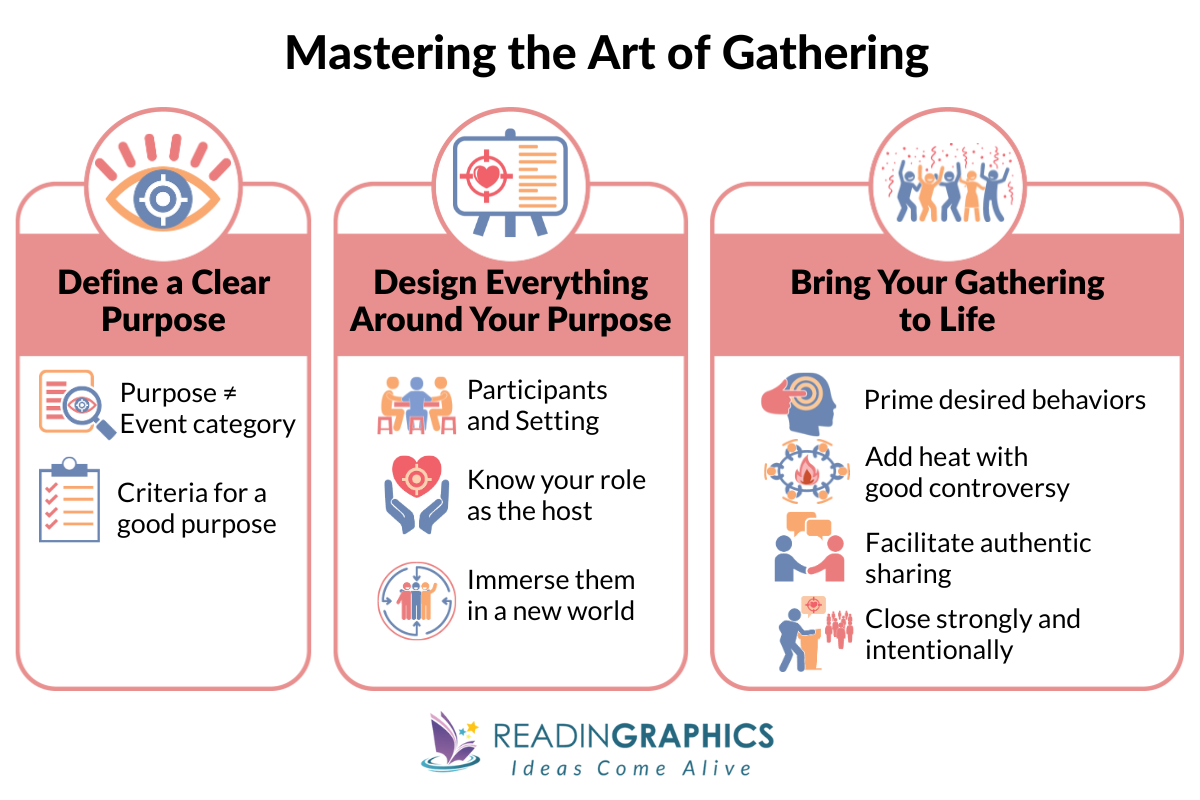
In this free summary, we’ll outline Parker’s insights in 3 parts:
- Define a clear purpose for your gathering;
- Design everything around your purpose; and
- Bring your gathering to life.
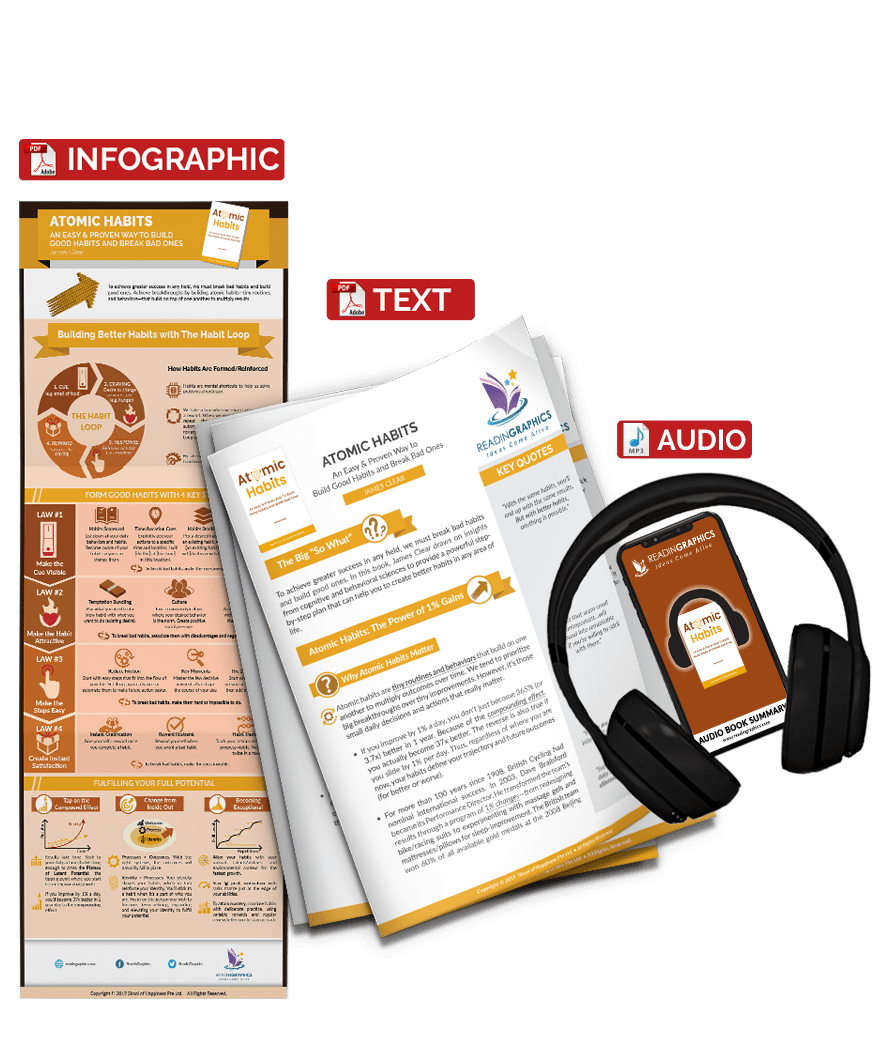
Here’s a visual representation of these insights:
Get the full infographic, 16-page summary and audio summary from our complete summary bundle! Meantime, let’s dive in.
Part 1: Define a Clear Purpose for Your Gathering
Most gatherings lack a clear intent. Often, people meet out of habit, or they might follow outdated formats and rituals.
For example, when Parker was pregnant, her female friends offered to throw her a baby shower complete with games and gifts. Upon reflection, she realized the event would’ve been more meaningful for her and her husband if it had been designed around preparing them emotionally for parenthood. Based on that goal, they could have invited both men and women to share stories or advice on raising a child together.
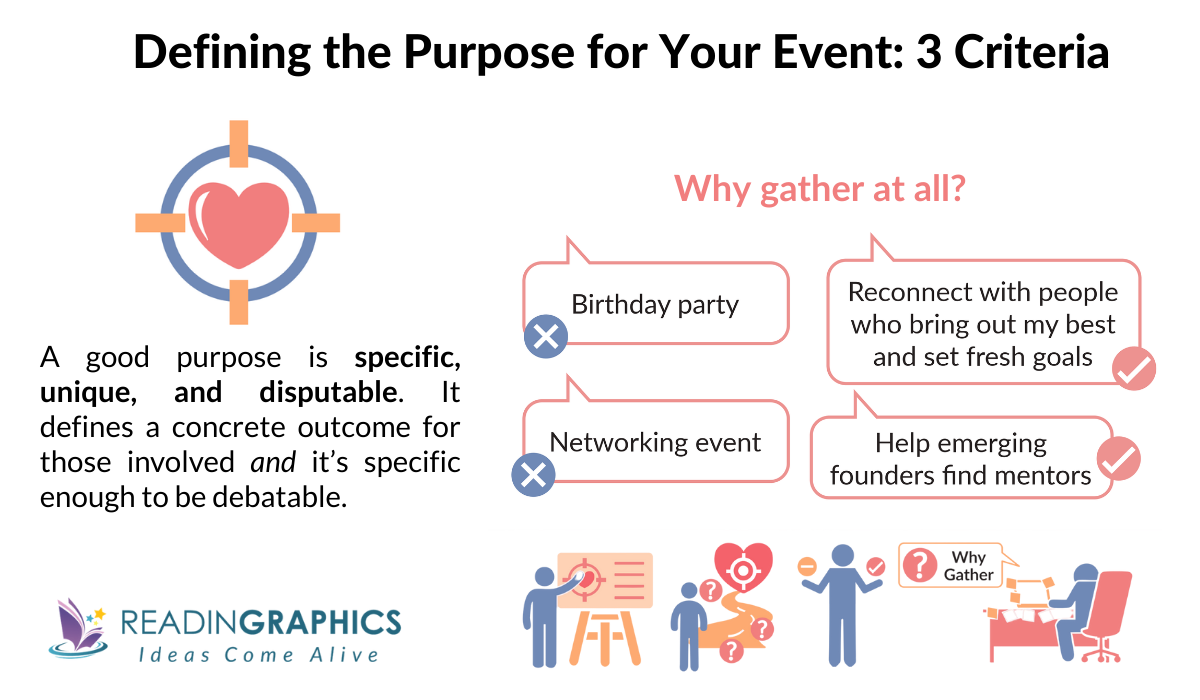
Often, people confuse an event category (e.g. networking event, dinner party, baby shower, book club) with its purpose—the specific outcome they want to create for those involved.
At most networking events, people show up to trade small talk and business cards. But if you specified the purpose as “helping emerging founders to find mentors,” then the guests, format, and activities would look entirely different.
A good purpose should be specific, unique, and disputable. Vague goals like “connect people” or “raise awareness” won’t guide decisions.
A strong purpose must be specific enough to be disputable. For example, a meetup group “for first-time app creators” or “for LGBT couples hiking with dogs” is narrow enough to filter out people who share the same goals, giving it energy and focus.
Once you have a clear purpose, design everything around it, for example:
- Brooklyn’s Red Hook Community Justice Center defined their purpose as reintegration of people into the community instead of punishing offenders. They re-imagine the traditional courtroom, leaning into calling people together in a setting where everyone—including the accused—sat in a circle to discuss the harm done and how to repair it. This would end with a shared agreement for restitution (rather than a sentence).
- Similarly, in 2016, New York Times editor Dean Baquet realized that their twice-daily “Page One” meetings had become obsolete in a world where most news was readily available on smartphones. He redefined their goals and redesigned the daily work meetings accordingly.
To define a meaningful purpose, focus on why you are gathering, not just what you are doing.
- Ask yourself: what larger need is this serving? If your community feels divided, maybe your purpose is to build trust and understanding. Instead of “teaching chemistry,” perhaps it’s about “helping students connect meaningfully with the world.”
- Keep asking “why” until the deeper intent (often anchored in deeper values or beliefs) becomes clear.
- If you can’t find a real purpose, then cancel the gathering, or treat it as a casual social meet-up instead.
Part 2: Design Everything Around Your Purpose
Once you know the outcome you want, design everything around that purpose: from who you invite, to where you meet, to how the gathering unfolds.
CHOOSE THE PARTICIPANTS AND SETTING
Don’t invite people out of habit or to avoid offending anyone. That only dilutes your purpose. Be intentional about who to include or exclude.
To help you decide, ask:
- Who supports or advances the purpose?
- Who threatens or holds it back?
- Who unintentionally dilutes or pulls focus away?
For example, Parker used to work out with 6 friends twice a week, but when one of them couldn’t make it, she realized the real purpose of their sessions was friendship, not exercise. Bringing in someone new would change the group dynamic, so they chose to keep it just between them.
True diversity isn’t just about putting different people in a room, but helping them to interact meaningfully. Thoughtful exclusion can actually enhance diversity. In our complete 16-page summary, we go deeper into:
- How the group size directly affects how people connect at a gathering, e.g. smaller group would be more intimate to allow for deep conversations while larger groups would be more energetic and have room for diverse viewpoints.
- How to choose an ideal venue and use physical surroundings to support your goal.
- How, as event planners, you can design the space to set the tone and shape behaviors, including making use of space and logistics.
KNOW YOUR ROLE AS THE HOST
A host has the power to shape a gathering. If you don’t exercise that power, it shifts to the guests, leading to confusion or drift. Take charge to ensure the gathering stays true to purpose.
In our complete book summary, you’ll learn:
- Things to avoid as a host and how to take charge as an event planner in order to create meaningful experiences for your guests.
- How to see yourself as the ruler of your gathering, but rule with “generous authority.” as well as your 3 main responsibilities when guiding your guests.
SPICE THINGS UP: Immerse Guests in a New World
Often, gatherings feel dull not because of a lack of entertainment. To liven up an event, transport guests temporarily into an alternate world with its own purpose, rules, and energy. In our complete The Art of Gathering summary, you will learn:
- How to go with “pop-up rules” instead of relying on implicit etiquette or implicit norms, in order to have the flexibility to experiment with fun or bold ideas.
- How pop-up rules might evolve or emerge organically over time, such as when Parker and her husband came up with their “I Am Here Day.” tradition.
- How you might add explicit rules to address specific problems.
Part 3: Bring Your Gathering to Life
PRIME DESIRED BEHAVIORS
Your gathering starts once your guests hear about it, not when they walk through the door. Think of a gathering as a social contract where both hosts and guests have expectations. Prior to the event, prime the guests so they know what to expect, and arrive ready to participate.
In out complete book summary, you’ll will learn:
- How to prime your guests before arrival using techniques such as Randa Slim’s “Ninety Percent Rule”, the use of purposeful touches as well the effect of invitation and event name on your guests
- How to help them transit into new world once your guests arrive by ushering them metaphorically, physically and psychologically
- How, as the event planner, you should use the gathering’s launch to set the tone for the entire event, and ways to achieve this with a human-centered approach.
FACILITATE AUTHENTIC SHARING
Professional gatherings often feel sterile and shallow because people hide behind polished speeches and titles. To bring out authenticity, Parker often uses a format called “15 Toasts.” In our 16-page summary, we also zoom in on:
- Parker’s 15 Toasts format that she used at an intimate dinner party setting to form human connections with the attendees at World Economic Forum in Abu Dhabi.
- Several powerful insights to design for real, authentic connection such as encouraging sprout speeches, share real experiences, choosing darker topics for discussion, the effects of stranger spirit etc.
ADD HEAT WITH GOOD CONTROVERSY
For generations, people were taught to avoid sensitive subjects (like sex, politics, and religion), which only leads to lifeless meetings and superficial conversations. People become truly engaged when they discuss what truly matters. In our full 16-page summary, you will also learn:
- Why good controversy is productive, not destructive and the methods Parker used to encourage participants to share their real views such as redesigning discussions as cage matches, ritualizing disagreements, surfacing hot spots safely in arguments etc.
CLOSE STRONGLY AND INTENTIONALLY
Most hosts overlook the ending, assuming it will take care of itself. Guests are left feeling adrift and unsure if the event has concluded. Our complete summary of The Art of Gathering goes deeper into:
- How to design the close intentionally, as well as several examples of how its been implemented in various settings.
- The 2 parts involved in a thoughtful close i.e. (i) Look Inward, (ii) Turn Outward. With examples of how the summer camp Seeds of Peace makes use of these at the end of their 3 week camp for teenagers from conflict zones.
- How to make the last moments count, usher people out and end the gathering in a memorable way that supports your purpose.
Getting the Most from The Art of Gathering
If you’d like to zoom in on the ideas above and get more detailed insights, examples and actionable tips, do check out our full book summary bundle that includes an infographic, 16-page text summary, and a 25-minute audio summary.
This book is packed with detailed stories, case studies, personal anecdotes and tips to illustrate how to plan and execute truly meaningful and impactful gatherings. You can purchase the book here or for more details, please visit priyaparker.com.
The Art of Gathering book rates 4.5 stars on Amazon (3506 reviews).
Looking for more resources to learn how to leave a lasting impression? Check out these powerful summaries:
- How to Talk to Anyone: Discover practical techniques to build rapport and connection in any setting
- Never Eat Alone: How to cultivate meaningful relationships through generosity and intentional networking.
- Dare to Lead: Learn how you can become a daring leader and build courageous cultures!
- How to Win Friends and Influence People in the Digital Age: Learn how to stand out as a leader and build rich, trusting and lasting relationships, in today’s digital age!
Who Should Read This Book
- Leaders, facilitators, and hosts who want to design meetings, workshops, and events that inspire genuine participation and connection.
- Event organizers and anyone who wants to plan truly meaningful personal or professional gatherings (e.g. work, learning, special occasions)

The Art of Gathering Chapters
Our summaries are reworded and reorganized for clarity and conciseness. Here’s the full chapter listing from The Art of Gathering by Priya Parker, to give an overview of the original content structure in the book.
See All Chapters (Click to expand)
Introduction
One: Decide Why You’re Really Gathering
Two: Close Doors
Three: Don’t Be A Chill Host
Four: Create A Temporary Alternative World
Five: Never Start A Funeral With Logistics
Six: Keep Your Best Self Out Of My Gathering
Seven: Cause Good Controversy
Eight: Accept That There Is An End
The Art of Gathering: How We Meet and Why It Matters [Publication Year: April 14, 2020/ ISBN: 978-1594634932]
About the Author of The Art of Gathering
The Art of Gathering: How We Meet and Why It Matters is written by Priya Parker. She is a facilitator, advisor, author, and host-cum-executive producer of the podcast Together Apart. Trained in conflict resolution, she has worked on race relations and peace processes in many countries, and now focuses on helping people to create collective meaning through gatherings. She studied organizational design at M.I.T., public policy at the Harvard Kennedy School, and political and social thought at the University of Virginia.
The Art of Gathering Quotes
“It is the way a group is gathered that determines what happens in it and how successful it is, the little design choices you can make to help your gathering soar.”
“There are so many good reasons for coming together that often we don’t know precisely why we are doing so.”
“Specificity sharpens the gathering because people can see themselves in it.”
“The purpose of your gathering is more than an inspiring concept. It is a tool, a filter that helps you determine all the details, grand and trivial.”
“Inviting people is easy. Excluding people can be hard.”
“When you abdicate leadership…you don’t eradicate power. You just hand the opportunity to take charge to someone else.”
“If you are going to gather, gather. If you are going to host, host. If you are going to create a kingdom for an hour or a day, rule it—and rule it with generosity.”
“Connection doesn’t happen on its own. You have to design your gatherings for the kinds of connections you want to create.”
“The best gatherings… transport us to a temporary alternative world.”
“A diamond may be forever, but a gathering rule is just for right now. This is its power.”
Click here to download The Art of Gathering infographic & summary