Most leaders will agree that strategy is crucial for an organization’s success. Yet most organizations don’t have a good strategy…they confuse strategy with ambition, innovation, inspirational leadership, goal-setting, high-level decisions, determination or successful outcomes. So, what exactly is a good strategy vs bad strategy, why is bad strategy so prevalent, and is there a way to systemically craft good strategies? In this book, Richard Rumelt specifically answers those questions. In this free version of the Good Strategy Bad Strategy summary, we’ll briefly outline some of these powerful ideas.
A strategy should be a cohesive blend of ideas, analyses, policies and actions in response to an important, high-stakes challenge. It’s about uncovering the critical factors in a situation, then directing your energy and resources to addressing those factors through focused, coordinated action. Let’s break down the difference between good strategy and bad strategy, before taking a brief look at what’s involved in crafting good strategies. You can get the detailed tips, guidelines and examples in our complete Good Strategy Bad Strategy summary.
Good Strategy vs Bad Strategy
The Kernel of Good Strategy
Fundamentally, strategy is a way of dealing with an important challenge. A good strategy has 3 essential components which form its core or “kernel”: a diagnosis, a guiding policy, and coherent action.
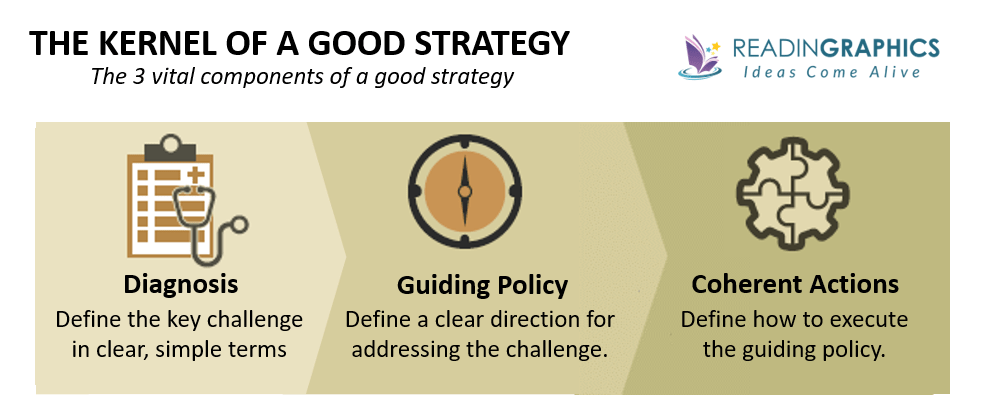
- A diagnosis defines the challenge in clear, simple terms. Just like how a doctor must diagnose a disease before prescribing medication and therapies, businesses must first diagnose the situation and challenge(s) before deciding what to do. It determines where/how you focus your energy and resources. A good diagnosis distills a complex, often-overwhelming reality into a simpler story that people can act upon. You must identify the critical aspects of the situation—this provides a focal point to design/evaluate the strategy, and to adjust the strategy as circumstances change. To help people to understand a complex or unstructured problem, it also helps to use a metaphor, analogy, or an accepted framework. Once people clearly grasp the issue, it’s easier to craft and execute a coherent response.
- A guiding policy is the broad approach to addressing the obstacles you’ve identified. It points you in a certain direction without dictating exactly what to do. Guiding policies are not desired end-states, goals or visions—those merely express your ambitions without defining how to get there. Good guiding policies provide parameters that’ll help you to choose certain alternatives over others, e.g. you’d make decisions very differently if you choose to focus on “price-conscious students” vs “time-sensitive professionals”, on offering “value for money” vs “luxurious experiences”.
- Coherent actions are the ways to execute the guiding policy. These are a set of coordinated policies, resources, and maneuvers that are aligned with and support each other. The kernel needn’t define all the actions to be taken, but it must provide enough clarity to make the strategy actionable while ensuring your actions are coordinated and non-conflicting.
Beware of Bad Strategy
Bad strategy is not just the absence of good strategy. It comes from misconceptions that hinder sound strategy. In our complete book summary, we’ll elaborate on:
- The 4 hallmarks of bad strategies: fluff, failure to face the challenge, mistaking goals for strategy, and bad strategic objectives;
- Two common types of bad strategy: “dog’s dinner objectives” and “blue-sky objectives”; and
- The 3 key reasons why bad strategy is so prevalent.
How to develop Good Strategies
Harnessing Sources of Power
Having a coherent strategy in itself already gives you 2 natural sources of strength since (i) most organizations don’t have one and won’t expect you to have one, and (ii) you can always uncover hidden insights just by looking at things from a fresh perspective.
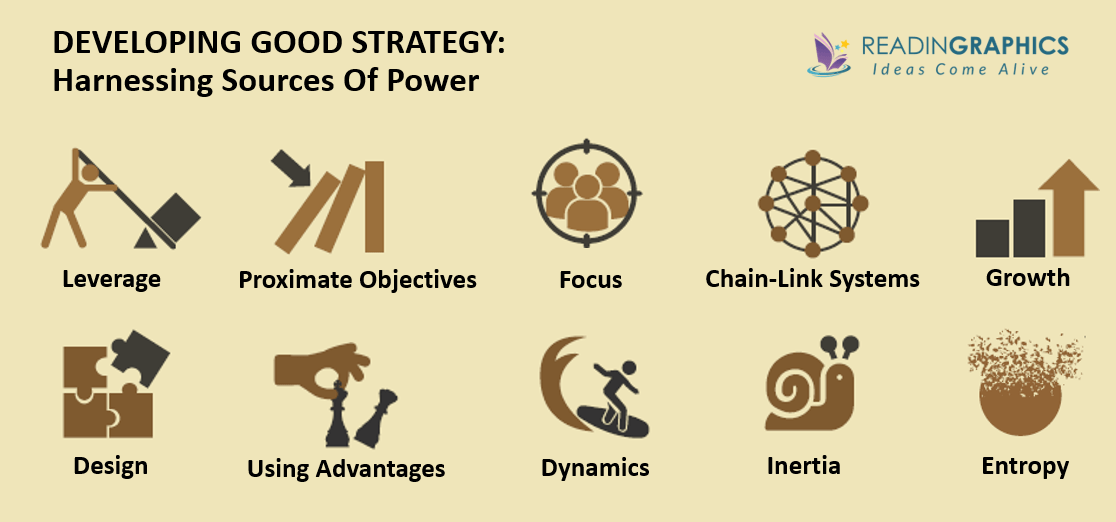
At the root, strategy is about applying your biggest strengths to your biggest opportunity. Good strategies amplify the impact of your strengths. A large section of the book is devoted to explaining various sources of power that you can harness to develop a great strategy. We won’t be going into details in this article, but feel free to check our full Good Strategy Bad Strategy summary where we’ll dive into each of these power sources including: (i) definitions, (ii) application tips/insights and (iii) short examples.
The sources of power are: strategic leverage, proximate objectives, focus, chain-link systems, growth, design, using advantages, dynamics, inertia and entropy.
Thinking like a Strategist
Although external ideas and feedback are useful, the most vital tool to a strategist could simply be to change your own way of thinking. To start thinking like a real strategist, you need to:
- Understand the Science of Strategy: Think of a good strategy as a well-formed hypothesis of what’ll work, learn to capture proprietary info and validate your hypotheses with logical and empirical tests.
- Use and keep your head: Check out a series of techniques to build 3 essential skills/habits needed for good strategic thinking (instead of falling prey to the impulses of bad strategy or herd instincts).
Feel free to get our complete Good Strategy Bad Strategy summary for more specific details.
Getting the Most from Good Strategy Bad Strategy
In this article, we’ve briefly outlined some of the key insights and strategies you can use to achieve desired change. For more examples, details, and actionable tips to apply these strategies, do get our complete book summary bundle which includes an infographic, 15-page text summary, and a 28-minute audio summary.
This book is packed with detailed examples and case studies across a wide range of industries, e.g. truck manufacturing, retail, F&B, military campaigns, schools, computing, automobiles, farming, TV and media. Each key message is reinforced by one or more example to illustrate the concepts at work. You can purchase the book here for the full details.
Who should read this:
• Business leaders, managers, consultants and anyone who wants to learn about strategy
• Entrepreneurs and business owners

Good Strategy Bad Strategy Chapters
See All Chapters (Click to expand)
Our summaries are reworded and reorganized for clarity and conciseness. Here’s the full chapter listing from Good Strategy Bad Strategy by Richard Rumelt-, to give an overview of the original content structure in the book.
INTRODUCTION: OVERWHELMING OBSTACLES
PART I: GOOD AND BAD STRATEGY
CHAPTER 1: GOOD STRATEGY IS UNEXPECTED
How Steve Jobs saved Apple
Business 101 is surprising
General Schwarzkopf’s strategy in Desert Storm
Why “Plan A” remains a surprise
CHAPTER 2: DISCOVERING POWER
David and Goliath is a basic strategy story
Discovering Wal-Mart’s secret
Marshall and Roche’s strategy for competing with the Soviet Union
CHAPTER 3: BAD STRATEGY
Is U.S. national security strategy just slogans?
How to recognize fluff
Why not facing the problem creates bad strategy
Chad Logan’s 20/20 plan mistakes goals for strategy
What’s wrong with a dog’s dinner of objectives?
How blue-sky objectives miss the mark
CHAPTER 4: WHY SO MUCH BAD STRATEGY?
Strategy involves choice, and DEC’s managers can’t choose
The path from charisma to transformational leadership to fill-in-the-blanks template-style strategy
New Thought from Emerson to today and how it makes strategy seem superfluous
CHAPTER 5: THE KERNEL OF GOOD STRATEGY
The mixture of argument and action lying behind any good strategy
Diagnosing Starbucks, K–12 schools, the Soviet challenge, and IBM
Guiding policies at Wells Fargo, IBM, and Stephanie’s market
The president of the European Business Group hesitates to act
Incoherent action at Ford
Centralization, decentralization, and Roosevelt’s strategy in WWII
PART II: SOURCES OF POWER
CHAPTER 6: USING LEVERAGE
Anticipation by Toyota and insurgents in Iraq
How Pierre Wack anticipated the oil crisis and oil prices
Pivot points at 7-Eleven and the Brandenburg Gate
Harold Williams uses concentration to make the Getty a world presence in art
CHAPTER 7: PROXIMATE OBJECTIVES
Why Kennedy’s goal of landing on the moon was a proximate and strategic objective
Phyllis Buwalda resolves the ambiguity about the surface of the moon
A regional business school generates proximate objectives
A helicopter pilot explains hierarchies of skills
Why what is proximate for one organization is distant for another
CHAPTER 8: CHAIN-LINK SYSTEMS
Challenger’s O-ring and chain-link systems
Stuck systems at GM and underdeveloped countries
Marco Tinelli explains how to get a chain-link system unstuck
IKEA shows how excellence is the flipside of being stuck
CHAPTER 9: USING DESIGN
Hannibal defeats the Roman army in 216 B.C. using anticipation and coordinated design
How a design-type strategy is like a BMW
Designing the Voyager spacecraft at JPL
The trade-off between resources and tight configuration
How success leads to potent resources that, in turn, induce laxity and decline
Design as order imposed on chaos — the example of Paccar’s heavy-truck business
CHAPTER 10: FOCUS
A class struggles to identify Crown Cork & Seal’s strategy
Working back from policies to strategy
The pattern of policy and segmentation called “focus”
Why the strategy worked
CHAPTER 11: GROWTH
The all-out pursuit of size almost sinks Crown
A noxious adviser at Telecom Italia
Healthy growth
CHAPTER 12: USING ADVANTAGE
Advantage in Afghanistan and in business
Stewart and Lynda Resnick’s serial entrepreneurship
What makes a business “interesting”
The puzzle of the silver machine
Why you cannot get richer by simply owning a competitive advantage
What bricklaying teaches us about deepening advantage
Broadening the Disney brand
The red tide of pomegranate juice
Oilfields, isolating mechanisms, and being a moving target
CHAPTER 13: USING DYNAMICS
Capturing the high ground by riding a wave of change
Jean-Bernard Lévy and tectonic shifts
The microprocessor changes everything
Why software is king and the rise of Cisco Systems
How Cisco rode three interlinked waves of change
Guideposts to strategy in transitions
Attractor states and the future of the New York Times
CHAPTER 14: INERTIA AND ENTROPY
The smothering effect of obsolete routine at Continental Airlines
Inertia at AT&T and the process of renewal
Inertia by proxy at PSFS and the DSL business
Using hump charts to reveal entropy at Denton’s
Entropy at GM
CHAPTER 15: PUTTING IT TOGETHER
Nvidia jumps from nowhere to dominance by riding a wave of change and using a design-type strategy
How a game called Quake derailed the expected march of 3-D graphics
Nvidia’s first product fails, and it devises a new strategy
How a faster release cycle made a difference
Why a powerful buyer like Dell can sometimes be an advantage
Intel fails twice in 3-D graphics and SGI goes bankrupt
PART III: THINKING LIKE A STRATEGIST
CHAPTER 16: THE SCIENCE OF STRATEGY
Hughes engineers start to guess at strategies
Deduction is enough only if you already know everything worth knowing
Galileo’s heresy trial triggers the Enlightenment
Hypotheses, anomalies, and Italian espresso bars
Why Americans drank weak coffee
Howard Schultz as a scientist
Learning and vertical integration
CHAPTER 17: USING YOUR HEAD
A baffling comment is resolved fifteen years later
Frederick Taylor tells Andrew Carnegie to make a list
Being “strategic” means being less myopic than your undeliberative self
TiVo and quick closure
Thinking about thinking
Using mind tools: the kernel, problem-solution, create-destroy, and the panel of experts
CHAPTER 18: KEEPING YOUR HEAD
Can one be independent without being eccentric? Doubting without being a curmudgeon?
Global Crossing builds a transatlantic cable
Build it for $1.5B and sell it for $8B
The worst industry structure imaginable
Kurt Gödel and stock prices
Why the 2008 financial crisis was almost certain to occur
Parallels among 2008, the Johnstown Flood, the Hindenburg, Hurricane Katrina, and the Gulf oil spill
How the inside view and social herding blinded people to the coming financial storm
The common cause of the panics and depressions of 1819, 1837, 1873, 1893, and 2008
About the Author of Good Strategy Bad Strategy
Good Strategy Bad Strategy: The Difference and Why it Matters is written by Richard Rumelt–the Harry and Elsa Kunin Professor of Business & Society at UCLA Anderson, a graduate school of business and management. He earned his Bachelor’s and Master’s of Science degrees in Electrical Engineering from UC Berkeley, and received his doctorate from the Harvard Business School (HBS). Prior to UCLA, he worked as a systems design engineer, and taught at the HBS and Iran Center for Management Studies.
Good Strategy Bad Strategy Quotes
“Good strategy is not just ‘what’ you are trying to do. It is also ‘why’ and ‘how’ you are doing it.”
“Strategy is at least as much about what an organization does not do as it is about what it does.”
“Strategy is the craft of figuring out which purposes are both worth pursuing and capable of being accomplished.”
“A leader’s most important job is creating and constantly adjusting this strategic bridge between goals and objectives.”
“A good strategy is, in the end, a hypothesis about what will work. Not a wild theory, but an educated judgment.”
“If your reasoning cannot withstand a vigorous attack, your strategy cannot be expected to stand in the face of real competition.”
Click here to download the Good Strategy Bad Strategy summary & infographic