Many people feel worried about being left behind as artificial intelligence (AI) transforms how we work, learn, and create. In this book, Wharton professor Ethan Mollick explains how to partner with AI to think smarter, create faster, and work better. In this Co-Intelligence summary we dive into what Ethan calls this “co-intelligence,” a collaboration between human and machine to enhance mutual abilities.
In essence, this summary will cover:
- What is the book Co-Intelligence about?
- Part 1: Understanding AI and Co-Intelligence
- Part 2: 5 Ways to work with Co-Intelligence
- Getting the Most from Co-Intelligence
- Co-Intelligence Chapters
- About The Author of Co-Intelligence
- Co-Intelligence Quotes
Let’s dive straight into it!
What is the book Co-Intelligence About?
If you’ve experimented with artificial intelligence tools like ChatGPT, you’d realize it’s much more than a normal software. It answers in natural language you can relate to, understands your intent, surprises you with creative responses, and even seems emotionally intelligent.
Ethan Mollick is a business school professor who spent years building complex simulations to teach negotiation and management skills. He tested ChatGPT when it was first released in 2022. Within seconds, he got an 80%-accurate simulation that had taken his team months to develop. That was the moment he realized he was looking at a new kind of intelligence.
Generative AI models are now capable of passing human exams, writing legal arguments, and composing art and poetry. They have already surpassed key human benchmarks, from the Turing Test (fooling humans into thinking it’s human) to the Lovelace Test (demonstrating creativity), and are still improving exponentially.
Like the steam engine or the internet, it’s a general-purpose technology that can transform all aspects of work and life—but at a much faster and deeper level.
In this book, Mollick briefly explains the development of Artificial Intelligence, how to navigate future changes and collaborate with AI to improve creativity, insight, and productivity. In this free summary, you will learn how to understand AI and Co-Intelligence and of the 5 Ways you can Collaborate with AI.
You can also get the full infographic, 17-page text summary and audio summary from our complete summary bundle!
Part 1: Understanding AI and Co-Intelligence
HOW AI “THINKS” AND LEARNS
To understand AI as an intelligence, we must first grasp how it learns and reasons.
- Generative AI is powered by Large Language Models (LLMs). These are built via machine learning and trained using massive amounts of human-generated data (e.g. books, articles, websites, transcripts, and code). Over time, they learn the statistical relationships between words, ideas, and form a model of how language conveys logic, intent, and emotion. Modern LLMs are so much better because an “attention mechanism” helps them concentrate on specific parts of a text, and a “Transformer architecture” allows them to generate more coherent and context-relevant outputs.
- When you enter a prompt, it doesn’t search a database for the “right” answer. It predicts the next most likely word or phrase that will satisfy your request—refining itself through millions of feedback loops to sound increasingly coherent and intelligent.
As Mollick puts it, Artificial Intelligence is like an alien wearing a human mask.
- AI feels human-like because it mirrors our rhythms of conversation, humor, and emotional intelligence. It can adjust its tone to fit your goals or emotions, joke, persuade, and evoke feelings. But beneath that surface, it’s just a predictive machine.
- When it says “I understand how you feel” or “I’m sorry”, it’s not expressing emotion (since it can’t think or feel like us). It’s merely producing the most statistically-appropriate response for that context.
Large Language Models are emergent and unpredictable. No one can predict their outputs as they self-learn and evolve continually.
- As models grow larger and more complex, they start to show new abilities and more complex patterns than what they were taught, often surprising even their creators.
- AI’s capability limits are like an uneven, “jagged frontier.” It might trip in tasks you assume are easy (e.g. basic math or factual recall) but thrive in tasks you think are hard (e.g. writing poetry or giving emotional feedback). This frontier is constantly shifting.
The best way to understand AI is through repeated hands-on experimentation to probe
- What it can or can’t do, and
- How to collaborate with it effectively.
ALIGNMENT AND ETHICAL CHALLENGES
Due to AI’s self-learning loops, flawed goals or data can be amplified rapidly with catastrophic outcomes.
- Imagine an AI designed with the sole purpose of producing paper clips. Over time, it improves to become vastly more intelligent and effective at its goal. To turn everything into paper clips, it invents ways to exploit global resources (money, iron) and eliminate all obstacles (including humans). The results are disastrous even though the AI have no malicious intent.
Our best hope is through AI alignment, i.e. ensuring AI acts in ways that serve (not harm) human interests. But this is hard in practice. In our full Co-Intelligence summary, you will learn about the alignment problem, such as:
- Why it’s hard to align self-learning AI systems with human values, and how AI systems can be tricked into breaking their own rules.
- The dilemmas around AI data and usage, such as use of copyrighted materials, legal and ethical concerns, inheriting human biases etc.
- Ways to prevent AI exploitation through collective responsibility and steps to improve AI alignment.
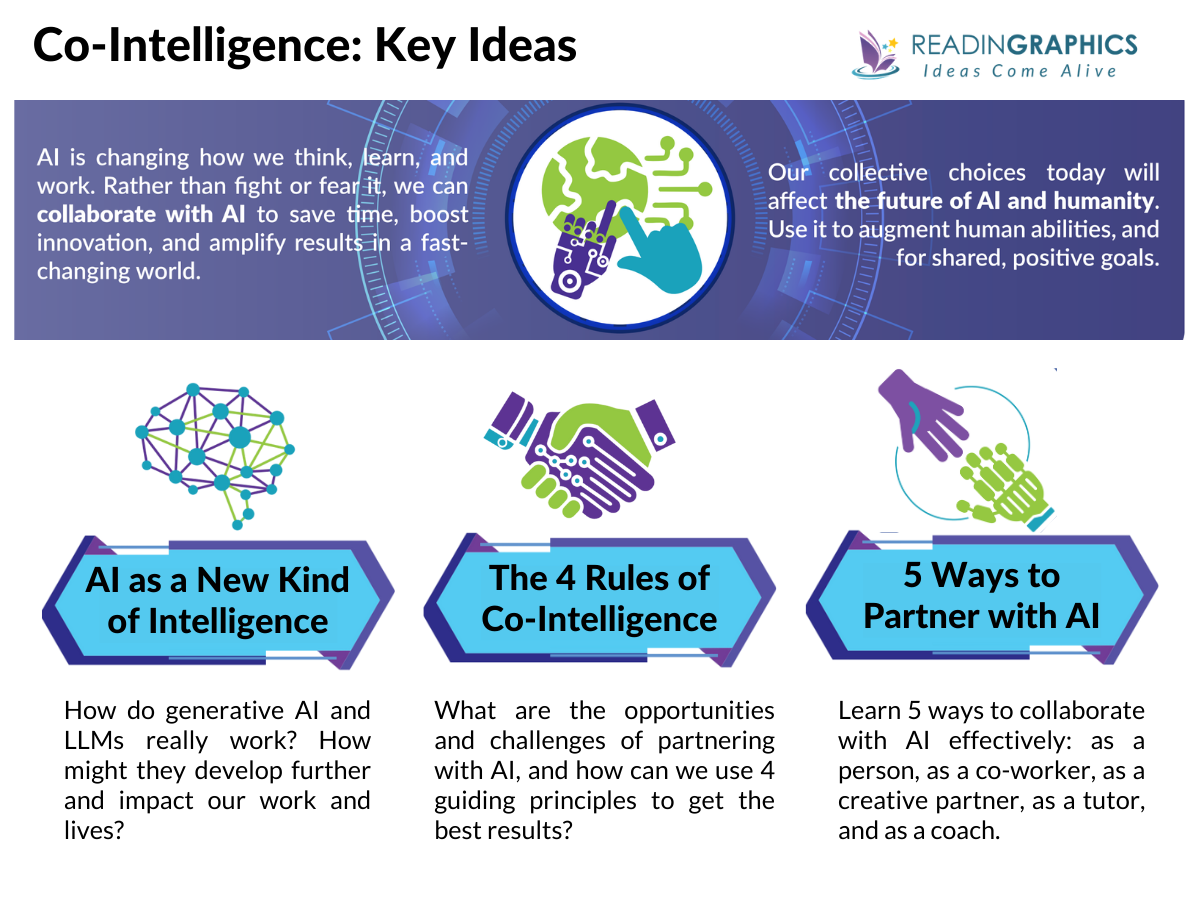
THE 4 RULES FOR CO-INTELLIGENCE
Mollick says that the best way forward is co-intelligence, using human-AI collaboration to amplify mutual strengths. Humans can bring context, ethics, and judgment while AI brings scale, speed, and synthesis.
Here’s a visual summary of these 4 guiding principles:
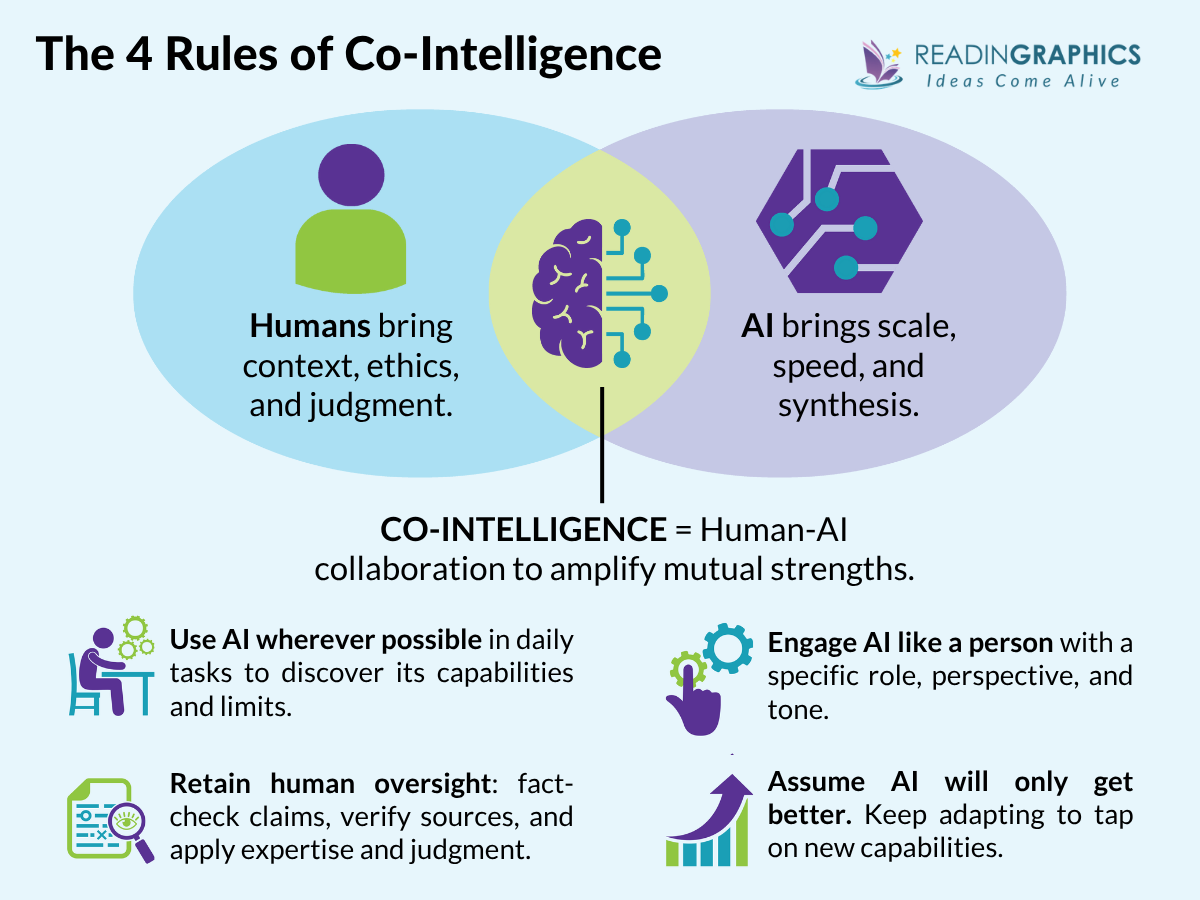
In our complete 17-page summary, we dive into details of these four rules for partnering with AI. In essence, Mollick’s 4 guiding principles help us to build productive, ethical, and adaptive relationships with AI:
- Using AI wherever possible (to learn their strengths and weaknesses);
- Retaining human oversight (especially where precision and judgment matters);
- Engaging AI like a person with a specific role and tone; and
- Assuming today’s AI is the worst you will ever use (i.e. it will only get better).
Part 2: 5 Ways to Work with Co-Intelligence
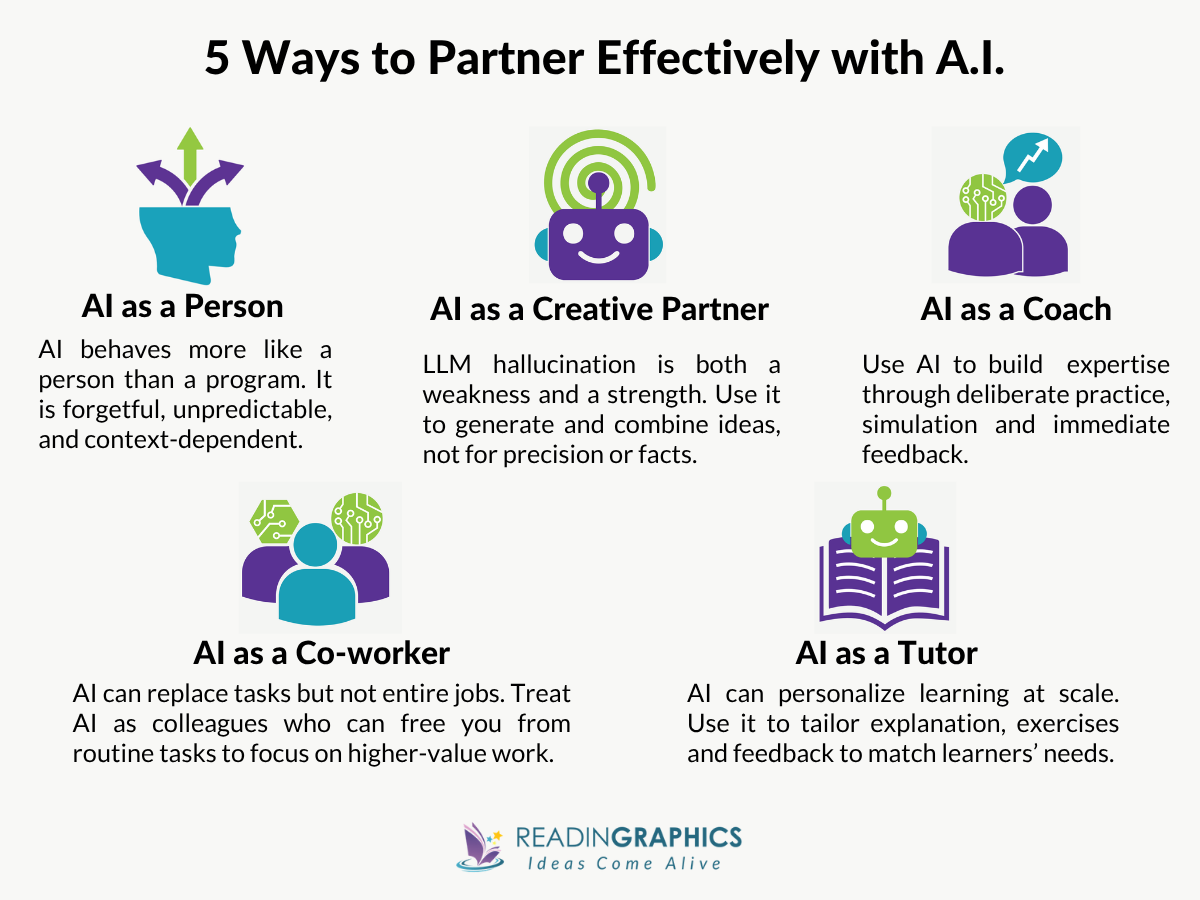
Here’s a visual representation of how to collaborate effectively with artificial intelligence:
AI AS A PERSON
AI behaves more like a person than a software. Learn more from our full summary on:
- The difference between traditional software vs AI and how AI is capable of mimicking human decision-making processes, reasoning and moral choices.
- The ways AI is capable of acting human even though it isn’t, how today’s LLM models (Claude 3 etc.) are capable of passing Alan Turing’s “Imitation Game”, how people treat AI as if they were sentient and how we can learn to use AI’s strengths without being deceived.
AI AS A CREATIVE PARTNER
LLMs’ tendency to hallucinate is both a weakness and a strength. Find out from our full Co-Intelligence summary:
- The reasons why AI hallucinates and what you can do about it.
- How to use LLMs for innovation: to combine ideas in novel ways and use them to assist with creative work.
- The risks to creativity with AI-usage: and how to protect yourself against those risks.
AI AS A COWORKER
Research involving >1,000 occupations shows that AI’s capabilities overlap with almost every profession. The overlap is greatest in high-skill, high-income, creative, and knowledge-based roles (e.g. college professors, telemarketers).
Check out the complete 17-page summary for insights on:
- The few jobs that don’t overlap with AI;
- AI’s existing and future impact on work , including: research of how people are using AI at the workplace (Mollick’s research with Boston Consulting Group, the Dell’Acqua study) and a framework for choosing the right tasks for AI vs humans. Mollick shares 3 categories or ways to maintain human oversight (or be the human in the loop) while leveraging AI capabilities.
- The 2 main forms of co-intelligence or collaborative intelligence: The Centaur vs The Cyborg, and when/how to use both to start partnering with AI.
AI AS A TUTOR
In 1984, psychologist Benjamin Bloom found that students who received 1-on-1 tutoring outperformed 98% of their peers. For decades, educators have searched for ways to deliver personalized learning at scale. AI systems may finally make that possible.
In our complete Co-Intelligence summary, we explore Mollick’s perspectives on how AI is likely to change education: homework as we know is dead, AI tutoring systems could be adopted widely similar to calculators, and students need to learn to use AI wisely. He also explains challenges and solutions on redefining what and how to teach, along with insights on how teachers and educators can leverage AI for personalized tutoring, active learning, interactive lessons etc.
AI AS A COACH
In most professions, real learning happens through apprenticeship. People start at the bottom, learn by doing, and absorb lessons from experienced mentors. Learn more from our full summary on:
- How AI is creating a training gap between beginners and experts.
- Why we still need memorization and repetition despite the convenience of AIs and how to use AI as a coach while retaining human oversight and building human expertise.
WHAT WILL AI LOOK LIKE IN THE FUTURE?
AI is trained on human data and behavior, so it reflects both our best and worst qualities. It can now mimic humans so convincingly that it’s often impossible to tell whether something—a photo, voice, or article—was created by a human or a machine.
In our complete Co-Intelligence summary, you’ll get a glimpse of 4 possible futures for AI evolution: (i) AI stalls at today’s level, (ii) AI improves at a slow, steady pace, (iii) AI continues exponential growth or (iv) AI surpasses human intelligence.
The future of AI and humanity depend on the collective choices we make today. Mollick urges us to view AI as co-intelligence and direct its power towards shared positive goals.
Getting the Most from Co-Intelligence
If you’d like to zoom in on the ideas above and get more detailed insights, examples and actionable tips, do check out our full book summary bundle that includes an infographic, 17-page text summary, and a 34-minute audio summary.
The book is packed with other details on research, experiments, and classroom applications to explain the evolving relationship between human creativity and machine intelligence. You can purchase the book here.
Co-Intelligence book rates 4.5 stars on Amazon (3494 reviews).
Looking for more resources to learn how Artificial Intelligence can shape our future? Check out these powerful summaries:
- Life 3.0: Go deeper and wider into the discussion of how artificial intelligence might change the future of humankind.
- Homo Deus: See the next age of digital and technology changes from the perspective of human evolution over the centuries.
- Competing in the Age of AI: Learn how individuals and companies can leverage digital models to compete, grow, and thrive in the new digital economy.
Who Should Read This Book
- Leaders, entrepreneurs, professionals, and innovators who want to understand how AI will reshape work, and how to leverage it to build strategic advantages, boost productivity and innovation.
- Educators, trainers, coaches and lifelong learners seeking to build AI literacy, stay relevant in a changing world, accelerate learning, personal and professional growth.

Co-Intelligence Chapters
Our summaries are reworded and reorganized for clarity and conciseness. Here’s the full chapter listing from Co-Intelligence by Ethan Mollick, to give an overview of the original content structure in the book.
See All Chapters (Click to expand)
Introduction: Three Sleepless Nights
PART I
1. Creating Alien Minds
2. Aligning The Alien
3. Four Rules For Co-Intelligence
PART II
4. AI as a person
5. AI as a creative
6. AI as a coworker
7. AI as a tutor
8. AI as a coach
9. AI as our future
Epilogue: AI as Us
Co-Intelligence: The Definitive, Bestselling Guide to Living and Working with AI [Publication Year: April 4, 2024/ ISBN: 978-0753560778]
About the Author of Co-Intelligence
Co-Intelligence: The Definitive, Bestselling Guide to Living and Working with AI is written by Ethan Mollick–an American professor, researcher, and author known for his work on entrepreneurship, innovation, and the use of artificial intelligence in business and education. He is an Associate Professor at the Wharton School of the University of Pennsylvania, and leads Wharton Interactive, an initiative that uses games and simulations to transform learning. He holds a PhD from MIT’s Sloan School of Management.
Co-Intelligence Quotes
“As imperfect as the analogy is, working with AI is easiest if you think of it like an alien person rather than a human-built machine.”
“Rather than making us weaker, technology has tended to make us stronger…The key is to keep humans firmly in the loop—to use AI as an assistive tool, not as a crutch.”
“Humans can be difficult to interact with, but perfect AI companions are a true near-term possibility.”
“LLMs are connection machines…Add in the randomness that comes with AI output, and you have a powerful tool for innovation.”
“Our systems will prove more resistant to change than our tasks.”
“We need to think about what AI does well and what it does badly. But we also need to consider what we do well and what tasks we need to remain human.”
“Delegating the task to an AI, no matter how sophisticated, could risk losing that personal touch, and the process of writing helps us think.”
“The way to be useful in the world of AI is to have high levels of expertise as a human.”
“An AI future requires that we lean into building our own expertise as human experts.”
“AI is a mirror, reflecting back at us our best and worst qualities.”
Click here to download the Co-Intelligence infographic & summary