Many aspiring entrepreneurs get stuck at the very first step: coming up with a business idea. It can feel like you need a genius moment or a once-in-a-lifetime concept to finally have wealth and freedom.
A decent business idea may be step in the right direction, but it isn’t enough. So before you think about your business name, or create a business plan, build a strong business structure with a validated business idea: one approved through real feedback, from real customers.
This startup guide will help you find, test, and refine a business idea without wasting your time, effort or savings. Let’s get started.
Step 1: Find a Real Problem to Solve
Behind every successful business is a problem that people genuinely care about. Even if you have the perfect business idea, you’ll never turn a profit without a customer base that needs your product or service. This is called a problem-solution fit.
Finding that fit, doing the market research, and locating your target market shouldn’t be difficult either. As with most startup ideas, a few online interest surveys can get you started, as well as tapping into your network of family and friends.
Even if your first test group is small, the key is to ask the right questions to get unbiased and valuable feedback. In Rob Fitzpatrick’s The Mom Test, he suggests that instead of asking for opinions, focus on people’s experiences.
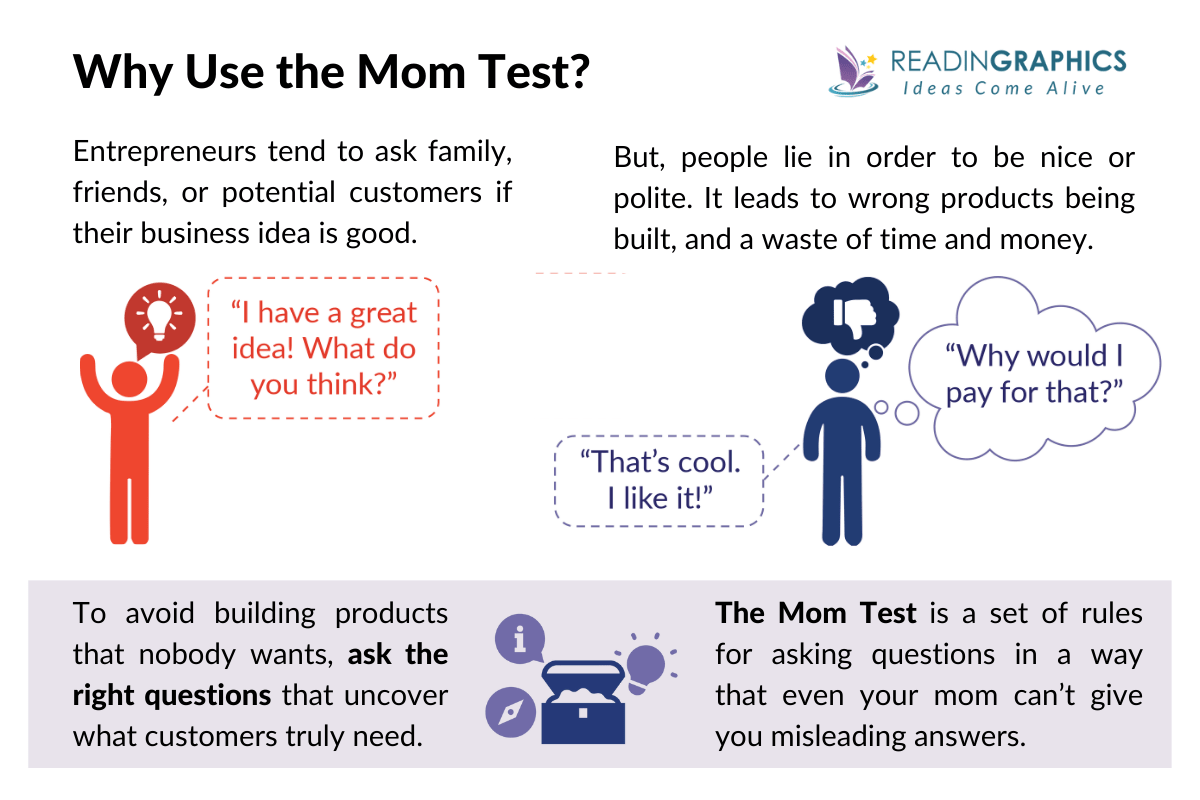
To find real customer needs, phrase your question like:
- How do you deal with this problem right now? – This reveals what people are already doing and how they approach the problem.
- What have you tried before? – This uncovers failed solutions and unmet needs.
- Have you ever paid to solve this? This shows if the problem is important enough for people to spend money on.
Questions like these should help you avoid forced answers. It might even refine the way you think about your potential customers. You’ll learn about how they deal with their day-to-day, their hobbies and interests which may come in handy in the future.
You shouldn’t need a comprehensive market analysis or marketing plan when you’re getting started. You need to start with problems people are willing to pay money to solve. This is how you find small business ideas that have big potential.
Will My Business Idea Work: 5 Key Criteria for Businesses That Last
Discovering a real problem is one thing, creating the right solution and building a business around it is another matter entirely. How do you know if your startup ideas are worth building?
In The Millionaire Fastlane, M.J. De Marco outlines 5 key commandments for a “Fastlane Business”. These commandments bring wealth and freedom potential for many entrepreneurs:
- Need: Does it address a problem that a customer needs solving? (This should be met by the problem-discovery discussed above).
- Entry: Is it hard for others to copy?
- Control: Do you own the product, process, or platform?
- Scale: Can it reach a large number of people without extra effort each time?
- Time: Can it eventually operate without you being involved every day?
You can use this 5-point criteria to narrow down small business ideas into the ones that have a sustainable revenue model. Here are 3 business models you can try that passes all 5 points:
- Internet-based businesses: Software, e-commerce, and content platforms that can scale without tying it down to a business location. Freelance specialists start here with skills like social media management, graphic design, or video editing. Then they end up building remote agencies to scale the business.
- Innovative businesses: New inventions or improvements to existing products that stand out and can be protected. This works best when you build your business idea around a disruptive innovation. This innovation could be physical inventions or software tools people haven’t seen before.
- Iterative businesses: Franchises, licensing, or repeatable systems that can be expanded to new markets. These are businesses that can be cloned or replicated fast, making recurring revenue easy.
These are a great fit if you aim to grow a business that runs without you. These will give you the safeguards and competitive advantage you need to build something that lasts.
Looking for more business ideas? Check out our article on Unique Home-Based Businesses. Or, you can also discover more about financial freedom our free The Millionaire Fastlane summary.
Once you have a problem-solution fit, the next step isn’t to build everything all at once. Don’t start yet with a business location, business name, or even a big launch team. You’ll have a better return on your investment by starting leaner: testing your business in a small scale.
Step 2: Test a Simple Solution or Offer (Minimum Viable Product)
Missing this step is how many aspiring entrepreneurs fail. They invest time, money and effort on untested solutions. They forget to gather real answers to questions like:
- Will people even actually use it?
- Are people willing to share this with their friends and family?
- Are people willing to pay for such a solution?
These questions can also come in the form of unfounded assumptions. They may sound like, “Of course, people are willing to pay for this!”
You don’t need a business plan or product based on assumptions. You need a real solution with a product-market fit.
According to Eric Ries in The Lean Startup, a better way to test your solution is through the Build-Measure-Learn loop. Build something simple, measure how people respond, and learn through real feedback.
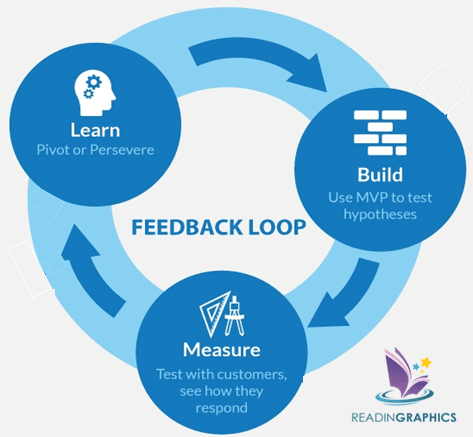
This loop starts with an MVP, or a Minimum Viable Product.
What is an MVP: Understanding Minimum Viable Product
An MVP (or Minimum Viable Product) is the first step to transforming small business ideas into real products and services. It is not an unfinished draft or prototype, but instead the simplest version of your product or service.
—
“Your MVP should be like a great reduction sauce—concentrated, intense and flavorful.” – Ash Maurya, Running Lean
—
Your MVP can come in various shapes or forms, but it should help answer or test your most critical questions. For example,
- Will people even actually use it? – Make a realistic demo or template, and see if people will ask where to get a full version, or are willing to leave their email address for it.
- Are people willing to share this with their friends and family? – Build a referral system around your product and see how many people spread the word.
It could be landing page with an email signup, a short demo video, or a clickable prototype. The goal is to validate demand before you invest heavily in development.
Once you’ve built your MVP that tests your key assumptions, it’s easy to set key metrics to measure your results. This is the second part of the Build-Measure-Learn loop. If you’re testing for interest, count the number of sign-ups. If you’re testing for growth, count the number for referrals.
Setting this up early will help conduct better market research you can really learn from. It will help you adjust your offer to meet market demand, and get you ready for the next step.
Step 3: Get Your First Customer
In The Millionaire Fastlane, DeMarco explains that the only proof that matters is whether someone will pay you to solve their problem. And, that only happens when you get your first paying customer.
Start lean by putting your MVP in front of real customers. There are a couple of free or low-cost ways to do this, without a comprehensive marketing plan:
- Social Media Strategy and Content Marketing – Post about your MVP and how it can help on blogs and social media. Make sure to choose channels where your target market is and where they often post or discuss about the problem they are facing.
- Online Advertising – social media or search engine/Google advertising is now available to anyone and everyone. With advanced targeting tools, it is a good opportunity to get your MVP in front of the right audience.
- Affiliate Program – create incentives around getting other people to sign-up or purchase the product or service. For example you can create a discount coupon that can be claimed when they share your product on social media.
You can do this while making continuous improvements on your MVP. In Traction by Gabriel Weinberg and Justin Mares, they suggest that you spend 50% of your time on the product, and the other 50% on gaining enough traction. This divided effort will help you build and improve more efficiently.
If you want to learn more, you can read our free Traction book summary and learn more about marketing strategy for startups.
Ready to Turn Your Business Idea Into Reality?
You do not need a million-dollar business idea or a catchy business name. You need a real problem to solve, a simple test to run, and the discipline to keep learning from customers.
This market analysis process will validate your business idea, turning your dream into reality. This is how you start making a living while providing great solutions for others.
Start with the problem. Build an MVP. Test quickly. When someone pays you to solve their problem, you no longer just have an idea. You have a business.
If you’re ready to dive deeper, explore Readingraphics’ text, visual, and audio summaries of the best books on startups and business development. Take the first step today—Subscribe to access all these great titles AND more than 300 other best-selling book summaries, to begin your startup journey!