Are book summaries any good, or are you better off reading full books? This guide explains everything you need to know about reading a full book vs a summary. We discuss when it’s beneficial to use summaries, when to use a full book, and how to use summaries alongside books. Furthermore, we explore frameworks and other actionable tips to get the most from summaries. If you want to see these ideas in action, we’ve included explainer videos throughout this guide.
In essence, this article covers:
- Why Do People Struggle to Learn from Books?
- Are Book Summaries Worth It?
- When to Use Book Summaries (and When to Read the Full Book)
- What Are the Different Types of Book Summary Formats?
- Which Book Summary Platform Is Best for Learning?
- How to Get the Most Out of Summaries: The 3A Framework
- Why ReadinGraphics Summaries Works?
- Conclusion
- Frequently Asked Questions
But first, let’s understand why we struggle to learn from books. This will form the basis for understanding when we can benefit from book summaries, or when full books are the better choice.
Why Do People Struggle to Learn from Books?
The way authors present their life stories or insights isn’t always so easy to understand. Think of reading a business book that explores critical ideas through a fable or allegory. You might draw lessons from the metaphors that are different from what the author intended. And often, you need to explore multiple books on the same topic before the concepts start to click.
Many people struggle to learn from books because they fail to connect with the author’s lessons, beliefs, or experiences. But this isn’t the only reason why you may struggle to learn from books. Here are some other reasons…
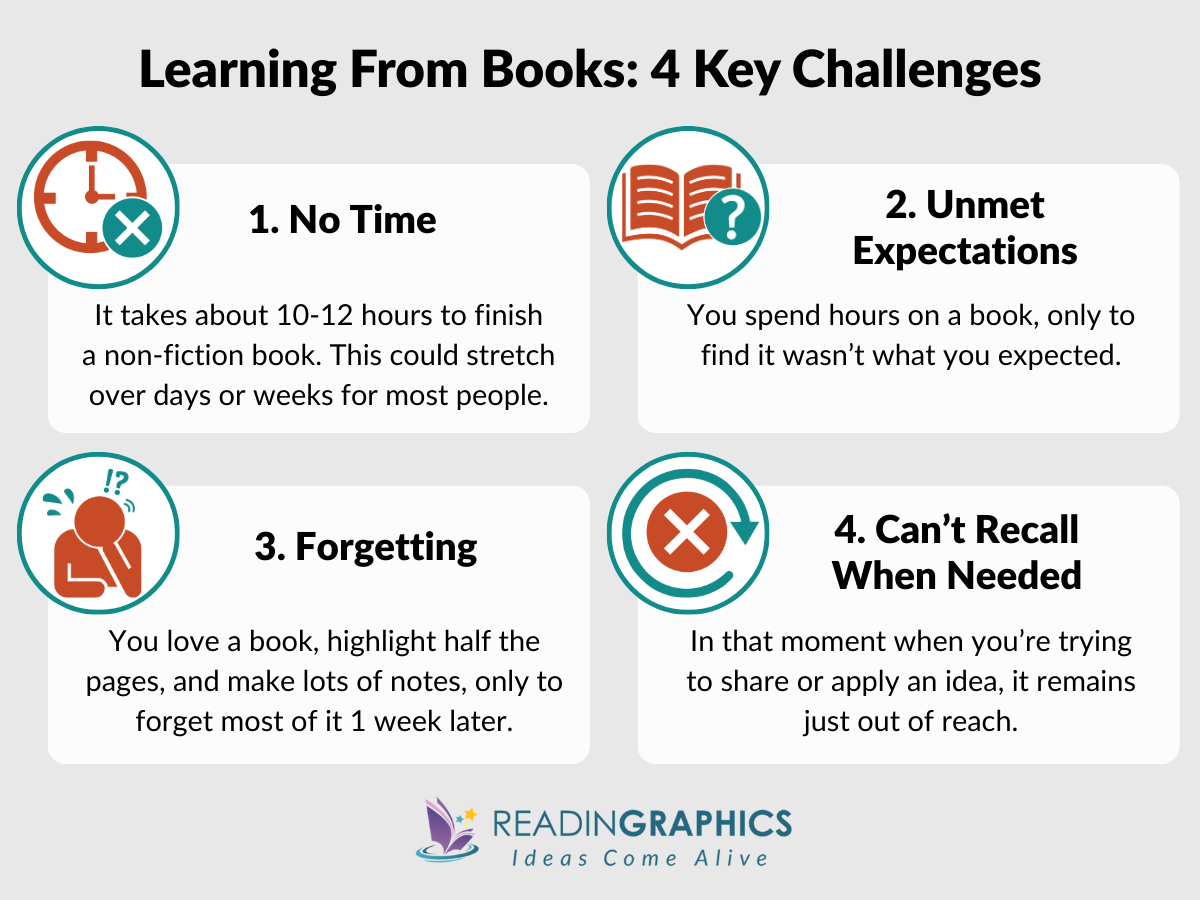
No Time
Most people do not have much free time. It often takes about 10 to 12 hours to finish a nonfiction book. With all our commitments, reading can stretch over days or even weeks. By the time we finish, it’s easy to forget the book’s contents. Sometimes, we simply quit reading because we’re so short on time.
Unmet expectations
You spend hours of your precious time on a recommended book… only to find there was nothing new, or it wasn’t what you expected. You close the book, thinking you just wasted all those evenings
Forgetting
You loved the book, highlighted half the pages, and felt like you learned a lot. But a week later, you can barely remember a thing.
Can’t Recall When Needed
Then there’s that moment when you’re trying to share a powerful idea with a colleague… but you can’t recall the details, or even which book it came from.
When struggling to learn from a book, Book summaries can be helpful. In the next section, we explain the benefits and drawbacks of book summaries.
Are Book Summaries Worth It?
Most debates on book summaries suggest they are a good starting point. You can understand what a book is about at a glance. You can also sink into its main ideas without having to read anecdotes, fillers, and more.
With summaries presenting an author’s insights without you needing to spend the extra time, it’s no wonder they’re gaining popularity. A 2024 report from Growth Market Research revealed that the book summary app market size is expected to grow by 16.7% annually between 2025 and 2033, showing an increasing demand.
But there’s also concern that book summaries take too much away from a book. Think about all the extras that bring context, spark imagination, empathy, and emotion.
What are the Pros and Cons of Using Book Summaries?
Here’s a deeper look at the advantages and disadvantages of using book summaries.
| Pros | Cons |
| Saves time – You can grasp the main ideas of a book in minutes instead of hours. | Lacks depth – Depending on the summary provider, you may miss out on extra examples, stories, and nuances. |
| Great for discovery – Summaries help you decide which books are worth reading in full. | Can create false confidence – You might feel like you know the material, but not truly understand it. |
| Boosts recall – Revisiting summaries after reading a full book helps reinforce key lessons. | Author’s intent may be lost – The summary writer’s interpretation might differ from what the author really meant. |
| Useful for busy people – Ideal when you need quick insights or reminders before meetings, writing, or decision-making. | Not suitable for complex ideas – Dense books on psychology, philosophy, or science often need full reading to make sense. |
You might have picked up that the strength of book summaries often comes with a trade-off. Understanding those trade-offs helps you know when and how to use them. Here’s a visual summary to answer the question: Are book summaries worth it?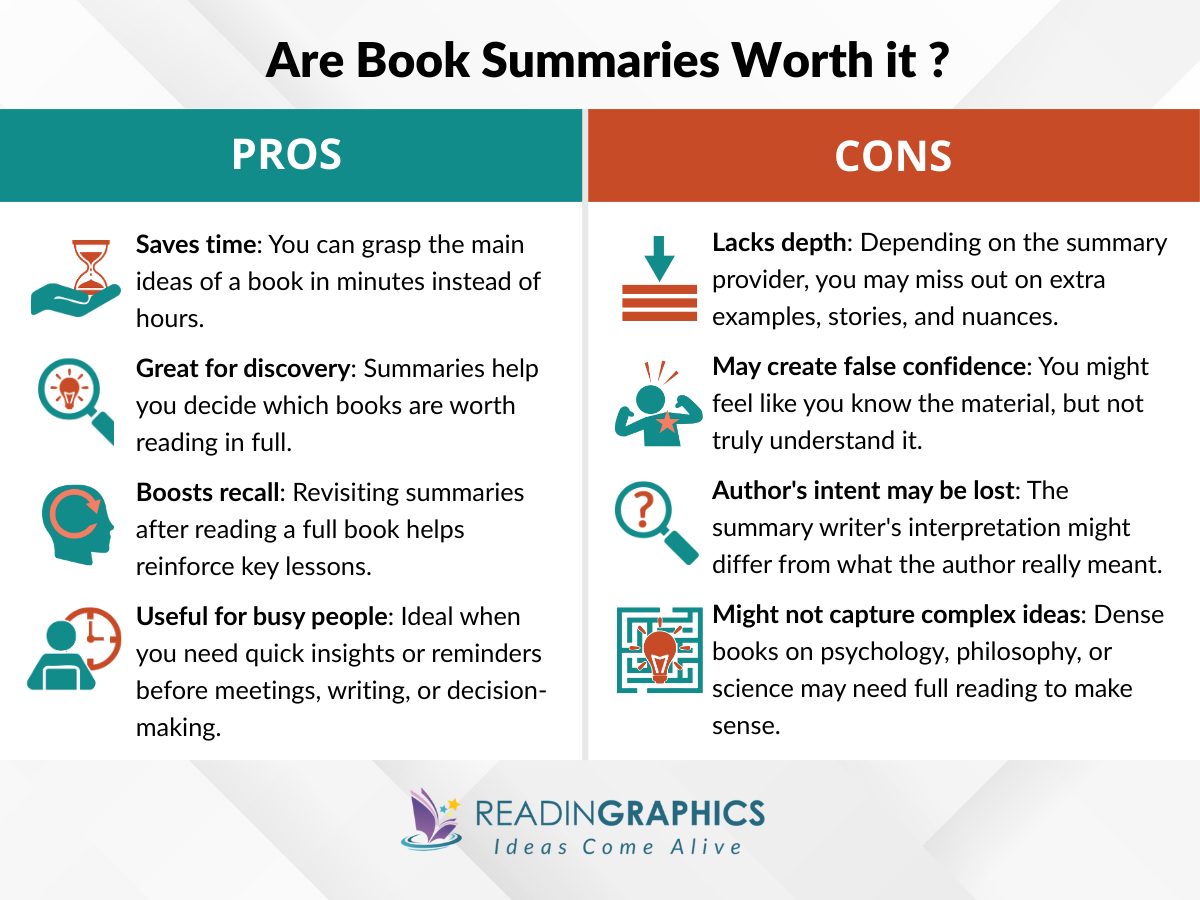
In essence, summaries shine when you need speed, clarity, and direction. They’re perfect for quickly getting the core of insights, scanning ideas, comparing perspectives, or refreshing your memory on key concepts. In just a few minutes, you can extract the essence of a book that might otherwise take hours to read.
But summaries can also have limits, depending on the book summary provider. If the person, or AI tool creating a summary, strips away all the stories, emotions, and detailed reasoning, you may find an information gap. With a lot of the original context stripped away, you may find it harder to remember or apply the summaries’ insights.
So, instead of thinking in terms of “summaries versus books,” it’s more useful to see them as different tools for different moments in your learning journey.
- When you’re exploring new topics, summaries help you find your direction.
- When you’re chasing specific goals, full books give you depth and context.
- And when you’re revisiting ideas, summaries help you recall what matters most.
That leads us to our next question: When to use summaries and when to reach for the full book?
When to Use Book Summaries (and When to Read the Full Book)
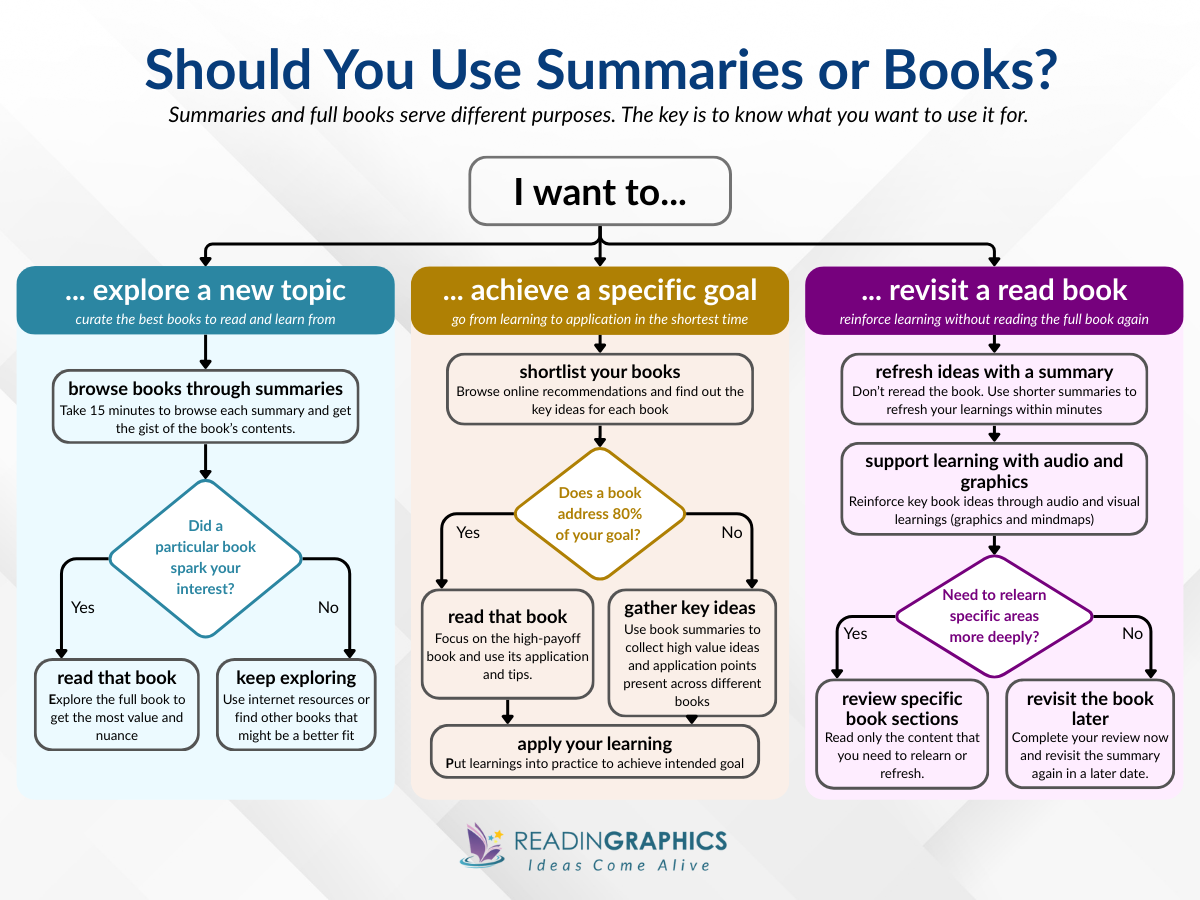
Summaries and full books serve different purposes. If you’re choosing to use one and completely ditch the other (i.e. “I only read summaries, or I only read books”), you may be limiting how much you get out of a book. The trick is knowing when to use each, so you save time and maximize your learning potential.
So how do you know when a summary is enough, or when you need to read the full book?
The best approach is to use both, but know when each one comes in and how to use it.
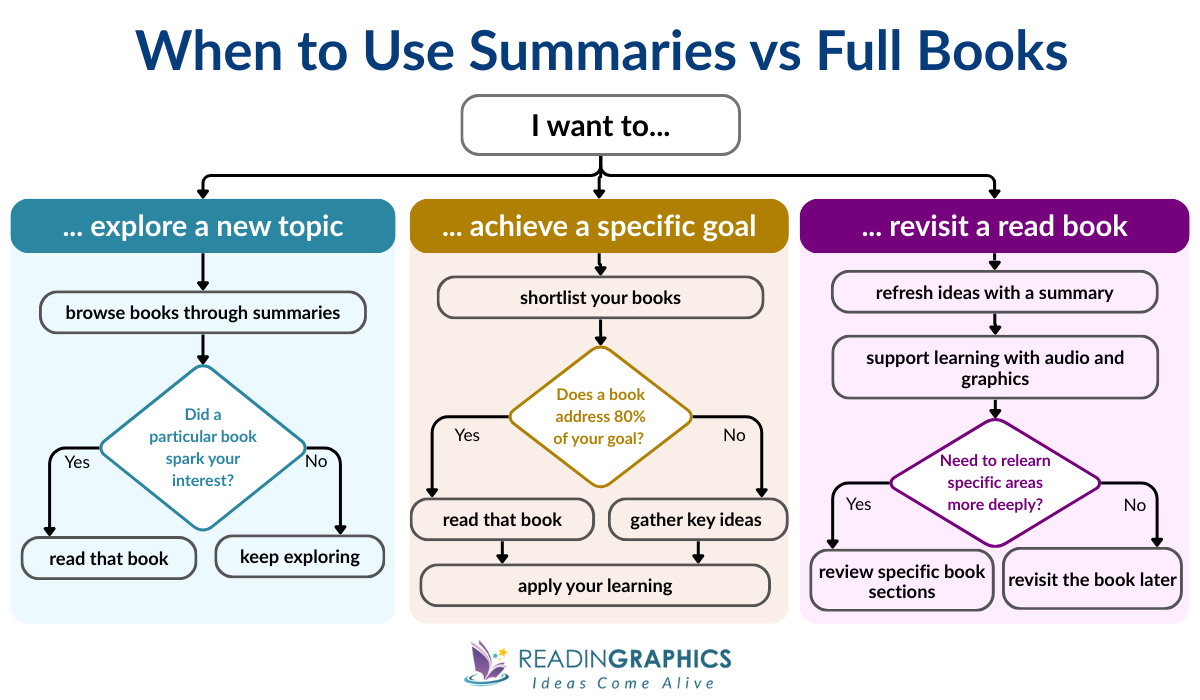
That’s why we’ve broken it down into three common scenarios:
- You’re exploring a new topic.
- You need to achieve a specific goal.
- You’re revisiting a book you’ve already read.
Exploring a New Topic: Summaries as “Trailers”
If you’re diving into a topic you’re curious about, start with a summary. Like you would with a movie trailer, in just 15 minutes, you can decide whether the “full feature” is worth your time.
For example, say you want to become more influential at work. You’ve heard of Influence, How to Win Friends and Influence People, and Pre-Suasion — but which one deserves your attention first?
Pull up the summaries:
- Influence covers six persuasion techniques, like Reciprocation, Consistency, Social Proof, Liking, Authority, and Scarcity.
- How to Win Friends and Influence People is about handling people, winning them over, and shaping outcomes through relationship skills.
- Pre-Suasion explains how setting the right mental or emotional context before a major meeting can influence what people are paying attention to, how they feel, or what they’re primed to think.
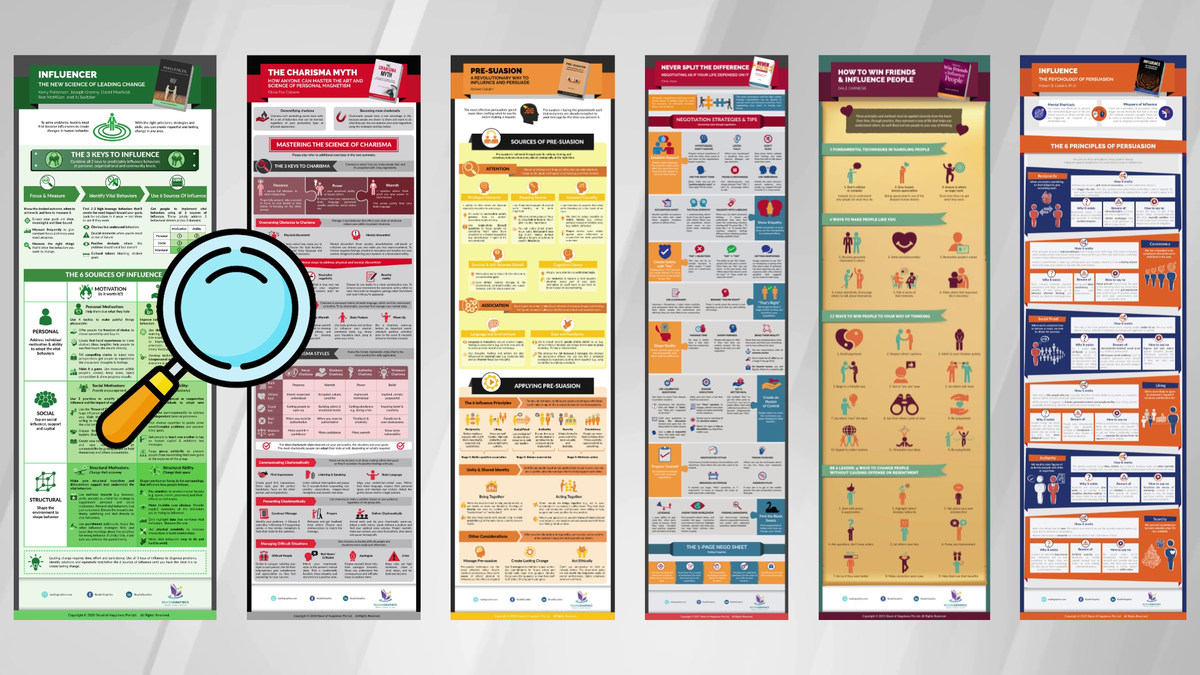
In just a few minutes, you’ve got the gist of each book, enough to make an informed decision about which to explore further.
Of course, reading a summary isn’t the same as reading the full book — you won’t get all the concepts, nuances, or real-life applications. Furthermore, not all summaries are equal. Some, like those on ReadinGraphics, offer visual overviews, examples, and tips that make grasping the main ideas even faster.
If your goal is to explore, start with summaries. If a book sparks your interest, dive deeper. If not, keep exploring through summaries. This way, you curate the best books without wasting time.
Achieving a Specific Goal: Summaries as “Just-in-Time Learning”
When you’re chasing a goal or solving a problem, a quick summary, or even a single book, isn’t enough. You’ll need multiple perspectives.
For example, if you have to pitch a big project to your CEO next week, you’d probably start by skimming online resources or asking AI for tips. You might find these books recommended:
- Influence — six persuasion triggers
- What the CEO Wants You to Know — strategic perspectives
- Smart Brevity — ways to get to the point
- The Back of the Napkin — persuasive visuals
- Storytelling with Data — making data persuasive
However, you’re pitching your project in a week, and that’s not nearly enough time to get through five books.
Here’s the smarter approach: skim summaries to get the big picture and pick the key ideas from each book.
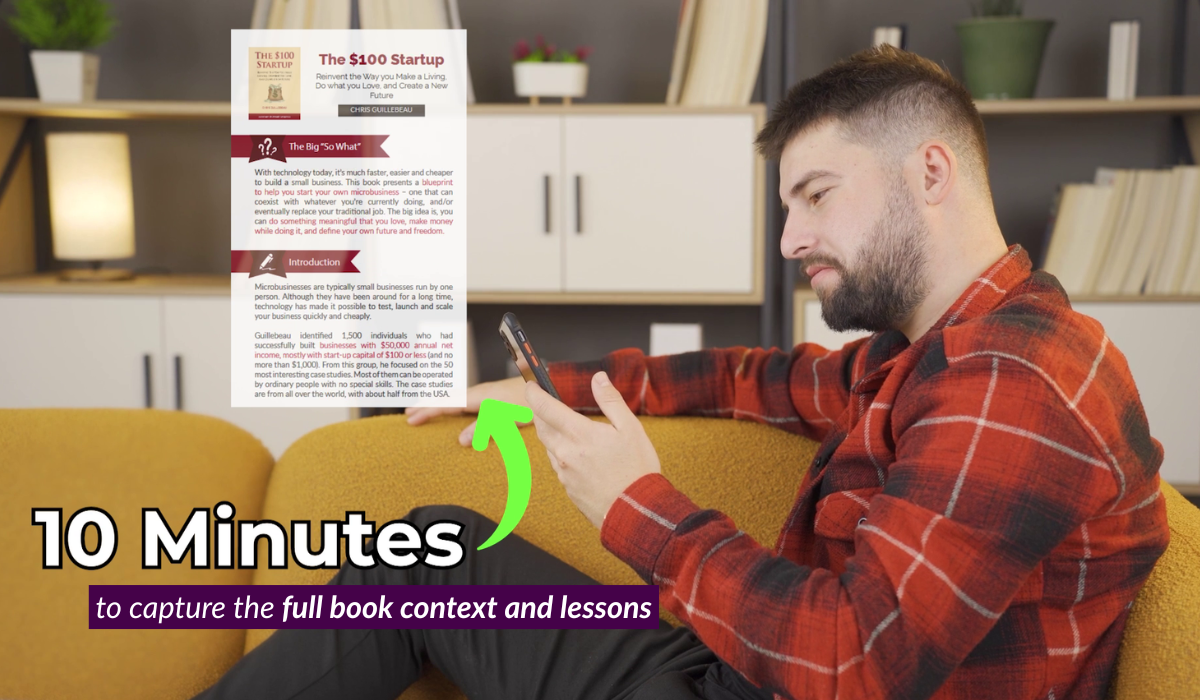
Then dive into the one that gives the highest payoff — maybe the one about data presentation if that’s critical for your pitch.
If none of the books match your goal perfectly, gather the repeated key ideas across books, then zoom in on those. You don’t need to read every page to get results. For just-in-time learning, it’s more effective to use summaries to guide you and full books for depth.
Revisiting a Book: Summaries as “Refreshers”
According to a 2024 study published in Springer Nature, if we don’t revisit what we read, we’ll forget a huge amount of it over time. A theory known as the Forgetting Curve suggests we could forget about 50–90% after the first read. However, with consistent review and reinforcement, our retention can increase to 80–95%. This is where summaries can be particularly useful.
Say you applied ideas from Storytelling with Data in your CEO pitch. Six months later, another presentation is coming up. You don’t have time to re-read 300 pages. A good summary, ideally with audio or visual elements, can bring the key ideas back in minutes.
Play the audio on your commute, skim the infographic for highlights, and only dip into the book when you need details.
Summaries become your cheat sheet, helping you apply ideas confidently, without re-reading the entire book.
To recap, here’s a detailed flowchart of when you should use summaries vs full books.
What Are the Different Types of Book Summary Formats?
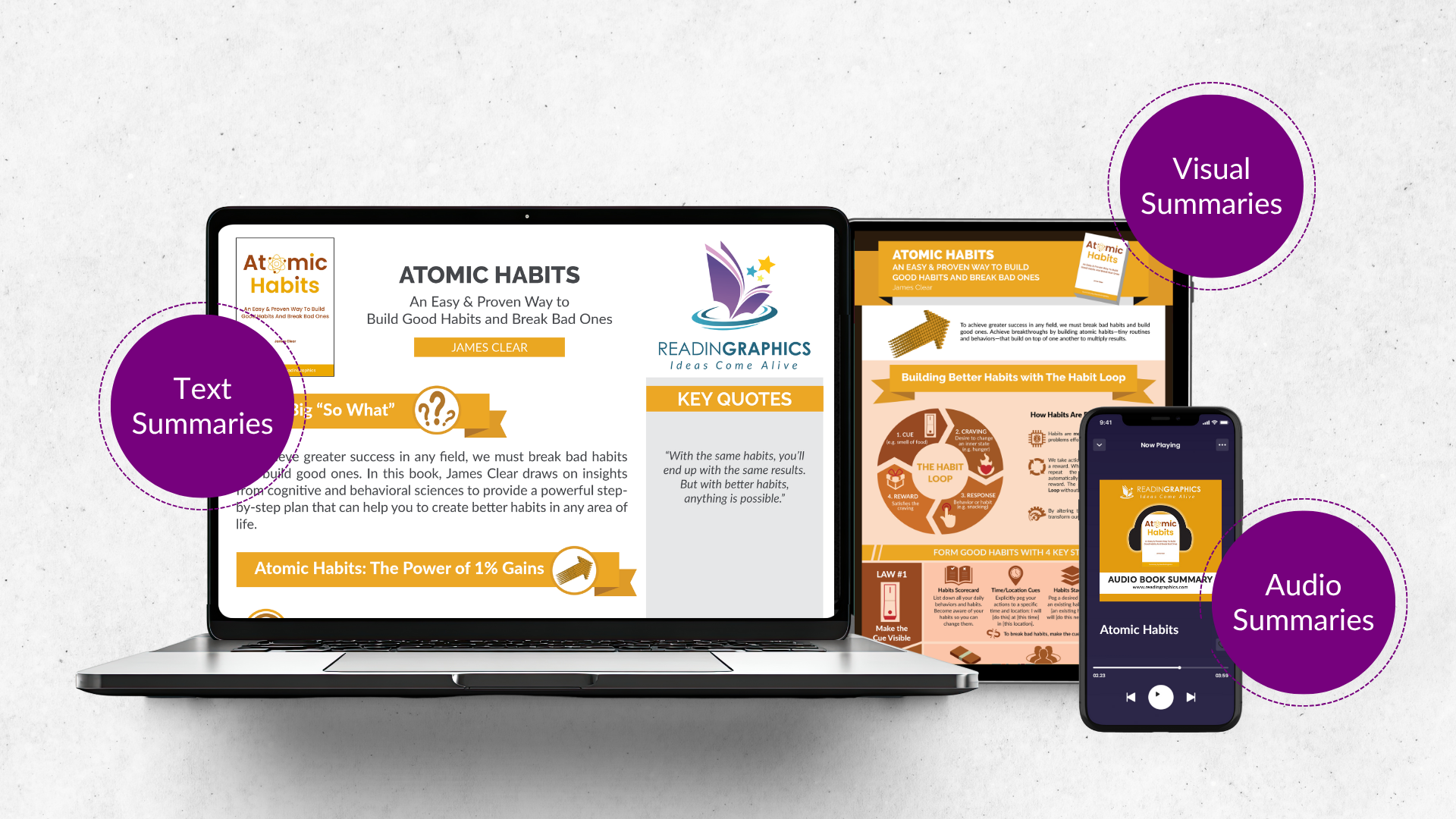
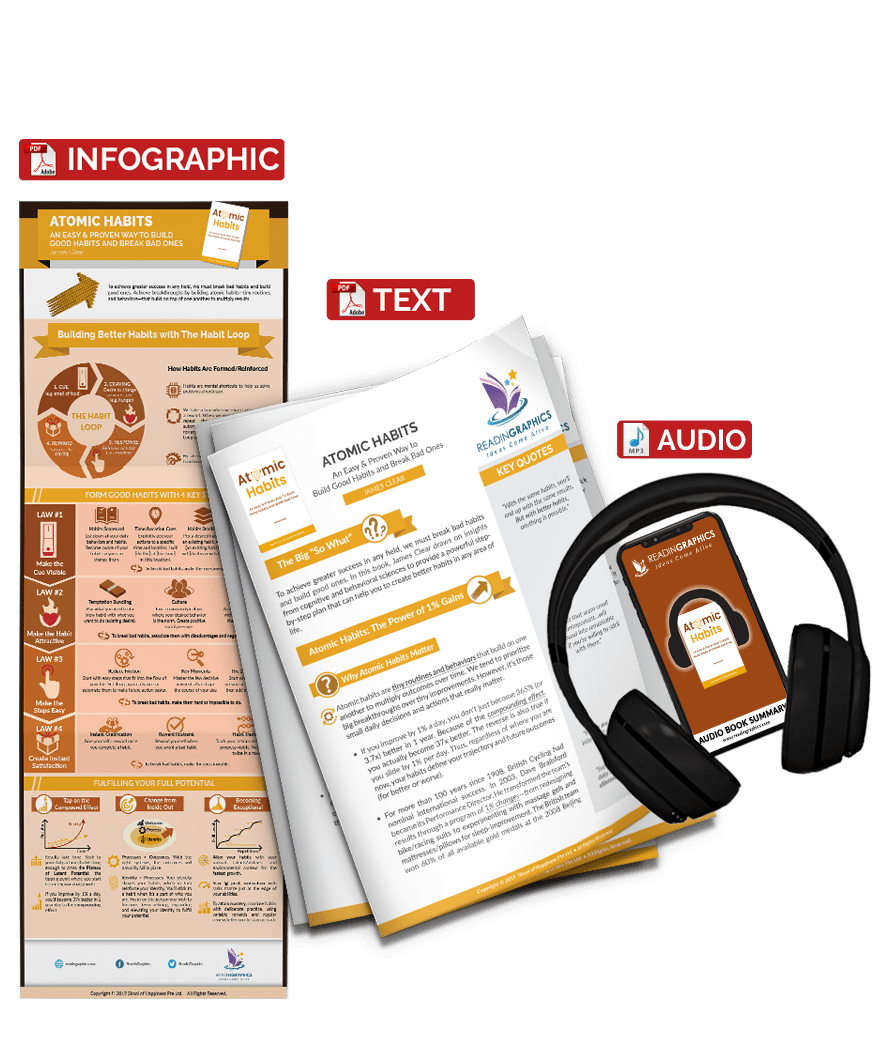
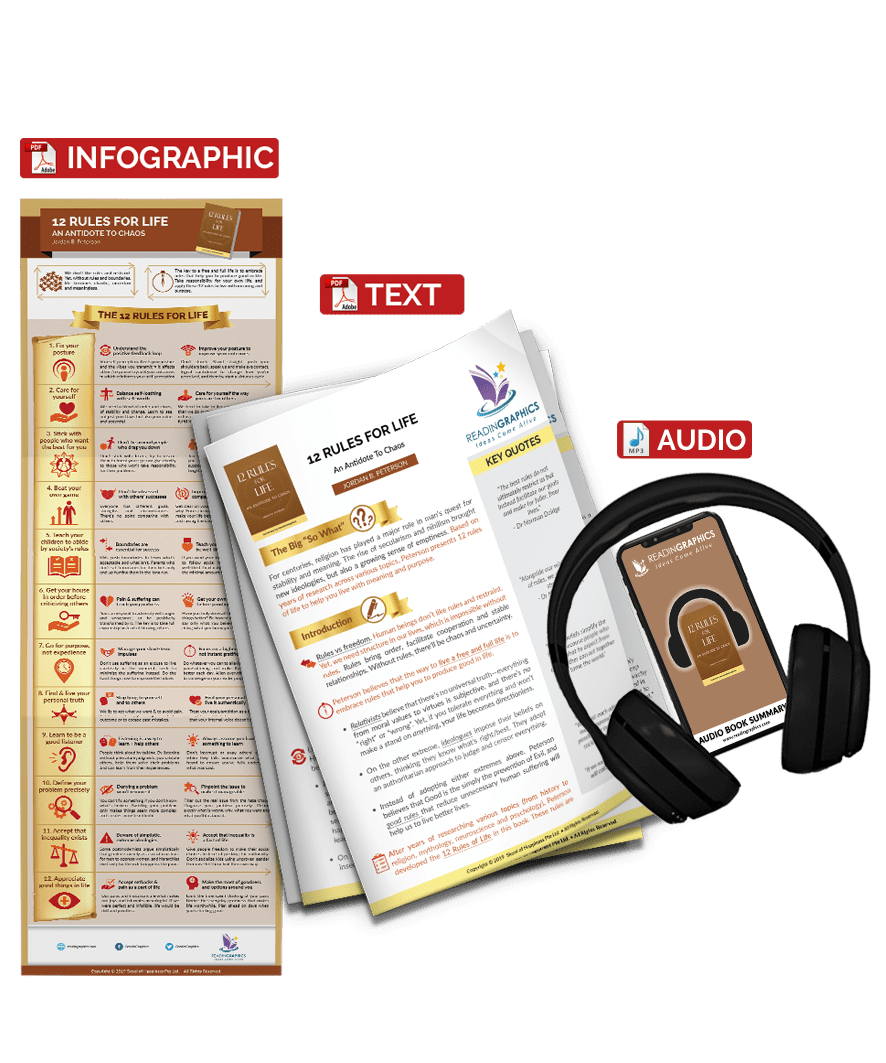
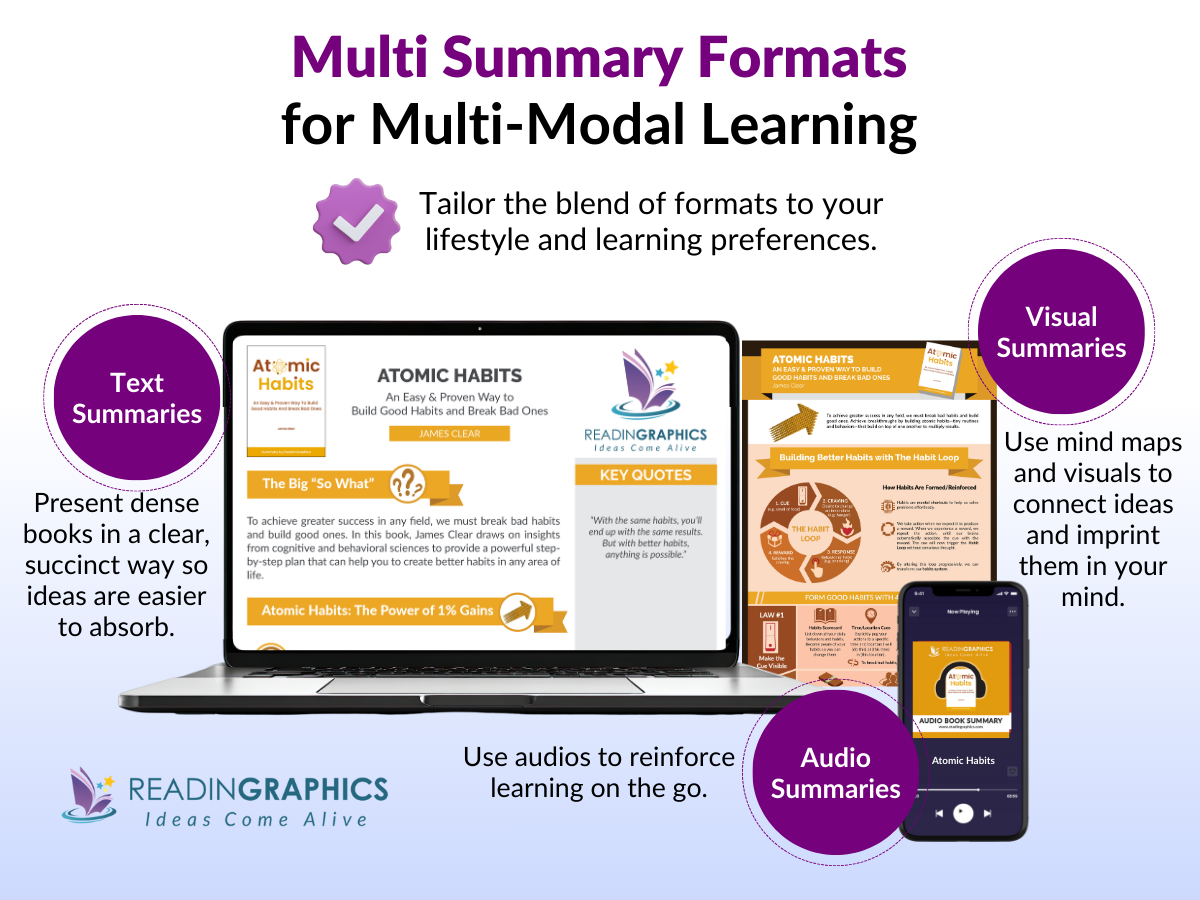
There are various summary formats, with the most popular ones being text formats, audio formats, and visual formats.
Try it today - Download a free summary!
Each style appeals to different senses and helps us grasp and remember what we read in its own way.
Visual summaries, which include options like mind maps, infographics (and to a lesser extent, videos), can make it easier to connect ideas and see everything together. Sometimes, this method works better than a long text summary with 20 bullet points which can be harder piece together. At the same time, a textual summary may offer more depth. In essence, each format has its pros and cons – We break these down in the table below.
| Format | Best For | Strengths | Limitations |
| Text | Note-takers, skimmers | Quick scanning; searchable; you can highlight or annotate | Can be dense; may require focused attention; less dynamic |
| Audio | Commuters, multitaskers | Learn on the go (while driving, walking, doing chores) | Harder to take notes; less visual engagement; retention may suffer if distracted |
| Infographic | Visual learners, quick recall | Engaging visuals; good for seeing structure and connections | Limited depth; may skip nuance or context |
| Video | Active learners, multitaskers who like multi-sensory input | Dynamic, combines visuals + audio; good for explanation + emotions + demonstration | Requires more time and focus; may be hard to connect ideas due to sequential flow |
Why does choosing the right book summary format matter?
Different formats excel in various aspects of learning, which is why switching between summary formats is important. However, an even more effective approach for retention is to combine formats. Research in neuroscience and cognitive psychology indicates that revisiting the same ideas through different sensory channels enhances both memory and learning. For example:
- The process of memory consolidation, which involves turning short-term insights into long-term retention, depends on repeated and varied exposure.
- Using more than one modality (for instance: seeing + hearing) engages more brain regions and boosts retention.
Hence, you gain more by using all formats together. When you see an idea as a diagram, read it as text, and hear it explained aloud — you’re likely to understand and remember it better than if you only did one of those.
In the video below, you can see how these formats look like in action, and how they work together to address the 3 different goals or scenarios outlined earlier:
Which Book Summary Platform Is Best for Learning?
Book summary services tend to have their own focus — from quick takeaways to in-depth analysis or visual learning. If your goal is to actually learn and retain ideas, it helps to know what each platform does well and where they might fall short.
Below, we take a closer look at five major players in the space:
Blinkist
Blinkist is a popular choice for book summaries, offering tons of non-fiction books in both written and audio versions. They’re quick and easy, with all their summaries providing a book’s main ideas in about 15 minutes. Blinkist is a great choice if you need some quick inspiration or just a basic overview. But since it’s all about keeping things short, Blinkist summaries sometimes miss out on the deeper examples or context that really help you understand the material better.
Shortform
If Blinkist is all about quick summaries, then Shortform is where you dive deep. In addition to quick overviews, their summaries include analysis, commentary, and connections to other books. With these add-ons, you get to see how their ideas fit into a bigger picture. It’s perfect for those who like to think things through and really get to the heart of the matter. Just keep in mind, it’s less about quick bites and needs a bit more time and focus to read.
getAbstract
getAbstract is made for professionals and businesses. Its summaries are short, structured, and to the point, making them perfect for corporate learning programs. The tone is pretty formal, focusing on performance and decision-making. If you want to keep up with the latest on leadership, management, and strategy books, getAbstract is a great choice. But if you’re looking for personal development or creative ideas, it might come off as a bit stiff.
Headway
Headway takes a gamified approach to learning. It helps you make reading a regular thing with daily goals, streaks, and quick “learning cards.” On the flip side, the summaries are pretty short, which is awesome for keeping your momentum going, but not ideal if you’re looking for more in-depth context or research-backed info.
ReadinGraphics
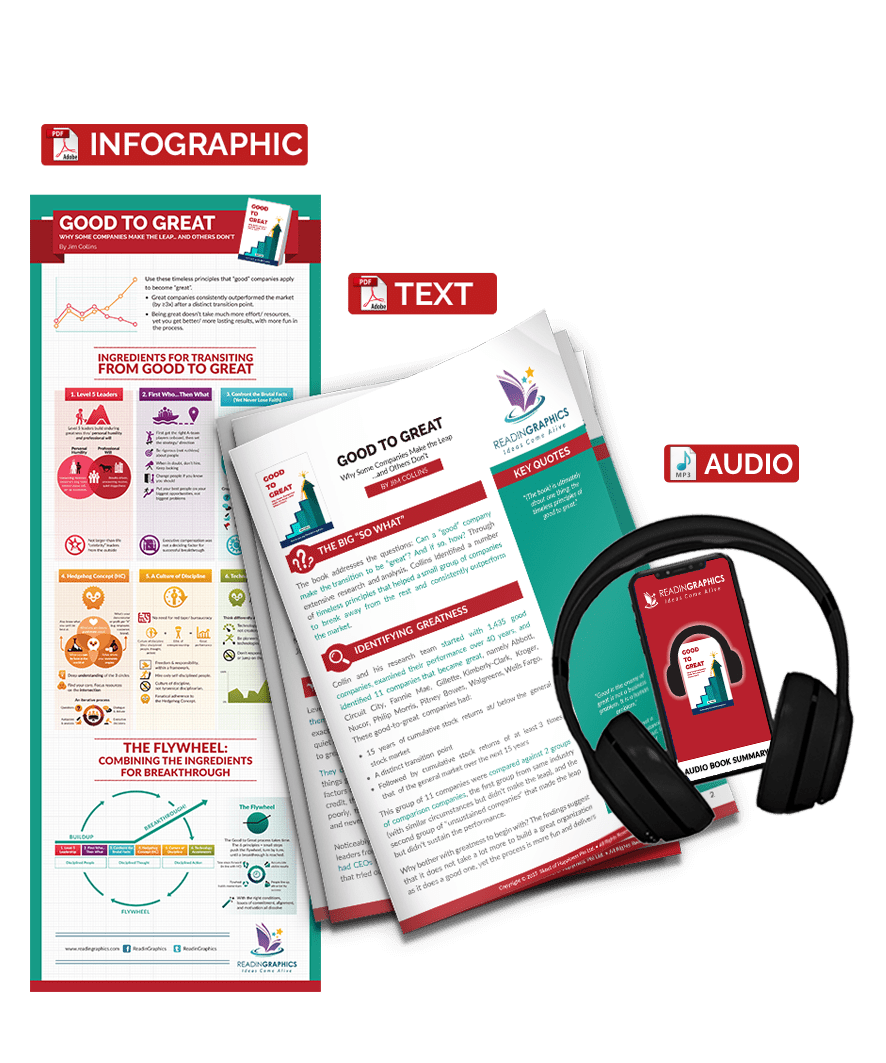
ReadinGraphics offers comprehensive text and audio summaries; however, it really stands apart for its visual infographic summaries, which are designed specifically for retention and clarity. Its infographics break down complicated ideas into easy-to-follow diagrams and flowcharts, making it simpler to recall and connect concepts later on. Even though its library is smaller than the big players, it really focuses on how you remember things, not just on how quickly you can read.
| Platform | Focus | Strengths | Limitations | How It Supports Learning & Retention | Best For |
| Blinkist | Quick insights in 15 minutes | The Blinkist library is massive; short text + audio “blinks” make it easy to explore many topics fast | Shallow coverage; skips nuance and supporting context | Great for idea exposure – helps you sample many books quickly and recall big ideas, but less effective for deep retention or applying lessons | Busy readers seeking quick inspiration or variety |
| Shortform | Deep understanding and analysis | Adds summaries, key quotes, and expert commentary; links ideas across books | Longer, denser reads; requires more focus and time | Excellent for concept mastery – promotes reflection, comparison, and practical understanding through guided questions | Reflective learners who want to connect ideas and think critically |
| getAbstract | Business and professional knowledge | Highly structured and concise; reliable source for corporate topics | Less storytelling or emotional depth; formal tone | Useful for knowledge reinforcement – distills key frameworks for quick recall and real-world decision-making | Managers, entrepreneurs, and professionals |
| Headway | Motivation through gamified micro-learning | Habit-building design, daily goals, and clean app interface | Oversimplified ideas; minimal context | Supports habit formation – encourages consistent review through small learning bursts, improving recall over time | Beginners or casual learners building a reading habit |
| ReadinGraphics | Visual + text + audio summaries focused on clarity | Integrates infographics, summaries, and audio for multi-sensory learning | Smaller library; less mainstream reach | Optimized for retention and application – visuals help you see structure, audio reinforces ideas later, text ties everything together | Visual learners, and those who want to remember and apply concepts |
Choosing the right one for you
Every platform has strengths — it’s not about which one is “best,” but which aligns with how you learn best. Ultimately, the best summary platform is the one that helps you retain, apply, and revisit what you learn, not just read it faster.
For more on choosing the right book summary service, check out our detailed blog exploring 2024’s Best Book Summary Service. We detail 6 personal considerations to make (like personal goals and budget), before choosing a book summary service. We also give you a comparison of their pricing and offerings.
How to Get the Most Out of Summaries: The 3A Framework
Getting the most out of summaries requires that you use them actively, so that you aren’t just getting through a book faster, but you’re learning smarter. ReadinGraphics’ 3A Framework helps you do exactly that by showing you how to choose what matters (Aware), apply what you learn (Apply), and retain it long-term (Anchor).
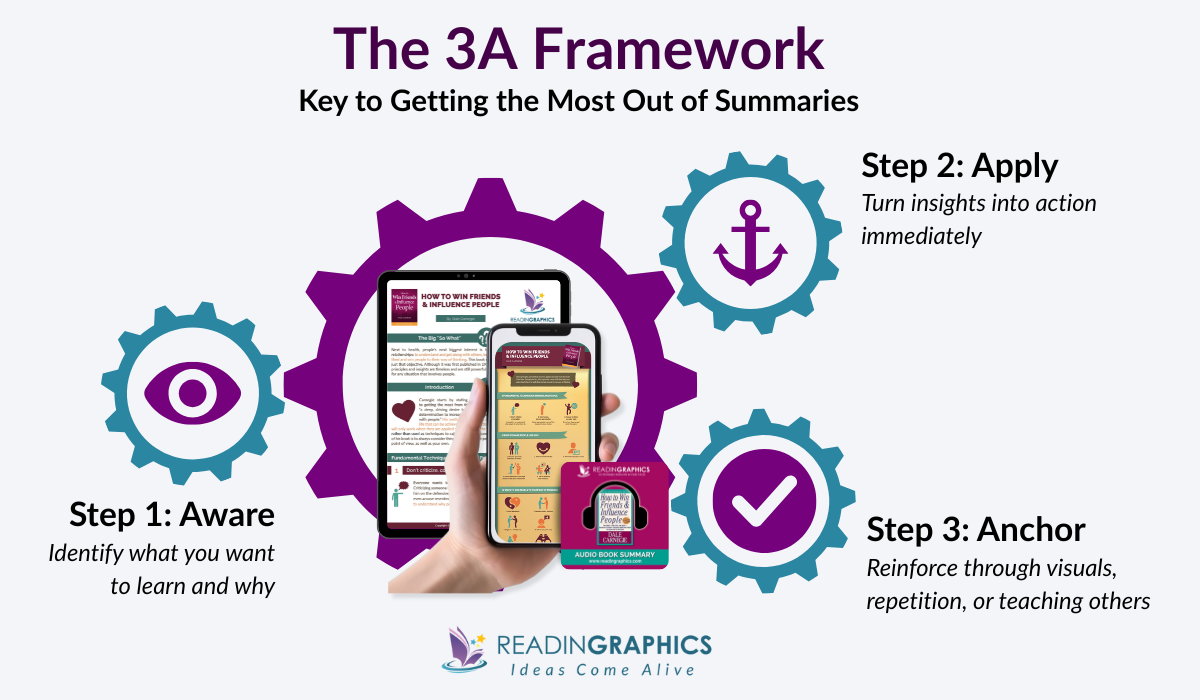
Let’s break down the 3A Framework:
AWARE – Identify what you want to learn and why
If you’ve got a stack of unread books, use summaries to help you cut through the noise. Start by getting clear on what you actually want to learn.
For instance, if you’re exploring productivity, don’t read Atomic Habits, Essentialism, and Feel-Good Productivity cover to cover. Instead, skim their summaries first to compare approaches.
- Atomic Habits → build good habits, break bad ones
- Essentialism → focus on what truly matters
- Feel-Good Productivity → use energy, emotion, and meaning to work smarter
In less than 15 minutes, you’ll know which one matches your current needs. You don’t have to do any guesswork or waste time.
APPLY – Turn insights into action immediately
Skimming a summary feels productive until you forget everything a week later. Applying one idea right after going through a summary is more efficient.
Think of it like this: if a colleague tells you how to use the latest tool to create amazing graphics, trying it immediately will help you remember it better than waiting a few months. The same applies when reading summaries. When you encounter a great hack, tip insight, find a way to apply it to your life immediately.
Don’t overload yourself. One insight, tested quickly, beats 20 half-remembered ideas.
ANCHOR – Reinforce through visuals, repetition, or teaching others
If you want to remember what you learn, you have to reinforce it. A great way is to revisit infographics, notes, or spaced retention tools.
For example, allocate a few minutes per week to listen to the Feel-Good Productivity audio summary and review the infographic.
Anchoring is what stops ideas from slipping away and turns quick reads into lasting understanding.
For more on the science behind spaced retention and how it helps you learn and recall more, check our detailed case study.
Otherwise, check out the video below which shows the 3A Framework in action for summary use.
Why ReadinGraphics Summaries Work?
Most summary services just condense information, but not many help you remember it. ReadinGraphics goes further. Our summaries are made to help you understand, remember, and use complex ideas. We bring together text, visuals, and audio in one learning experience, so you can reach your reading goals more quickly and effectively.
Our text summaries pull out the main ideas but keep the structure and reasoning of the original book. With them, you see how each concept builds on the next. Furthermore, with clear references to the book, you’re rest assured that the author’s intent remains intact. For example, in Influence by Robert Cialdini, you can follow how each persuasion principle connects across chapters, with examples that reflect the original text.
Our visual summaries turn dense material into clear diagrams and mind maps, helping you “see” how ideas interrelate. Take Smart Brevity — a book that teaches how to communicate clearly in a noisy world. Our visual summary breaks down their approach with a clear description of the 4 cores of smart brevity, guiding principles, and application tips, all alongside clear images for understanding.
And with our audio versions, you can reinforce learning on the go. Listening after reading or viewing engages another sense, strengthens recall, and keeps your reading goals on track.
Together, these layers mirror how we naturally learn, by seeing, hearing, and revisiting ideas over time. This multi-sensory process activates more parts of the brain, deepens understanding, and helps turn short-term insight into long-term knowledge.
Ultimately, ReadinGraphics doesn’t just summarize books — it helps you internalize them. You walk away not only remembering key ideas but knowing how to use them in your work, studies, and everyday decisions.
Try it yourself: Download a free summary bundle and see how ReadinGraphics helps you learn smarter, remember longer, and apply ideas with confidence.
Conclusion
If you had any doubts about whether book summaries are any good, now you know they are absolutely worth it. They save time, broaden your exposure to ideas, and serve as useful refreshers. That said, they aren’t supposed to replace original book totally. A well-written book will always contain extra nuances. insights or pearls of wisdom.
That’s why the most effective learners use summaries and books together.
- Summaries to explore topics and identify what’s worth reading in full.
- Books to dive deeper into ideas that truly matter.
- Summaries again to reinforce learning and strengthen recall.
It’s a simple matter of using each format for its purpose. Summaries make learning efficient; books make it meaningful.
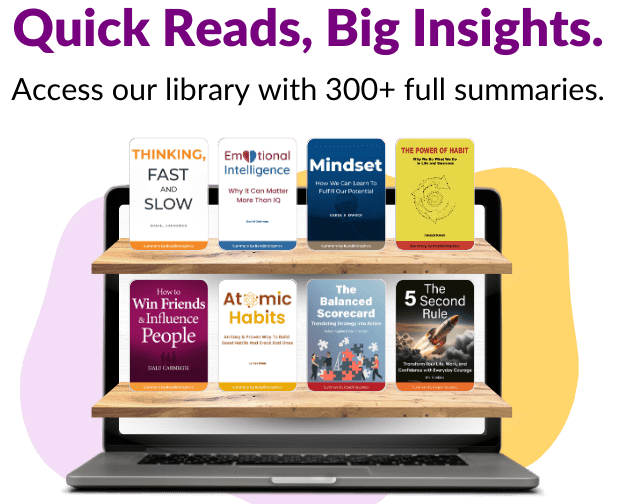
Ready to make it happen? Explore Readingraphics’ text, visual, and audio summaries of the best books on business growth and development. Take the first step today—Subscribe to access all these great titles AND more than 300 other best-selling book summaries to grow your thriving business!
Frequently Asked Questions
Should you Read Books or Summaries?
Both have value. Book summaries save time and help you explore ideas quickly, while full books offer the depth and context that summaries often miss. The best approach is to use both together, summaries for efficiency, books for deeper understanding.
Which is more effective for learning: reading the full book or reading a summary?
It depends on your goal. Summaries help you grasp key ideas fast, while full books build stronger understanding and recall. Using both gives you the best of speed and depth.
What are the impacts on critical thinking when reading summaries versus entire books?
Full books strengthen critical thinking by showing reasoning and context. Summaries are great for quick insights but can miss nuance. A well-designed summary, though, can still spark reflection and idea connections.
Is it better for your Brain to Read a Book or Listen to it?
Both stimulate your brain differently. Reading builds focus and comprehension, while listening aids recall and multitasking. Combining both helps you learn and remember more effectively.
How Long Should it Take to Read a Full Book?
It depends on the book and your pace. Most nonfiction books take several hours or weeks to finish. What matters most isn’t speed but how much you retain and apply afterward.