
For centuries, religion has played a major role in man’s quest for stability and meaning. The rise of secularism and nihilism brought new ideologies, but also a growing sense of emptiness. Based on years of research across various topics (from history to religion, mythology, neuroscience and psychology), Jordan Peterson developed the 12 rules for life, to help you live with meaning and purpose. In this 12 Rules for Life summary, you’ll learn the 12 rules and how you can use them as an antidote to chaos to re-establish direction, order and fulfillment in your life.
In essence this article covers:
- What are The 12 Simple Rules for Life?
- Is 12 Rules for Life Worth Reading?
- Who Should Read the 12 Rules for Life
- What are the Criticisms of 12 Rules for Life?
- 12 Rules for Life vs Other Self-Help Books
- Other Details in “12 Rules for Life”
- 12 Rules For Life Chapters”
- About the Author of 12 Rules For Life
- 12 Rules For Life Quotes
- Frequently Asked Questions
What are The 12 Simple Rules for Life?
Clinical psychologist Dr. Jordan Peterson developed 12 rules based on his clinical practice and personal experiences that can help us live a free and fulfilling life. The 12 Rules for Life are built on the fundamental rule that we must each take responsibility for our own lives.
He recognises that human beings don’t like restraint; however, rules give us the structure we need in our lives. Rules bring order, facilitate cooperation and stable relationships, without which there’ll be chaos and uncertainty.
Furthermore, he suggests that Good is simply the prevention of Evil, and good rules that reduce unnecessary human suffering will help us to live better lives.
The 12 Rules in this book help you get your life in order and do the best for yourself, your society, and the world at large.
Only then will you discover the true extent of your potential and resilience, while helping mankind to thrive collectively.
Here’s a visual overview of the 12 rules for life.
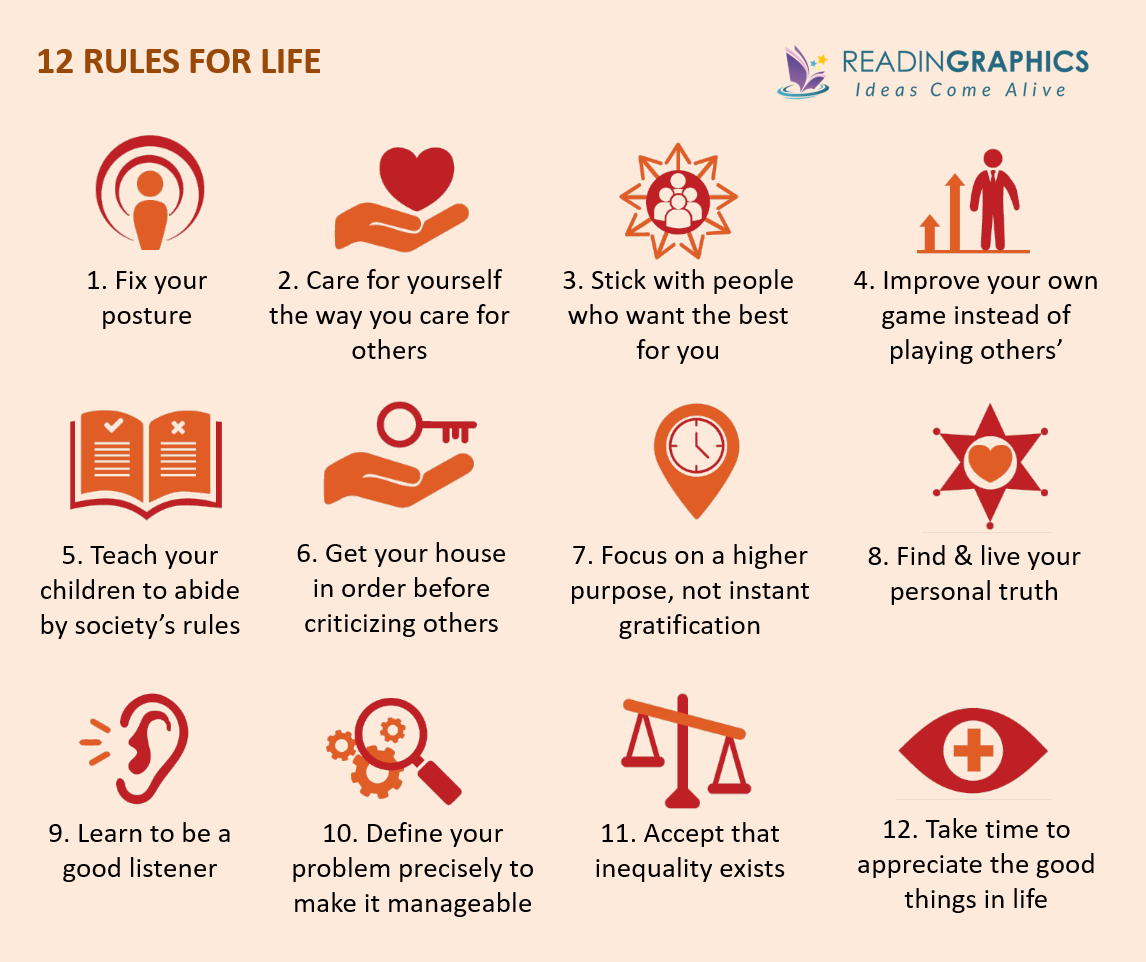
We’ll provide a 12 Rules for Life Summary by Chapter. Each chapter focuses on one of Peterson’s Rules. We’ll zoom into the first rule in detail, with a brief outline of the remaining rules.
We have reworded the rules to better reflect the essence of the chapters. However, for the ease of reference, we’ve also included Peterson’s original wording in quotation marks at the bottom of this article.
Do get our complete 15-page summary for more details on all 12 rules for life!
Rule 1: Fix your Posture
Nutshell: Stand tall and take responsibility – confident posture changes how you feel and how others see you.
All animals, including humans, are governed by dominance hierarchies and involuntary biochemical responses. Peterson uses a study on Lobsters to explain this idea. Lobsters battle for dominance. During a confrontation, 2 lobsters size each other up using their body/claw sizes and chemical secretions (which signal their health, strength and mood).
Dominant lobsters have higher serotonin levels, project greater confidence, a better posture, and can fight longer. An alpha lobster typically “wins” without even having to fight physically.
After each confrontation, a lobster’s brain changes—the loser avoids further conflict, whereas the victor gains even higher confidence and serotonin levels.
Similar patterns can be found in other animal species—generally, stronger animals get more food, better “homes”, higher status, better mates, and greater cooperation from others. That’s nature’s way of distributing scarce resources.
Likewise, humans also have a kind of “dominance detector” in the brain. A 2020 study by Murat Kezer and Zeynep Cemalcilar in the International Review of Social Psychology backs this up. They found that how we think about our own social or economic status affects our well-being — and this then feeds back into how we see our status, creating a cycle.
-
-
- People with strong self-esteem feel/transmit a sense of security and confidence, which makes them more attractive and respected. This improves their productivity and well-being, which further reinforces their self-perception. Higher serotonin levels are associated with greater resilience, happiness, health, lifespan, pro-social behavior and leadership.
- On the other hand, people with a low self-perception feel insecure. They’re more likely to be stressed, jumpy and reactive. They make poor decisions, fail to command respect/resources, which reinforce their loser complex.
-
Our self-perception affects the vibes we transmit to create a self-reinforcing loop.
In short:
Fix your posture: Confident posture = more respect = higher serotonin and self-esteem.
Don’t Sloch: Slouched posture = signals defeat = less respect = lower self-worth.
Fixing your posture equals taking responsibility for your life. Stand straight, push your shoulders back, speak up and make eye contact. Speak clearly, and hold yourself as though your presence matters – because it does.
Rule 2: Care for yourself like how you’d care for someone else
Nutshell: Give yourself the same care and attention you give to others.
We tend to take better care of our pets than we do ourselves. When a pet is sick, we diligently follow the prescribed care. Yet, when we’re sick, we fail to fill/take our prescriptions. In the full summary we look at how our self-loathing plays a part and how to counter it.
Rule 3: Surround yourself with people who want the best for you
Nutshell: Spend time with people who lift you up. Your social circle shapes your habits, mindset, and growth.
We become the average of the people we spend the most time with. In the wrong company, we can end up in crime or even suicide. So, why do we hang around people who drag us down? Find out more from the complete 12 Rules for Life summary, and learn how to surround yourself with the right people.
Rule 4: Improve your own game instead of playing others’
Nutshell: Focus on self-improvement, not competition. Measure progress against yourself, not others.
In a highly-connected, populous world, you can always find someone who’s better than you—be it in looks, wealth, status or relationships. No matter what you’ve achieved, you can still feel miserably inferior compared to others. Check out our full summary to learn how to improve your own game, fundamentally shift your viewpoint, and propel yourself towards your ideal life.
Rule 5: Teach your children to abide by society’s rules
Nutshell: Set clear boundaries and guidance for your children; teaching responsibility early helps them thrive socially and emotionally.
Children aren’t born with social-cultural skills—they must be taught how the world works and how to navigate human society. Parents who don’t set clear boundaries for their young kids actually end up hurting them in the long run. Get our full 12 Rules for Life summary to learn the 5 principles to help your kids become well-liked.
Rule 6: Get your own house in order before criticizing others
Nutshell: Deal with your own challenges first; self-discipline and accountability build credibility and resilience
Setbacks and suffering are inevitable in life. Some people respond with denial, helplessness, anger, or even acts of vengeance (e.g. genocide). Yet, others are positively transformed by adversity—they make peace with what happened and devote themselves to making a positive difference. Which type are you? Learn more about getting your own house in order first, from the complete summary bundle.
Rule 7: Focus on a higher purpose, not instant gratification
Nutshell: Prioritize long-term meaning over short-term pleasure – this creates fulfillment and direction in life.
We can use suffering as an excuse to live carelessly in the moment, or we can do something meaningful to minimize the suffering. Peterson encourages individuals to aim for a higher purpose despite the irresistible forces that push for immediate satisfaction. In our full 12 Rules for Life summary, we share more insights on discovering who we are and what values to live by.
Rule 8: Find your personal truth and live it
Nutshell: Be honest with yourself and others. Living authentically helps reduce conflict and builds trust.
Willful blindness is a common human practice, where we avoid facing uncomfortable truths. Find out why we lie, how we get stuck in a “life-lie” because and what it means to find and live your personal truth.
Rule 9: Learn to be a good listener
Nutshell: Listen actively; every conversation is a chance to learn and connect deeply with others.
People need a listening ear. As a good listener, you can learn while helping others to solve problems. In the 15-page version of our summary, we explain how talking helps people to think, how to be a good listener, and get the most from your conversations.
Rule 10: Define your problem precisely to make it manageable
Nutshell: Identifying problems with clarity helps you act effectively and reduce chaos.
We avoid looking deeply into a problem in the hope that it’ll go away by itself, but this only causes the doubts and uncertainties to build up into a catastrophic failure. Find out why/how to use specificity to bring order to chaos.
Rule 11: Accept that inequality exists
Nutshell: Life isn’t perfectly fair; recognize hierarchy and risk as part of growth, while acting responsibly.
Some post-modernists argue that gender is entirely a social construct or a tool for men to oppress women, and that hierarchies are created by the rich to exploit the poor. Peterson disagrees. Find out why this is so from our full summary!
Rule 12: Take time to appreciate the good things in life
Nutshell: Pause to notice and embrace small joys, for example, petting a cat when you see one. Gratitude and mindfulness help balance life’s challenges.
Suffering is inevitable and some people just seem to have a worse lot in life than others. Peterson’s own daughter suffered from a rare juvenile rheumatoid arthritis, and was plagued with years of chronic pain. If you find yourself wondering about the seemingly-pointless suffering around us, this last rule from the 12 Rules for Life helps us to see things from a different perspective and to balance the good and bad in life so life seems worth living.
Is 12 Rules for Life Worth Reading?
Several good rules and disciplines make 12 Rules for Life worth reading. In the book, Dr Jordan Peterson reminds us to be honest even if it feels uncomfortable, to listen to others’ perspectives, and to not demonize humanity, amongst a few. The book offers useful fatherly advice. That said, it isn’t without its flaws.
The next sections provide an all-around 12 Rules for Life Review, starting with a look at who will benefit from this book.
Who Should Read the 12 Rules for Life
Jordan B Peterson’s book 12 Rules for Life is for people who:
-
-
- Feel overwhelmed or lost in a chaotic world.
- Want practical guidance on self-improvement and personal responsibility.
- Are interested in psychology, philosophy, or the ways human behavior and social hierarchies shape our lives.
- Struggle with motivation, confidence, or finding direction.
- Want to understand how small habits and choices can have big impacts on life.
-
What are the Criticisms of 12 Rules for Life?
Many readers on GoodReads find the structure of each chapter a bit confusing. For example, in Chapter 1, Peterson starts with a story of Lobsters, explores Wrens, goes back into lobsters before journeying through millions of years of evolution. He somehow compares this to how humans enjoy music – and wraps it up with some advice. Each chapter follows the same random flow.
Another concern is how he uses research to support his arguments. Readers find a mismatch between the studies he uses and the context in which he applies them. Some reviewers note that the studies aren’t strong enough to help readers understand both sides of the argument. In fact, reviewers suggest he purposely chooses them to support his work, without allowing the evidence to speak for itself.
With that being said, below is a look at how 12 Rules for Life compares with other similar books.
12 Rules for Life vs Other Self-Help Books
Let’s compare 12 Rules for Life with 2 other popular self-help books on finding purpose, strength, and meaning during chaos: Beyond Order also by Jordan Peterson, and Man’s Search for Meaning by Viktor Frankl.
Each author uses their unique background and worldviews to offer a different path towards that goal.
12 Rules for Life (2018), suggests moral order as the answer to chaos. The book is rooted in psychology, mythology, and practical life lessons.
Beyond Order (2021) builds on those ideas, exploring how too much order can stifle growth and how embracing uncertainty fosters resilience and creativity. It helps you go deeper into creativity, chaos, and personal transformation.
Man’s Search for Meaning (1946) presents the ideas shared in both of the above books and is grounded in existential psychology. The author shows that even in the darkest circumstances, meaning is what allows humans to endure.
In addition to the author’s worldviews and suggestions being different, these books vary in tones and approaches.
Below is a quick comparison table showing how 12 Rules for Life, Beyond Order, and Man’s Search for Meaning differ across key criteria.
| Criteria | 12 Rules for Life | Beyond Order | Man’s Search for Meaning |
|---|---|---|---|
| Practical, immediate tactics | ⭐⭐⭐ | ⭐⭐ | ⭐⭐ |
| Deep worldview & moral framework | ⭐⭐⭐⭐⭐ | ⭐⭐⭐⭐⭐ | ⭐⭐⭐⭐⭐ |
| Ease of reading | ⭐⭐ | ⭐⭐ | ⭐⭐⭐⭐⭐ |
| Psychological / philosophical grounding | ⭐⭐⭐⭐ | ⭐⭐⭐⭐⭐ | ⭐⭐⭐⭐⭐ |
| Emotional / existential depth | ⭐⭐⭐⭐ | ⭐⭐⭐⭐ | ⭐⭐⭐⭐⭐ |
| Controversy / polarising content | High | Medium | Low |
If you’d like a more in-depth look into each book, check out our detailed summary of a Man Search for Meaning and Beyond Order.
Other Details in “12 Rules for Life”
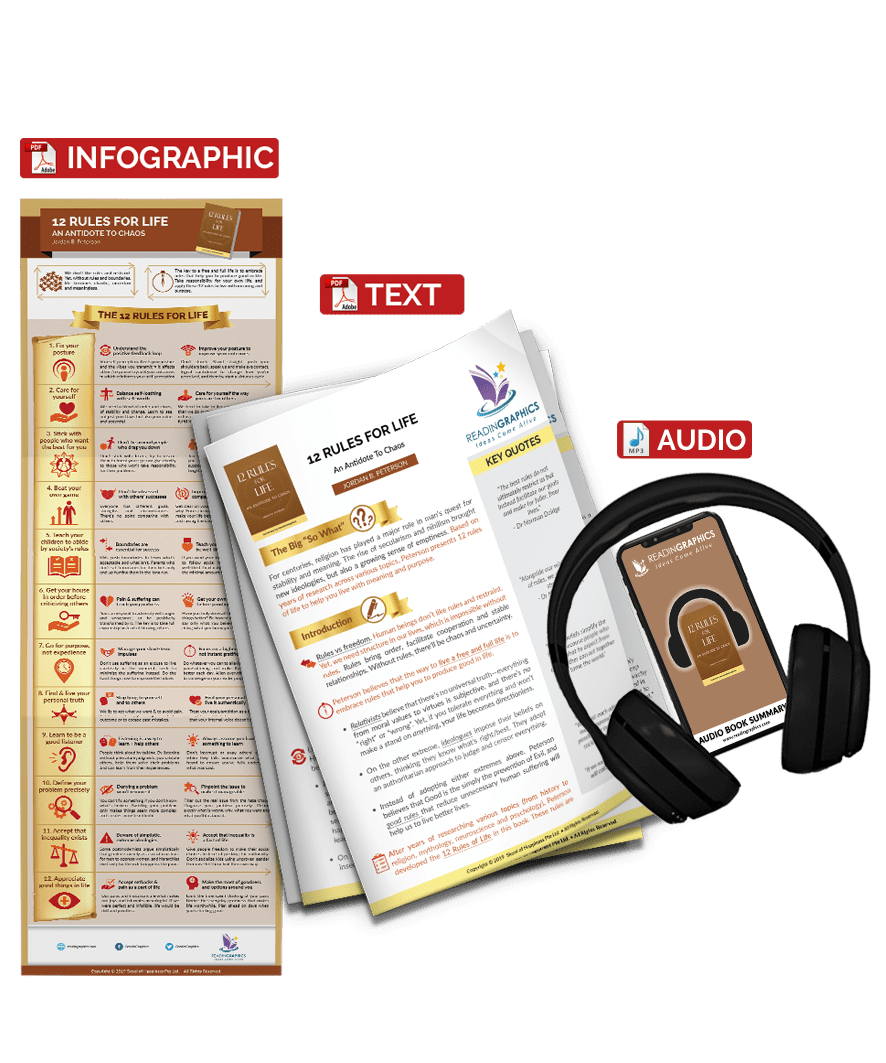
Ready to zoom in on the details of all 12 rules above, embrace the path of life, and discover your potential without challenge? Do check out our 12 Rules for Life book summary bundle. This includes an infographic, 15-page text summary, and a 26-minute audio summary.
In the book, Jordan Peterson shares (in great detail) a range of personal stories and perspectives, his interpretation of Biblical and mythical stories, references to and citations from various ancient texts, philosophers, psychologists, etc., to explain how he arrived at the 12 rules for life. You can check out more details at jordanbpeterson.com.
Also, check out our Beyond Order summary for 12 more rules to help you embrace chaos in times of turbulence!

12 Rules For Life Chapters
See All Chapters (Click to expand)
Our summaries are reworded and reorganized for clarity and conciseness. Here’s the full chapter listing from 12 Rules for Life by Jordan Peterson, to give an overview of the original content structure in the book.
- Rule 1: Stand up straight with your shoulders back
- Rule 2: Treat yourself like someone you are responsible for helping
- Rule 3: Make friends with people who want the best for you
- Rule 4: Compare yourself to who you were yesterday, not to who someone else is today
- Rule 5: Do not let your children do anything that makes you dislike them
- Rule 6: Set your house in perfect order before you criticize the world
- Rule 7: Pursue what is meaningful (not what is expedient)
- Rule 8: Tell the truth, or, at least, don’t lie
- Rule 9: Assume that the person you are listening to might know something you don’t
- Rule 10: Be precise in your speech
- Rule 11: Do not bother children when they are skateboarding
- Rule 12: Pet a cat when you encounter one on the street
12 Rules For Life: The Antidote to Chaos [Publication Year: January 1, 2018/ ISBN: 9780241351635]
About the Author of 12 Rules For Life
12 Rules For Life: An Antidote To Chaos was written by Jordan B. Peterson (born 1962)—a Canadian clinical psychologist and a professor of psychology at the University of Toronto. He holds bachelor’s degrees in political science and psychology from the University of Alberta and a Ph.D. in clinical psychology from McGill University. Peterson was a post-doctoral fellow at McGill, before becoming an assistant professor, then an associate professor, at Harvard University. He moved back to Canada in 1998.
12 Rules For Life Quotes
“If we each live properly, we will collectively flourish.”
“Circumstances change, and so can you.”
“You need to place one foot in what you have mastered and understood and the other in what you are currently exploring and mastering…That is where meaning is to be found.”
“What you aim at determines what you see.”
“Freedom—even the ability to act—requires constraint.”
“Have some humility. If you cannot bring peace to your household, how dare you try to rule a city?”
“True thinking is rare—just like true listening.”
“If you will not reveal yourself to others, you cannot reveal yourself to yourself.”
“Not thinking about something you don’t want to know about doesn’t make it go away.”
“Perhaps happiness is always to be found in the journey uphill, and not in the fleeting sense of satisfaction awaiting at the next peak. Much of happiness is hope, no”
Click here to download the 12 Rules for Life summary & infographic
Frequently Asked Questions
What are the 12 Simple Rules for Life?
Jordan B. Peterson’s book, “12 Rules for Life: An Antidote to Chaos,” shares twelve straightforward principles for living a meaningful and responsible life. He mixes psychology, philosophy, and personal stories to help guide people toward finding order, discipline, and purpose, especially in a world that often feels chaotic.
What is the summary of the 12 Rules for Life?
The book emphasises the importance of personal responsibility, self-improvement, and having moral integrity as the way to a fulfilling life. Peterson believes that true meaning comes when we face our struggles, tell the truth, and work on making ourselves and our surroundings better.
Is 12 Rules for Life hard to Read?
It’s got some challenging bits since it includes academic references, religious themes, and deep philosophical ideas. But the stories and relatable examples help make the points easier to understand for most readers willing to dive in.
What is the Rule 1 of the 12 Rules of Life?
Rule 1 is “Stand up straight with your shoulders back.” It highlights the idea that having a confident posture is a way to take responsibility for your life and confront challenges, which can change how you feel inside and how others see you.
Are there any controversial ideas or critiques of the book?
Some people think that particularly his views on gender roles and social hierarchies lean too traditional or get a bit politically charged. On the flip side, others appreciate his insights on promoting accountability and resilience.
What are some key takeaways in the 12 Rules for Life?
Key takeaways from “12 Rules for Life” include embracing responsibility, choosing truth over comfort, getting your own life in order before judging others, and focusing on meaning instead of just chasing happiness. The main message is that having order, discipline, and moral courage is what leads to a life filled with purpose.






This is not what Jordan Peterson’s rules are about…
does he really teach relativism in the chapter titled “tell the truth or at least don’t lie”