Many organizations struggle to innovate. They rely on market research, bet on untested technology, or tweak existing products, only to end up with ideas that feel incremental or disconnected from what people truly want. In this book, Tim Brown presents IDEO’s proven framework for design thinking to help you uncover real needs and turn them into solutions people will actually embrace. In this free Change by Design summary, we’ve distilled the book’s key insights on design thinking.
In essence, this summary will cover:
- What is the Change by Design Methodology?
- Understanding Design Thinking
- Applying Design Thinking for Systemic Change
- Getting the Most from Change by Design
- Change by Design Chapters
- About The Author of Change by Design
- Change by Design Quotes
Let’s dive straight into it!
What is the Change by Design Methodology?
Design thinking is a practical, people-first method to tackle tough problems. It focuses on uncovering hidden needs, generating novel ideas, testing them quickly, and refining them into solutions that people will adopt and love.
Most organizations fall into 3 common innovation traps. They:
- Start with budgets or constraints, which leads to safe, incremental ideas;
- Bet on new technology without knowing if it solves a real problem; or
- Use market data to guess what customers want, instead of engaging directly with people.
In this book, Tim Brown (former CEO of IDEO) explains how to apply design thinking to challenge assumptions, reimagine offerings, transform organizations, and even tackle complex social challenges.
Whether you’re leading a company, designing products, or driving social change, you can use the mindset and tools to design for impact.
In this free Change by Design summary, you will:
- Get an overview of design thinking frameworks, processes, and success factors; and
- Learn how to apply design thinking at individual, organizational, and social levels.
More detailed frameworks, examples, and practical tips can be found in our full 14-page Change by Design book summary bundle (with text, infographic and audio formats).
Understanding Design Thinking
Design thinking is a flexible, human-centered approach that can create meaningful, innovative solutions across entire systems.
In the 1970s, cataract blindness was widespread among India’s rural poor. After studying the problem closely with his team, Dr. Govindappa Venkataswamy (“Dr. V”) found that traditional hospitals were either too costly or intimidating for rural patients.
Following a human-centered approach, they took user needs into consideration and built a different model.
- They manufactured ultra-low-cost lenses in-house for just $5 (compared to $200 for imported ones).
- They built simple wards with concrete floors and mats (to match the local culture) and delivered fast, reliable surgeries at scale.
The result was a financially sustainable system that helped millions to restore their sight and escape the trap of poverty.
That is the essence of design thinking: starting with real human experiences, then crafting holistic solutions that combine product, service, and environment to meet the user needs.
DESIGN THINKING FUNDAMENTALS
Here’s a visual summary of design thinking principles and foundations.
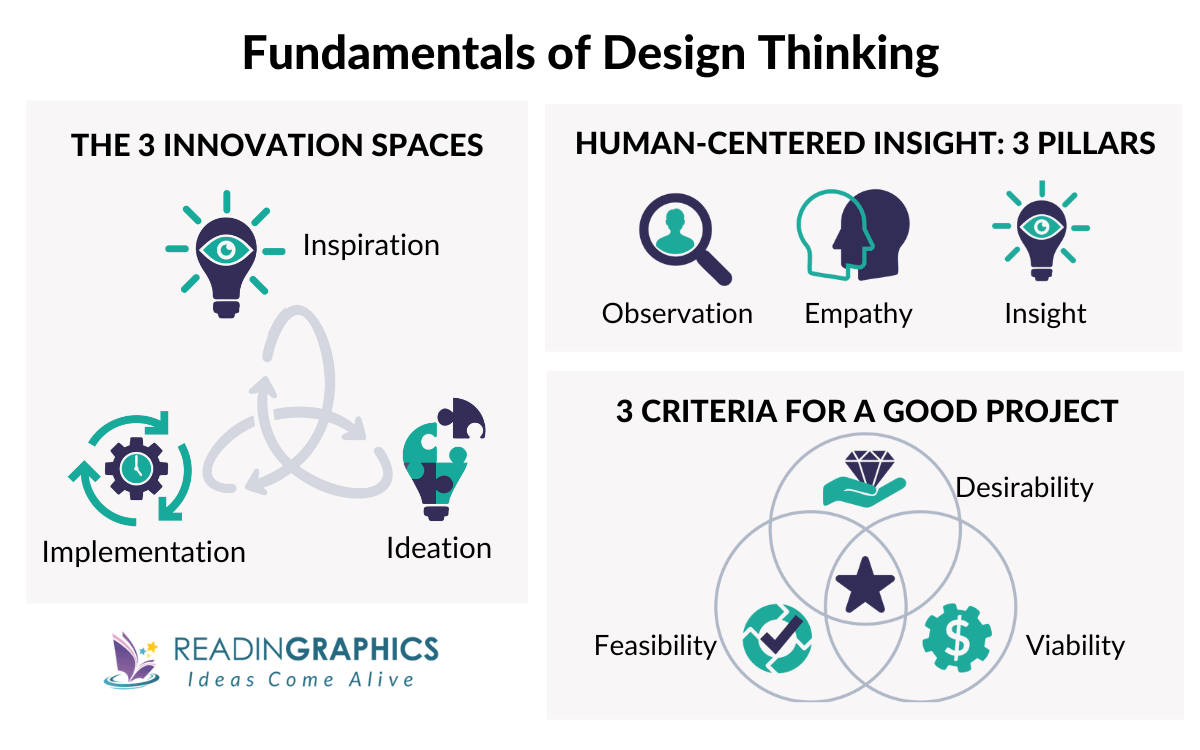
Innovation doesn’t move in a straight line. An idea must be revisited and refined repeatedly before it becomes an effective solution.
Innovation involve 3 overlapping spaces:
- Inspiration Space: Finding new insights and opportunities by observing and engaging with people.
- Ideation Space: Creating, combining, and refining possible solutions.
- Implementation Space: Bringing the most promising ideas to life and into people’s hands.
The goal of design thinking is to uncover what people truly need and translate those needs into solutions that fit their lives.
There are 3 pillars to uncovering human-centered insights:
- Observation. Spend time where users live, work, and play, to watch what they say or do (or what they don’t say or do). Implementing the process of rigorous examination, you can discover unspoken needs by studying how people improvise fixes or little workarounds in their daily lives.
- Empathy: Data is useless without empathy—the ability to step into others’ shoes and feel their frustrations and motivations.
- Insight: Synthesize what you’ve learned (observations) and empathy to understand latent needs and come up with functional ideas that also carry an emotional meaning.
In our complete 14-page book summary, we go deeper into:
- Specific examples: such as how IDEO’s design process was applied to redesign kitchen tools for Zyliss, or how IDEO’s Kristian Simsarian feigned injury to experience an emergency room as a patient (to capture the customer journey on a hidden camera, then use the findings to create the ER customer experience).
- Other details including: the 3 layers to the user experience, the advantage to using conventional research tools as well as the 3 criteria behind a good solution that improves customer experience.
KEY SUCCESS FACTORS
The innovation process might seem chaotic and uncertain. To succeed, you need the right mindset, tools, and processes. In our full Change by Design summary, we elaborate on each of these success factors in detail.
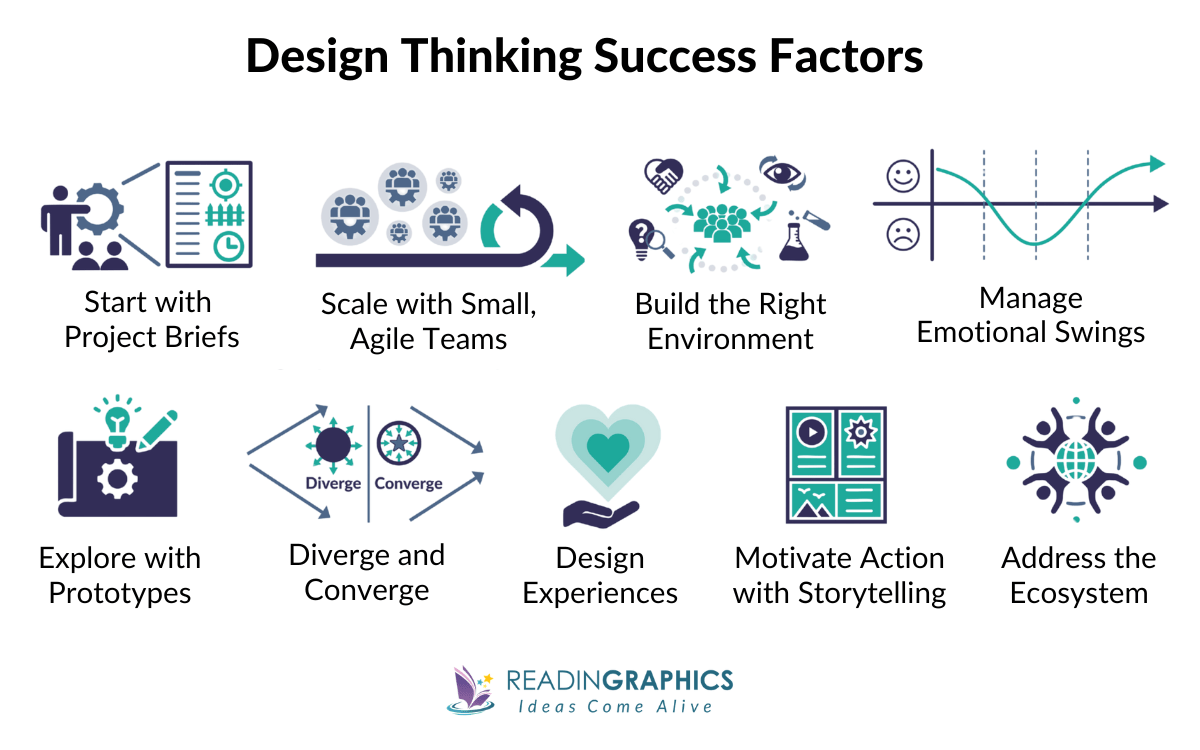 Here’s a quick overview:
Treat every problem as a finite project.
A problem-centric approach focuses on fixing what’s broken, while a project-centric approach focuses on creating something new within clear boundaries.
Scale up gradually with teams of small, agile teams:
Build small, multidisciplinary teams that bring diverse skills and perspectives, collaborate closely and learn quickly.
Help teams persist through emotional ups and downs:
The innovative process is by nature fluid and unpredictable. To achieve breakthroughs, teams must navigate and endure the emotional highs and lows.
Cycle between convergent thinking and divergent thinking:
- Divergent thinking: Expand choices by generating a wide range of ideas, possibilities, and alternatives.
- Convergent thinking: Narrow down the choices, analyze options, and select the most promising directions.
Explore ideas using prototypes:
Prototyping helps to make ideas tangible, so they can be tested, discussed, and improved.
Other Success Factors:
Our full 14-page Change by Design summary also offers a more detailed breakdown along with examples on how you can:
- Build the right environment;
- Build meaningful customer experiences that they can co-create;
- Use storytelling to turn breakthrough ideas into something real, memorable and contagious; and
- Apply design thinking at a systems level to create a lasting impact.
Applying Design Thinking for Systemic Change
The true potential of design thinking goes beyond isolated solutions. By understanding latent needs, adopting a systemic perspective and co-creating with stakeholder, and testing and refining ideas quickly, it can create sustainable solutions at individual, organizational and social levels. Here’s a quick overview of how you can implement design thinking to improve user experience–more details can be found in our full Change by Design summary.
ORGANIZATIONS: Embed Innovation into Organizational DNA
In large corporations, the real challenge is to embed design thinking mindsets and practices so continuous innovation to address social issues becomes the norm organization-wide.
In our complete Change by Design summary, you’ll learn more on:
- How to achieve need organization-wide adoption for long term success
- Benefits of an innovative culture
- Why leaders must set the tone
- How to use physical spaces and creative tools to impact innovation and culture,
- How to manage innovation as a portfolio across 4 quadrants (from incremental improvements to evolutionary and revolutionary offerings)
We also share the example of how Kaiser Permanente successfully implemented this methodology and spread of design thinking across the entire healthcare system.
SOCIETY: Collective Action & Activism
Design activism applies design thinking to society’s hardest challenges from health to education, poverty, and climate. Often, the biggest opportunities lie in places of greatest need, like underserved communities, or people facing severe poverty. Check out our full Change by Design summary bundle for more details and examples such as:
- How social design works to create long-term, systemic change;
- Why we need a shift in mindset from provider to partnership;
- How to trigger change more easily by understanding human behavior and building on existing habits; and
- How we can make use of design thinking to drive large-scale change and solve complex problems from education to climate change.
PERSONAL: Designing a Meaningful Life
Design your life like a prototype. Continually, experiment, learn, and adapt. And in doing do, you can improve upon the design thinking through observation for hidden opportunities and though sharing and collaborative processes.
Getting the Most from Change By Design
Design thinking offers both the mindset and toolkit for innovation in any field. By applying the ideas above, you can design impactful solutions, reimagine organizations, tackle social challenges, and even design a more meaningful life. If you’d like to zoom in on the ideas above and get more detailed insights, examples and actionable tips, do check out our full book summary bundle that includes an infographic, 14-page text summary, and a 26-minute audio summary.
Besides the core insights distilled in this summary, the book is packed with many stories, case studies, and insights from IDEO’s projects, from Shimano’s coasting bikes
to prototyping the first Apple computer mouse, to other stories of design sprints and competitions. For more details, can purchase the book here or visit designthinking.ideo.com.
The Change By Design book rates 4.4 stars on Amazon (648 reviews), and 3.9on Goodreads.
Looking for more resources to learn how to improve your design thinking and create solutions people will actually embrace? Check out these powerful summaries:
- The Back of the Napkin: Learn how to use simple sketches to solve complex problems or explain your ideas persuasively!
- The Innovator’s Dilemma: Discover how to stay relevant in face of unexpected competition!
- Sprint: Find and test the solution to any problem or challenge within 5 days!
Who Should Read This Book:
- Business leaders, managers, and entrepreneurs who want to embed innovation into their organizations and create solutions through collaborative processes that resonate with people.
- Designers, consultants, and professionals in strategy or product development who want a structured framework for product innovation and user-centered design.
- Educators, policymakers, and social innovators who want a human-centered approach to tackle systemic issues and bring about service innovation in health, education, poverty, or public sectors.

Change by Design Chapters
Our summaries are reworded and reorganized for clarity and conciseness. Here’s the full chapter listing from Change by Design by Tim Brown, to give an overview of the original content structure in the book.
See All Chapters (Click to expand)
Part I – What is Design Thinking?
1. Getting Under Your Skin, or How Design Thinking is About More Than Style
2. Converting Need into Demand, or Putting People First
3. A Mental Matrix, or “These People Have No Process!”
4. Building to Think, or The Power of Prototyping
5. Returning to the Surface, or The Design of Experiences
6. Spreading the Message, or The Importance of Storytelling
Part II – Where Do We Go From Here?
7. Design Thinking Meets the Corporation, or Teaching to Fish
8. The New Social Contract, or We’re All in This Together
9. Design Activism, or Inspiring Solutions with Global Potential
10. Designing Tomorrow—Today
About the Author of Change By Design
Change by Design: How Design Thinking Transforms Organizations and Inspires Innovation [Publication year: March 5, 2019/ Edition: Hardcover-Illustrated /ISBN: 978-0062856623] is written by Tim Brown.
He is the Chair Emeritus of IDEO (a global design and innovation firm) and co-founder and chief evangelist of Neol. As a long-time leader at IDEO, he has worked with organizations across industries to apply human-centered design to products, services, and systems. Brown is widely recognized as one of the pioneers who helped bring design thinking into the mainstream of business and social innovation. He has written and spoken extensively on creativity, leadership, and the role of design in tackling global challenges.
Change By Design Quotes
“People are so ingenious at adapting to inconvenient situations that they are often not even aware that they are doing so.”
“Our real goal…is helping people to articulate the latent needs they may not even know they have, and this is the challenge of design thinkers.”
“Great design thinkers hold multiple ideas in tension and embrace the mess, because complexity is the most reliable source of creative opportunities.”
“Design is now too important to be left to designers.”
“Design thinking is rarely a graceful leap from height to height; it tests our emotional constitution and challenges our collaborative skills, but it can reward perseverance with spectacular results.”
“Analysis and synthesis are the yin and yang of good design.”
“Prototypes are always inspirational…because it inspires new ideas.”
“An experience must be as finely crafted and precision-engineered as any other product.”
“A new idea will have to tell a meaningful story in a compelling way if it is to make itself heard.”
“Logic makes us think, but emotion makes us act.”
Click here to download the Change By Design infographic & summary