Ego is a key obstacle to personal growth and success in any phase of life. Whether you are just setting out, sitting at the pinnacle of success, or reeling from a precipitous fall, you must subdue your ego if you wish to capitalize on your opportunities and gifts. In this free Ego is the Enemy summary, we’ll outline insights by Ryan Holiday on how we can master our ego to achieve personal success.
This summary will cover:
- What is the book Ego is the Enemy About?
- What is the lesson from Ego is the Enemy?
- Lesson 1: Ego And Aspiration
- Lesson 2: Ego And Success
- Lesson 3: Ego And Failure
- Getting the Most from Ego is the Enemy
- Ego is the Enemy Chapters
- About The Author of Ego is the Enemy
- Ego is the Enemy Quotes
- Frequently Asked Questions
Let’s dive straight into it!
What is the book Ego is the Enemy About?
In this book, Holiday shares the deep insights about ego which he has developed through his personal experience and extensive research.
By 25 years of age, Holiday had achieved considerable career progress with all the trappings of success, from material success to press coverage and influence. Then, things fell apart and he lost his reputation, businesses, wealth, promoters and admirers. As he struggled to reconcile who he was without those success symbols, he realized that his ego had been his worst enemy—it had deceived him, set him up to fail and kept him from rebounding from failure.
He hopes that the pearls of wisdom derived from stoic philosophy will help you to make the right decisions at the critical junctures of your life.
We’ll now outline some of these ideas below. Do get a copy of our full Ego is the Enemy summary for more details.
What is the lesson from Ego is the Enemy?
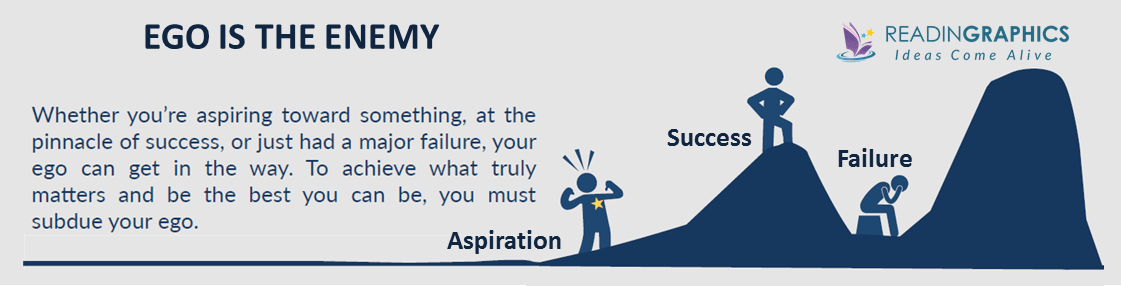
In the context of this book, ego refers to the belief that we’re special and better than we really are. It’s an inflated sense of self that wraps us in fantasy and blinds us to the truth about ourselves.
Mastering your ego doesn’t mean denying your talents or individuality. It’s about putting aside the sense of superiority so you become connected and grounded in reality, and can be confident without being arrogant. This frees you up to focus on your inspiration or mastery, so you’ll achieve even more.
Everyone goes through 3 experiences:
- Aspiration,
- Success
- Failure
Holiday draws on the philosophies of stoic thinkers, not only explaining how ego can get in the way at each phase but he also offers practical ways to do something about it in the long term.
We’ll now zoom in on 1 key idea at each phase and briefly outline the rest. You can get more details from our complete 14-page summary.
Lesson 1: Ego and Aspiration
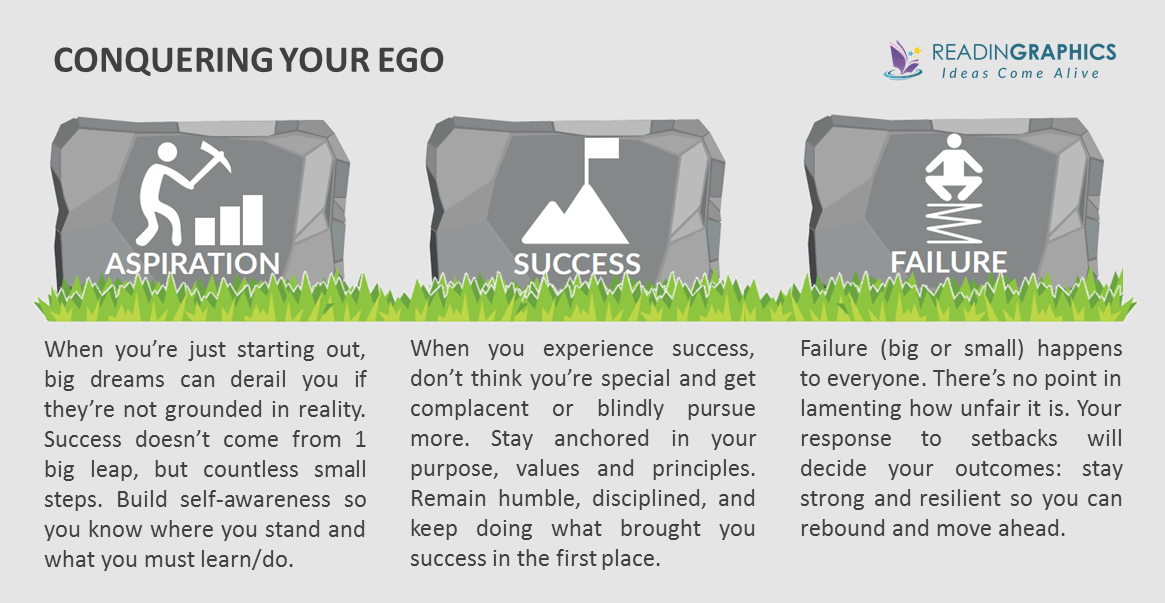
When you’re just starting out, your ego can be an obstacle if you think you already have what it takes and know exactly what to do. You end up focusing on appearances instead of objectively examining the situation, addressing your shortfalls and doing the hard work with humility and patience.
Remember: Success doesn’t come from 1 big leap, but a series of small, iterative steps. It’s ok to have a big vision so long as you take the small, concrete steps to move toward your goal.
Talk is Cheap
Big talk is no substitute for action and only hinders results. You can’t chatter and think deeply at the same time. Talking exhausts valuable time and energy which could’ve been better spent on brainstorming, planning, learning, or problem-solving.
People also use talk to escape from the difficult tasks at hand—they spend so much time talking about something that they think they’ve done the work or put in their best effort when they haven’t done anything of value.
In 1934, author Upton Sinclair was running for the governor of California. He wrote a book that detailed his political exploits as the governor as if they were already accomplished. Having exhausted his inspiration on the book, he lost the election by a huge margin.
Social media only encourages us to “talk” more. It’s easier to post and tweet about how well we’re doing rather than actually do the work. We end up looking great but not getting any real results.
Silence is a mark of strength, not weakness. People who need validation will keep talking about how great they are. People who’re strong and confident will quietly do the work and let the results speak for themselves.
How to manage your ego while aspiring toward your goals?
In our full Ego is the Enemy summary, we also explain why/how you should:
- Focus on substance over image: titles, accolades and fame do not equate greatness.
- Be a lifelong student: be open to feedback and remain humble, curious and observant.
- Focus on purpose (not passion): both John Wooden and Eleanor Roosevelt were well known for putting this into action.
- Be an ace apprentice: to achieve professional growth work your way from the bottom up.
- Maintain self-control: even when faced with external obstacles likes prejudice and mistreatment, learn to stay calm and restrain yourself.
- Stop living in your head: visualizing goals is an important aspect to achieve success but so is maintaining the ability to take concrete actions.
- Embrace humility: don’t fall into the trap of thinking you’re better than you are.
- Keep doing the work: In order to make your aspirations a reality, don’t just fake it till you make it. Put in the effort.
Lesson 2: Ego and Success
Once you’ve achieved some success, it’s normal to feel a sense of pride and accomplishment. The danger comes when you start believing that you’re special and above the rules. Ego can make you complacent (you think you’ve “arrived”) or push you to blindly pursue more so you stop doing what brought you success in the first place.
No matter how much you’ve achieved, stay anchored in your purpose, values and principles, and remain humble and disciplined.
Keep Learning
With each success (e.g. getting promoted to a bigger role or growing your business to a new level), you’ll face new challenges. To stay successful, you must keep learning, improving and adjusting.
The higher we rise, the more we see and realize how much we don’t know. Yet, ego pushes us to pretend to know, or to confine ourselves to a niche where we won’t be challenged. This is also supported by the 2023, Current Psychology publication which you can read here: Do Bigger Egos Mean Bigger Presence?
Ghenghis Khan was one of the greatest conquerors and military minds in history because he was a lifelong student. With each culture he conquered, he broadened his knowledge of warfare and learned ideas and technologies from smart people like astrologers, doctors, and scribes.
Learn from everyone and everything. Read up on a totally new subject, learn from both your friends and foes, and sharpen how you learn.
How to manage your ego while you’re experiencing success?
In our 14-page Ego is the Enemy summary, we also explain why/how you should:
- Focus on facts (not stories): a tactic that allowed Coach Bill Walsh to transform his team from the worst in football history to super bowl champions.
- Know what truly matters (so you don’t get derailed): how William Sherman succeeded in retiring comfortably after his union victory
- Manage your changing roles and responsibilities: delegate tasks for effective time management.
- Avoid the “Disease of Me”: the taste of victory can lead successful teams/people towards hubris.
- Connect with the big picture: the belief of Stoic thinkers that going beyond yourself is the only way to derive true meaning.
Maintain your sobriety: avoid getting deceived by the trappings of success.
Lesson 3: Ego and Failure
Failure (big or small) happens to everyone. There’s no point in lamenting how unfair it is. Your response to setbacks will decide your outcomes: stay strong and resilient so you can rebound and move ahead.
John Kennedy Toole took his life after his manuscript for “A Confederacy of Dunces” was repeatedly rejected. His mother eventually got the book published and it won the Pulitzer Prize. The material was the same; what differed was their response.
Exploit Your Downtime
Failure can disrupt our lives and bring things to a standstill. You can use your downtime to wallow in self-pity or to improve yourself.
After landing in prison at 21 years old, Malcolm X decided to use this time to self-study. His time in prison ended up paving the foundation for his future success.
Furthemore, when Ian Fleming was put on bed rest, doctors forbade him to even use a typewriter. So, Fleming started writing with a pen and produced his well-loved fantasy Chitty-Chitty Bang-Bang.
When you’re hit with failure, don’t dwell on the problems, hide from them, or plot revenge. Reflect on how your choices have led to where you are, and use what you have to turn things around.
How to manage your ego when you’ve experienced failure?
In our full 14-page summary, we also explain why/how you can:
- Do your best and release the rest: don’t let negative reactions of others affect the effort you put in.
- Rebound from rock bottom: even if it hurts, use the crises in your life to find ways to grow.
- Stop making things worse: how John DeLorean gave in to his ego when his business started failing and became the architect of his own destruction.
- Establish your own standards (vs living by others’ standards): maintain an inner scorecard instead of focusing on standards that those around you might set.
- Choose love over hate: don’t waste time and resources by focusing on the hurt and blame when things go wrong.
So there you are, a quick overview of how ego is your enemy during aspiration, success and failure, and what you can do to conquer it.
Getting the Most from Ego is the Enemy
In this article, we’ve briefly outlined some of the key insights and strategies you can use to achieve desired change. For more examples, details, and actionable tips to apply these strategies, do get our complete book summary bundle which includes an infographic, 14-page text summary, and a 25-minute audio summary.

This book is a compilation of many stories and citations from famous people and philosophers to show how Ego shows up in each of the 3 areas above. In this article, we’ve only given a brief outline with selected examples. You can purchase the book here for the full details, or check out more resources/details at egoistheenemy.com.
Ego is The Enemy book rates 4.6 stars on Amazon (20,690 reviews).
Want more from Ryan Holiday?
Learn about the art of turning Trials to Triumph and make obstacles work for you in our free summary for The Obstacle is the Way
Want to learn how to master your thoughts, desires and actions through self-discipline and learn true meaning and freedom? Check out our free Discipline is Destiny summary!
Looking for more? Discover the proven secrets to success through positive change from within with our The 7 Habits of Highly Effective People summary!

Ego is the Enemy Chapters
Our summaries are reworded and reorganized for clarity and conciseness. Here’s the full chapter listing from Ego Is The Enemy by Ryan Holiday, to give an overview of the original content structure in the book.
See All Chapters (Click to expand)
• The Painful Prologue
• Introduction
PART I. ASPIRE
• Talk, Talk, Talk
• To Be or To Do?
• Become a Student
• Don’t Be Passionate
• Follow the Canvas Strategy
• Restrain Yourself
• Get Out of Your Own Head
• The Danger of Early Pride
• Work, Work, Work
• For Everything That Comes Next, Ego Is the Enemy . . .
PART II. SUCCESS
• Always Stay a Student
• Don’t Tell Yourself a Story
• What’s Important to You?
• Entitlement, Control, and Paranoia
• Managing Yourself
• Beware the Disease of Me
• Meditate on the Immensity
• Maintain Your Sobriety
• For What Often Comes Next, Ego Is the Enemy . . .
PART III. FAILURE
• Alive Time or Dead Time?
• The Effort Is Enough
• Fight Club
• Moments
• Draw the Line
• Maintain Your Own Scorecard
• Always Love
• For Everything That Comes Next, Ego Is the Enemy . . .
EPILOGUE
• What Should You Read Next?
• Selected Bibliography
• Acknowledgment
Ego Is The Enemy: The Fight To Master Our Greatest Opponent [Publication year: June 14, 2016/ISBN:978-1591847816]
About the Author of Ego is the Enemy
Ego Is The Enemy: The Fight To Master Our Greatest Opponent is written by Ryan Holiday–an American author, marketer, entrepreneur and founder of Brass Check (a creative advisory firm). He began his professional career at the age of 19, and is a media strategist, a former director of marketing for American Apparel and a media columnist and editorat-large for the New York Observer. Holiday has been credited by the New York Times with the increasing popularity of stoicism.
Ego is the Enemy Quotes
“To whatever you aspire, Ego is your enemy.”
“Though we think big, we must act and live small in order to accomplish what we seek.”
“Appearances are deceiving. Having authority is not the same as being an authority. Having the right and being right are not the same either.”
“Greatness comes from humble beginnings; it comes from grunt work.”
“Make it so you don’t have to fake it.”
“We don’t need pity—our own or anyone else’s—we need purpose, poise, and patience.”
“Failure always arrives uninvited, but through our ego, far too many of us allow it to stick around.”
Frequently Asked Questions
What is meant by “ego is the enemy”?
It means our own inflated sense of self can block learning, feedback, and growth. In ‘Ego is the Enemy’, Holiday explains that ego sabotages ambition and success by pushing us to seek validation instead of real progress.
Is Ego is the Enemy worth reading?
Yes, ‘Ego is the Enemy’ is an accessible guide that uses real examples to show how ego can create problems even for talented people. It offers clear, actionable insights to help you stay focused and grounded at any stage of your life or career.
What does Ryan Holiday mean by ego vs healthy confidence?
In ‘Ego is the Enemy’, Holiday defines ego as an inflated sense of self that blinds us to feedback and growth by keeping us focused on recognition. Healthy confidence, however, is grounded in competence and self-awareness.
Why does Holiday claim ego is the main obstacle to success??
Holiday argues that ego blocks progress by making us chase praise and appearances instead of real skill and effort. It stops us from learning from mistakes and ultimately sabotages long-term success by distorting both ambition and failure.
How to tell the difference between ambition and ego?
Ambition aims for growth, mastery, and meaningful goals, while ego-driven ambition chases status and recognition. If we act mainly to prove ourselves rather than improve, our motivation is likely coming from ego.
Click here to download the Ego is the Enemy summary & infographic