
Ever rolled your eyes at someone and thought to yourself “What an idiot”? Well, you are certainly not alone! When someone cannot understand you or behave in totally unexpected ways, you may assume there’s something wrong with them. The truth is, they may simply be different from you. In this book, Thomas Erikson explains how to recognize and communicate with 4 key behavioral profiles. In this Surrounded by Idiots summary, you’ll uncover the key traits, differences, strengths and weaknesses of the 4 types of behaviors, and how to effectively interact with each type.
In essence, this summary will cover:
- What is the main idea of Surrounded by Idiots?
- What are the 4 Personality Types in Surrounded by Idiots?
- Understanding the Four Behavior Types
- Becoming a More Effective Communicator
- Getting the Most from Surrounded by Idiots
- Surrounded by Idiots Chapters
- About The Author of Surrounded by Idiots
- Surrounded by Idiots Quotes
- Frequently Asked Questions
Let’s dive straight into it!
What is the Main Idea of Surrounded by Idiots?
Why are some people so quiet while others talk non-stop? Why are some people always late while others are punctual? Why do you relate naturally to some people but find others irritating? Our behavioral differences come from a mix of internal factors (e.g. personality traits, character, temperaments) and external factors (e.g. environment and situational factors). Understanding why people behave and communicate differently based on these factors can help us improve how we communicate and relate to others.
Our core values and attitudes affect how we behave and who we aspire to become. Our values define what we think is right or wrong (e.g. “It’s wrong to lie” or “Hard work is good”). Our attitudes are the opinions that we develop from our life experiences (e.g. “Salespeople can’t be trusted”).
We also moderate our behaviors (or wear different masks) based on what we think is appropriate for a given situation.
In any communication, what matters isn’t what you say but what the recipients hear and interpret based on their perceptions, biases and frames of reference. To interact more effectively and improve your communication skills, you need to understand:
- Your own tendencies,
- Others’ needs/preferences, and
- How others may perceive your actions,
So you can tailor your approach accordingly.
What are the Four Behavior Types in Surrounded by Idiots?
This book describes 4 behavior types—Dominance, Inducement, Submission, and Analytic (DISA)—which explain the key differences in human behavior and communication. Each of the behavior types or personality styles are associated with a color: Red, Yellow, Green, and Blue.
These behavior types have existed for millennia, i.e. people have been behaving like this for a very long time. For example, you may have heard of the 4 “humors” by Hippocrates or the DISC profile.
Thomas Erikson brings these ideas to life via this behavior classification system that organizes the 4 personality types around 4 colors. Here’s a quick comparison of how Erikson’s 4 color system relate to other common behavior profiling tools, especially the DISC assessment and DISA system.
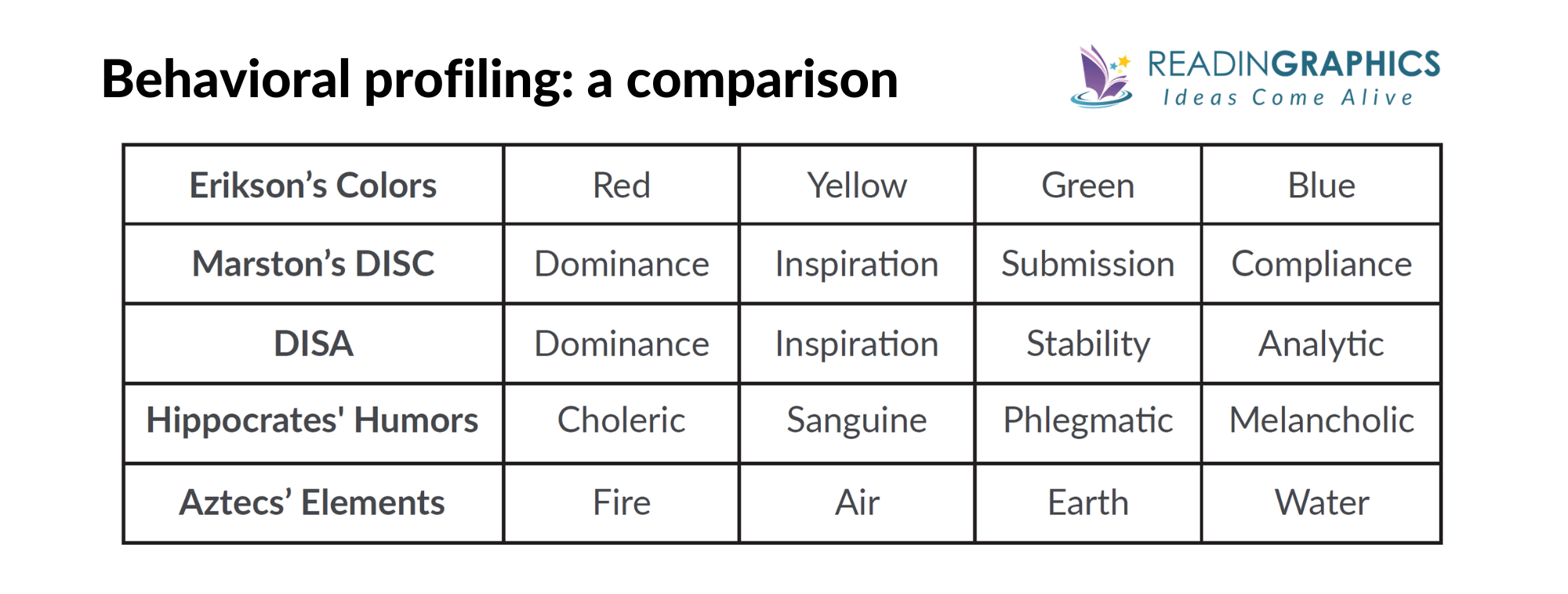
In the complete Surrounded by Idiots summary, we’ll elaborate more on the models above. Simply put, Erikson’s 4 color system is derived from the DISA model: Red for Dominance, Yellow for Inspiration, Green for Stability and Blue for Analytic. This is also similar to DISC method except “C” is replaced by “A” for Analytic.
Understanding the Four Behavior Types
Thomas Erikson’s 4 colors are meant to help us understand why people behave the way they do, not to narrowly compartmentalize people. Here are the 4 behavior types at a glance:
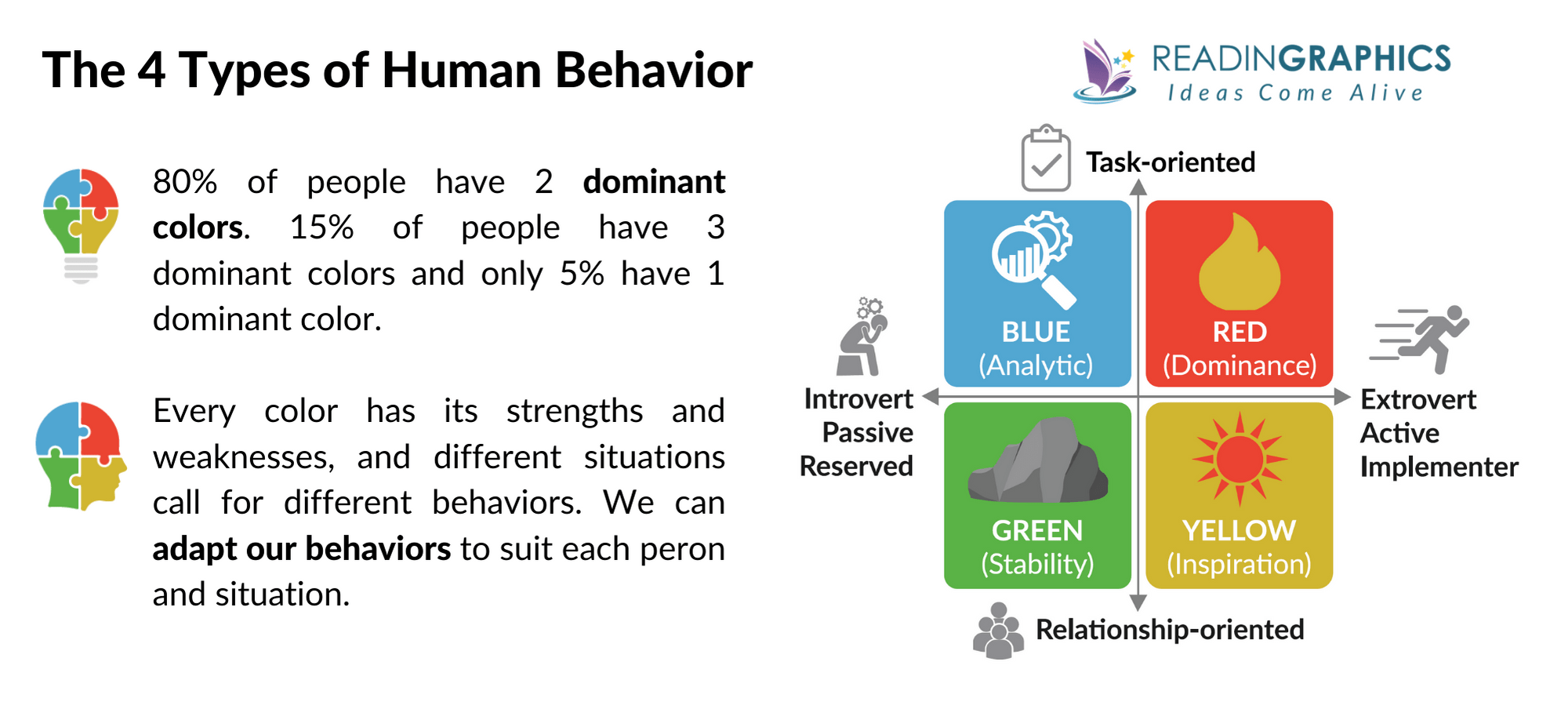
Every color has its desirable and not-so-desirable traits. A quality (e.g. ambition) can be a strength in some situations and a liability in others. Different situations also call for different behaviors. So, treat the behavior patterns as tools that you can use in your social interactions.
It’s impossible to account for all human differences and there will always be exceptions. Moreover, we are capable of adapting our behaviors instead of rigidly sticking to 1 set of behaviors which can lead to improved social interactions, communication and emotional intelligence.
Only 5% of people have 1 dominant color. The majority have >1 dominant color: 80% have 2 dominant colors and 15% have 3 dominant colors. No one seems to have all 4 dominant colors.
For readers interested in the scientific underpinnings of such behavioral models ,you can also check out this 2019 research article on DISC Personality Traits which examines how analytical frameworks can explain complex patterns of human interaction.
Red = Dominance
Reds are driven, ambitious, decisive and dynamic, which makes them natural leaders.
They bring energy and momentum to a team/project, are extremely competitive, work hard, and constantly challenge themselves. Reds are task-oriented and are always on the go. They’re straightforward in their communication and won’t hesitate to state their views.
However, Reds can appear aggressive, impatient, or domineering. They’re so focused on getting things done that they may bulldoze over their team members or leave others behind. They may also interrupt others, assert their views, or seem controlling/confrontational.
Yellow = Inducement
Yellows are positive, creative and sociable.
They are social butterflies: outgoing, popular, and have a huge social network. Yellows are always full of vitality, fun, and laughter, infecting others with their positive energy. They’re also optimistic, resourceful and inspiring.
Of the 4 colors, Yellows are the most animated, expressive and talkative, however, Yellow people can also come across as impulsive, attention-seeking, and overly-verbose. They are bad listeners and tend to dominate a conversation, often spewing ideas or opinions without prior thought or knowledge. Yellow personality types are so fun-loving that they may resist rules, miss deadlines/appointments, and get carried away by excessive optimism.
Green = Stability
Green personality is associated with being calm, stable, and loyal.
They prefer a calm, predictable environment where they can move at a leisurely pace. They’re patient, reliable, great team players, but shy away from the spotlight. They’d avoid conflict wherever possible to maintain harmony and stability.
On the flip-side, Greens may be perceived as stubborn, indifferent or even dishonest. They don’t change their minds or take action until something feels truly “right” for them. The bigger the challenge or problem, the more they hold back. So, they can seem slow or resistant to change.
To avoid conflict, Greens may sit on the fence or speak in vague terms. Even if they disagree with something, they’re unlikely to speak up, preferring to voice their displeasure privately behind your back.
Blue = Analytic
Blues are detail-oriented, analytical and perfectionists who seek to have the right answers to everything.
Blue personality types like to categorize, label and document everything, and do things in a systematic way. You’ll find them using complex spreadsheets and decision-making tools to evaluate a problem from all angles. They will check everything multiple times and insist on contingency plans before taking action.
They don’t speak unnecessarily, preferring to quietly observe and analyze everything around them, however, Blue behavior is also associated with being distant, pessimistic and fastidious. It can be slow and tedious to work with them. They can also appear cold and critical, always asking for evidence, and pointing out risks and problems.
Putting it Together
As you can see, there’s no perfect behavior type. Each color has its strengths and weaknesses. Any quality can backfire if it’s applied in the wrong situation or if it’s taken to an extreme. Moreover, most people have >1 dominant color and may exhibit different traits under different circumstances.
[You may also wish to check out our Strengths Based Leadership summary to see how you can specifically leverage strengths as a team!]Becoming a More Effective Communicator
Now that you know about each of the 4 behavior profiles, you can become more aware of your own tendencies and learn to interact with other people more effectively. A large portion of Thomas Erikson’s book is devoted to real-life application tips.
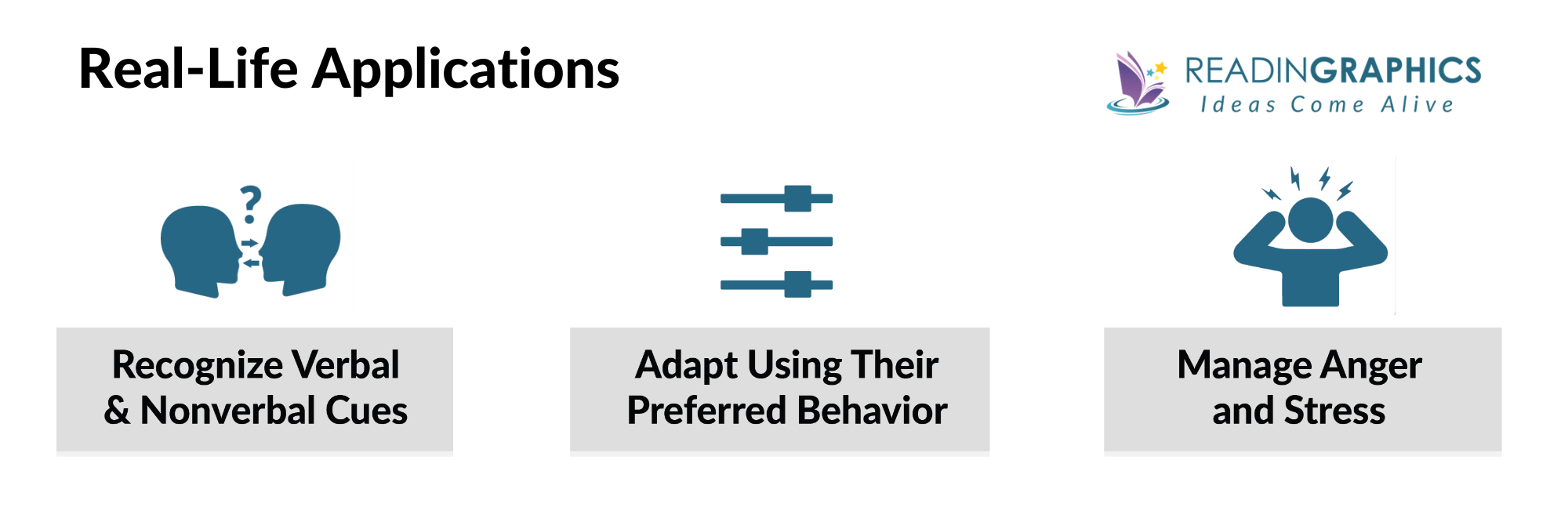
In our complete Surrounded by Idiots summary (get the full 17-page summary here), we’ve organized those insights into the following sections:
- How to recognize and respond to each color type via written communication and body language;
- How to adapt to people who’re not like you;
- How to manage collaboration and group dynamics involving different colors; and
- Understand what angers or stresses out each color type, and what you can do about it.
You can also learn more about effective communication by learning how to identify and manage pivotal conversations to achieve your desired outcomes with our Crucial Conversations summary.]
Getting the Most from “Surrounded by Idiots”
The only way to become fluent at the language of human behavior is to keep practicing it. To start applying the ideas, Thomas Erikson encourages you to try identifying the profile of people around you and experimenting with the various communication approaches and other suggestions in the book. If you wish to truly understand human interaction and achieve positive outcomes when interacting with others, do check out the our full book summary bundle. This includes an infographic, 17-page text summary, and a 30-minute audio summary.
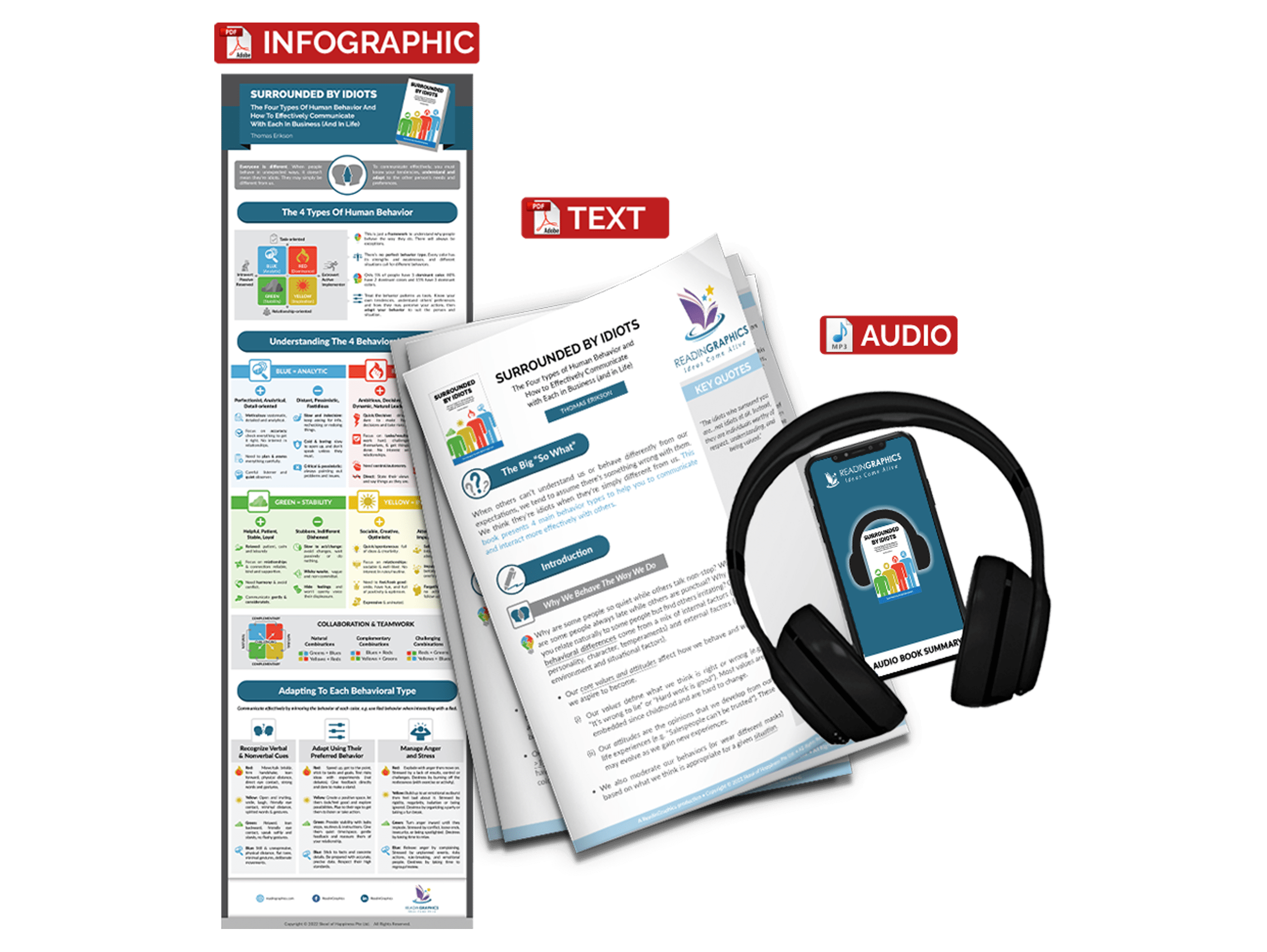
This book is full of examples, personal observations and colorful anecdotes (pun intended) to bring the 4 behavior types to life. It also includes numerous real-life stories and a short quiz. You can purchase the book here or visit surroundedbyidiots.com for more details.
Surrounded By Idiots book rates 4.4 stars on Amazon (13,633 reviews).
Who should read this:
- Business leaders, managers, coaches, trainers and those in people development.
- Anyone who wishes to improve their relationships, communication and people skills.

Surrounded by Idiots Chapters
See All Chapters (Click to expand)
Our summaries are reworded and reorganized for clarity and conciseness. Here’s the full chapter listing from Surrounded by Idiots by Thomas Erikson, to give an overview of the original content structure in the book.
Introduction: The Man Who Was Surrounded by Idiots
1. Communication Happens on the Listener’s Terms
2. Why Are We the Way We Are?
3. An Introduction to the System
4. Red Behavior: How to Recognize a Real Alpha and Avoid Getting in His Way
5. Yellow Behavior: How to Recognize Someone Whose Head Is in the Clouds and Get Him Back to Reality Again
6. Green Behavior: Why Change Is So Difficult—and How to Get Around It
7. Blue Behavior: In Pursuit of Perfection
8. No One Is Completely Perfect: Strengths and Weaknesses—What No One Wants to Talk About
9. Learning New Things: How to Use What You’ve Learned
10. Body Language: Why How You Move Matters—How Do You Really Look?
11. A Real Life Example: The Company Party—How to Understand Everyone You Meet
12. Adaptation: How to Handle Idiots (i.e., Everyone Who Isn’t Like You)
13. How to Deliver Really Bad News: The Challenge of Speaking Your Mind
14. Who Gets Along—and Why It Works: Group Dynamics in Its Finest Form
15. Written Communication: How to Evaluate Someone When You Can’t Meet in Person
16. What Makes Us as Mad as Hell?: Temperament Can Reveal Everything About a Person
17. Stress Factors and Energy Thieves: What Is Stress?
18. A Short Reflection Through History: People Have Always Been Like This
19. Voices from Real Life
20. A Quick Little Quiz to See What You’ve Learned
21. A Final Example from Everyday Life: Perhaps the Most Enlightening Team Project in the History of the World
Surrounded by Idiots: The Four types of Human Behavior and How to Effectively Communicate with Each in Business (and in Life) [Publication year: July 30, 2019 (Audible)]
About the Author of Surrounded by Idiots
Surrounded by Idiots: The Four types of Human Behavior and How to Effectively Communicate with Each in Business (and in Life) was written by Thomas Erikson–a behavioral expert, lecturer, speaker, and author. For more than 20 years, he has been helping people to improve their communication with one another. Erikson has authored several best selling books and developed tools and online courses to facilitate both professional and personal development.
Surrounded by Idiots Quotes
“The idiots who surround you are…not idiots at all. Instead, they are individuals worthy of respect, understanding, and being valued.”
“Communication happens on the listener’s terms…Everything you say to a person is filtered through his frames of reference, biases, and preconceived ideas.”
“Behavior patterns are like a toolbox. All types are needed.”
“No group should be composed solely of individuals of the same type. Diversity is the only possible route. The best way to put a group of people together is by mixing different types of people.”
“Some people become angry because of stress; others become stressed because of anger.”
“Communication is often a matter of adapting to others.”
Frequently Asked Questions
What is the Surrounded by Idiots theory?
The Surrounded by Idiots theory divides people into four types—Red, Green, Yellow, Blue—to simplify behavior and communication. Misunderstandings often arise when we fail to recognize or adapt to these styles.
What is the book Surrounded by Idiots about?
Surrounded by Idiots explains the four color-coded personality types, how to identify them in yourself and others, and offers practical strategies to improve communication, reduce conflict, and work effectively with different personalities.
How can I identify which color personality type I am?
You can identify your personality type by reflecting on your natural behavior, decision-making, and communication style. Surrounded by Idiots outlines traits for each color, helping you see whether you lean more toward ambition, impulsiveness, stubbornness, or perfectionism.
How does knowing your color personality help with communication?
Understanding your own and others’ personality types helps you adjust your communication to reduce misunderstandings and conflict. It also makes teamwork easier by letting you adapt to different styles instead of expecting others to adapt to you.
How does the book suggest managing difficult personalities?
Surrounded by Idiots suggests observing others’ motivations and adjusting your communication to match their needs. By respecting differences without judgment, you can reduce frustration and collaborate more effectively with opposite personality types.
Click here to download the Surrounded by Idiots summary & infographic



Hi There,
I am reading the book from South Sudan, Africa, but the publication I am reading has blank page 62.
Can I get the copy of the said page from you?
I will appreciate.
Thanks a million.