Modern societies frown on the use of force or brutality to gain power over people. Instead, we persuade others by baiting them with pleasure, appealing to their desires, psychology and forming emotional connections. In short, we’re constantly trying to seduce others—or being seduced by others. This book by Robert Greene helps you to see the world through the eyes of a seducer, to master the art of seducing anyone politically, socially, or sexually. In this free version of The Art of Seduction summary, you’ll learn about the key types of seducers, victims, and the 4-part process to seduction.
In essence, this summary will cover:
- What is the book The Art of Seduction About?
- Part 1: Know Yourself and Your Victims
- Part 2: What are the 4 Stages of Seduction?
- Getting the Most from The Art of Seduction
- The Art of Seduction Chapters
- About The Author of The Art of Seduction
- The Art of Seduction Quotes
- Frequently Asked Questions
Let’s dive straight into it!
What is the book The Art of Seduction About?
At its core, this book is a study of human psychology and desire, probing deeply into our universal longing for connection, validation, and control. Robert Greene draws inspiration from historical figures and strategists such as Cleopatra, Casanova, Madame de Pompadour and Kennedy, to bring you into a world where prolific seducers work their magic on individuals and masses alike.
Seduction is a psychological game that can be mastered by anyone. Master seducers cast a long-term spell by winning the love of an individual, a crowd, or even a nation. They see love not as a thing of beauty, but a form of power like a tool to be wielded. If you’re not careful, you could easily find yourself ensnared in their web.
In this free summary, we’ll outline the key ideas in 2 parts:
- Matching your seductive qualities with your victims’ needs; and
- Mastering the 4 phases of seduction.
More details, examples, and actionable insights can be found in our full 20-page version of The Art of Seduction summary.
Part 1: Know Yourself and Your Victims
Every successful seduction involves 2 parts: a seducer and a target. You must wield your strengths as a seducer, and bait your victims effectively by targeting their specific needs.
Know Yourself: The 9 Types of Seducers
There are 9 types of seducers, each with an essential quality that can be highly attractive including physical appearance, charisma, and confidence. Identify your own seductive trait(s) so you can cultivate and leverage them. At the same time, beware of the tendency of anti – seducers that could repel others.
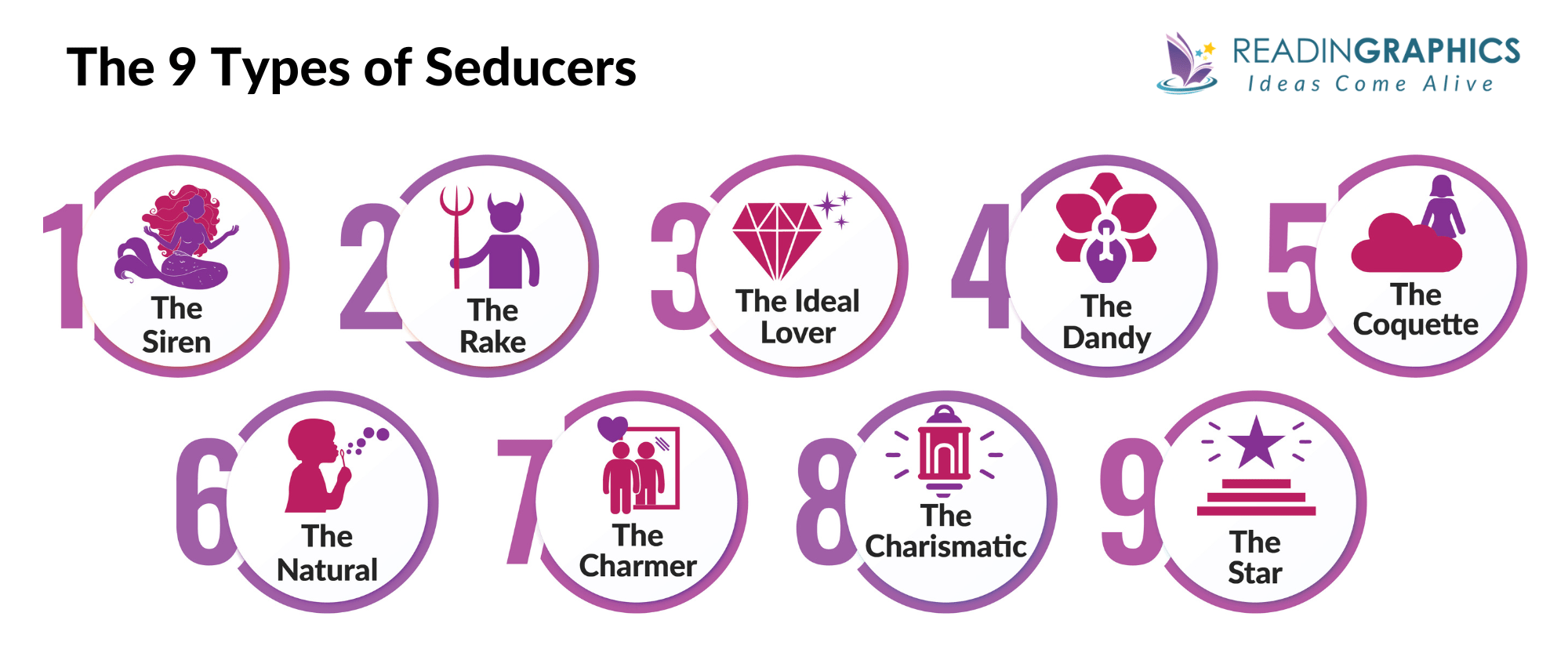
Here are the 9 types of seducers in a nutshell:
- The Siren is usually a woman. She captivates with her a blend of beauty, sexual energy, and enigma, using her voice, body and movements to appear sensual, alluring, yet hinting at danger.
- The Rake is usually a man. He’s bold, wild, passionate, and rebellious—the classic “bad boy.” The Rake goes the extreme for those he desires, offering danger and pleasure with no strings attached.
- The Ideal Lover is a keen observer. He/she identifies the victims’ deepest desires, then gives an illusion of what they want to satisfy their needs and make them feel truly special. They’re like your dream come true.
- The Dandy exhibits a mix of male & female traits. They’re ambiguous, fluid, and radically different, defying all norms and expectations. They embody freedom, creativity, and confidence to capture our imagination.
- The Coquette is a master of the push pull technique. They draw their victims in, then create distance, baiting them with rewards that always remain just out of reach. They seem self-sufficient yet elusive, making them a coveted prize.
- The Natural exhibits a blend of childlike innocence, mischief, wonder, openness, and youthful zest. They play to their victims’ protective instincts, or lure those who are attracted to purity and innocence.
- The Charmer is people-oriented and can adapt to all types of people. They focus on their victims’ pains, moods, and desires, lavishing care and attention so to make others feel special and valued. They are masters at influencing others with subtle suggestions.
- The Charismatic radiates an intense energy and sense of higher purpose that infects people. They use a blend of conviction, magnetic presence, words and theatrics, often with a touch of the uncanny.
- The Star is beautiful, ethereal, distant, and unattainable. They exude a dream-like allure that haunts and stirs people’s imagination. They’re like a blank screen on which others can project their dreams and desires.
In our complete 20-page summary, we elaborate on the seductive traits of each of these 9 seducer types, along with examples such as: Marilyn Monroe, Lou von Salome, Madame de Pompadour, Rudolph Valentino, Gabriele D’Annunzio, and John F. Kennedy.
Anti-Seducers
Anti-Seducers are the opposite of seducers—they repel others with their self-centeredness, insecurity, or lack of subtlety.
Most of us have at least 1-2 anti-seductive qualities. Be aware of those qualities so you won’t accidentally drive others away. At the same time, steer away from anti-seducers or use these traits to keep them at bay.
In our full summary, we’ll explain more about each of these 8 types of anti-seducers: Brutes, Suffocators, Moralizers, Tightwads, Bumblers, Windbags, Reactors, and Vulgarians.
Know Your Victim: The 18 Types of Victims
Everyone has unmet needs, making us all susceptible to seduction. Robert Greene identifies 18 types of victims, each with a primary unmet need. The key to the seduction process is to use the right strategies and maneuvers to target each one:
- Reformed Rakes/Sirens
- Disappointed Dreamers
- Pampered Royals
- New Prudes
- Crushed Stars
- Novices
- Conquerors
- Exotic Fetishists
- Drama Queens
- Professors
- Beauties
- Aging Babies
- Rescuers
- Roués
- Idol Worshipers
- Sensualists
- Lonely Leaders
- Floating Genders
Tailor your approach to match the victim’s needs. If they fall into multiple categories, pinpoint the key unmet need. Avoid victims with the same gap as you, since you can’t fulfill those needs.
A common mistake in the seduction process is failing to identify and address these key differences, which can lead to frustration or failure in capturing their attention and desire.
Part 2: What are the 4 Stages of Seduction?
Seduction is an art and cannot be rushed.The seductive journey involves 4 distinct phases or stages:
(i) Gradually capture their minds,
(ii) Tap into their emotions,
(iii) Awaken their hidden desires,
(iv) Culminate in their physical surrender.
You must patiently worm your way into your target’s heart and mind, always adapting your approach to keep them intrigued while fostering a deep emotional connection that makes them feel seen, valued, and emotionally invested. Check out this 2022 article on Perceived Effectiveness of Flirtation Tactics for scientific insights into how subtle social cues and emotional attunement influence attraction.
These principles apply to politics, business, or mass seduction, and even to everyday life, where influence and persuasion are often key to success in relationships, negotiations, and social interactions.
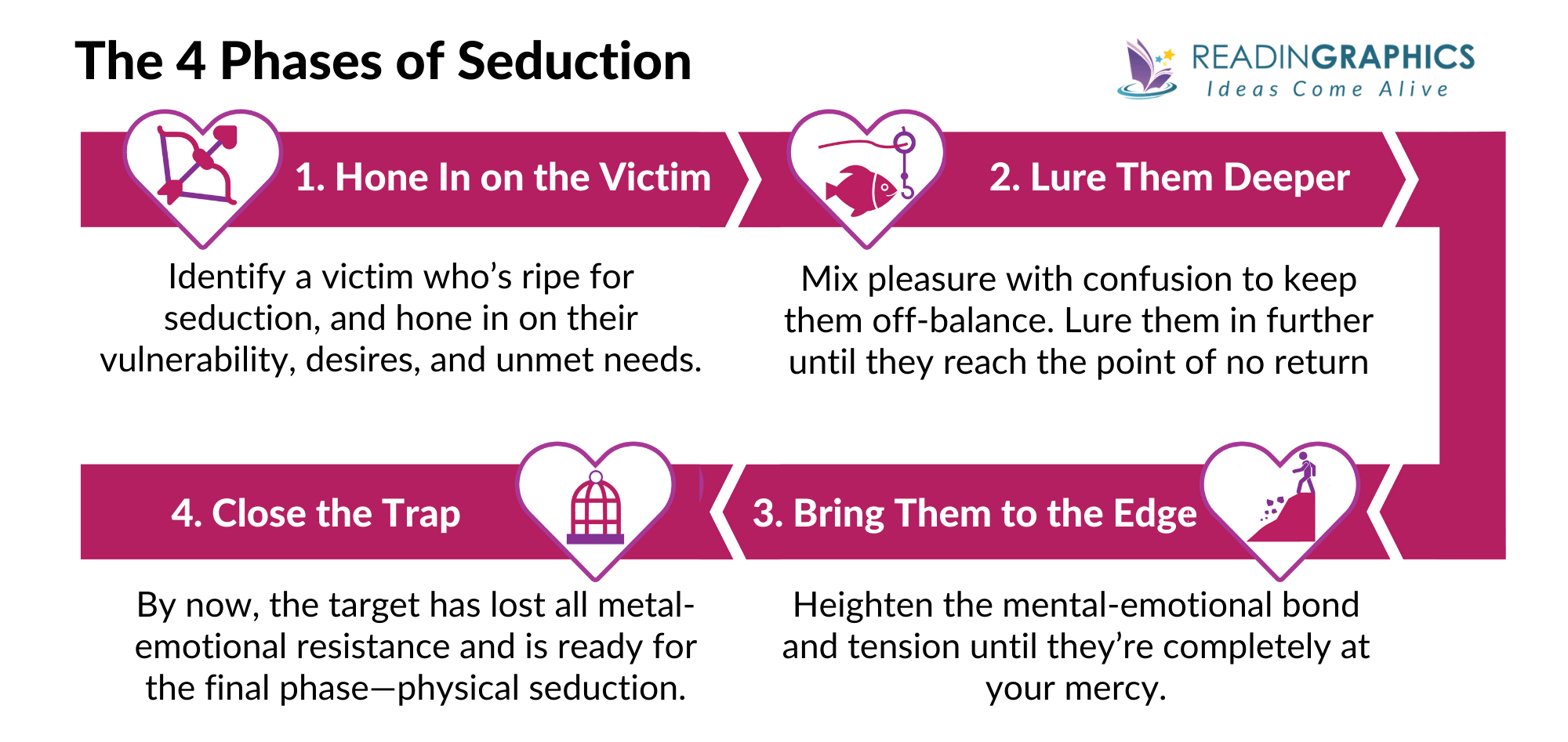
For each of these phases, Greene presents specific tactics you can deploy to gradually reel your target in as part of the seductive process. We’ll just share a broad overview here.
Feel free to check out the book or our full version of The Art of Seduction summary for detailed tips and examples.
Phase 1: Hone in on the Victim
Seduction takes time and effort, so be selective and choose your target wisely. Identify a victim who’s ripe for seduction, and hone in on their vulnerability, desires, and unmet needs.
An ideal seduction target isn’t someone who’s ready to rush into your arms. It is someone who:
- Has a primary need you can fulfill, making them susceptible to your appeal; and
- Has qualities that attract and excite you. This adds spice and energy to the chase.
Once you’ve chosen your victim, draw them in subtly instead of pursuing them directly.
Phase 2: Lure Them Deeper
By now, your victims are intrigued by you, but they can still retreat. Your goal in this phase is to entice them further until they reach the point of no return.
Offer pleasure to keep them yearning for more, and sprinkle in some confusion to keep them off-balance. Focus on becoming the object of desire and employ strategies that reflect the mindset of a successful seducer to maintain their interest and deepen their attraction.
Check out our complete version of The Art of Seduction summary, for specific strategies and tactics to keep them guessing and wanting more.
Phase 3: Bring them to the Edge
Now that you have them properly hooked, heighten the mental-emotional bond and tension, artfully moving your target between hope and despair until they’re completely at your mercy. Create a false sense of security, making them believe they are in control, while you remain the true center of attention.
In our full summary, we’ll touch on strategies/tactics how to win them over with a selfless/gallant act, using regression to evoke deep-seated emotions, create a spiritual connection, and more.
Phase 4: Close the Trap
By now, you’ve conquered your target’s mental and emotional spaces. They have lost all resistance and are ready for the final phase—physical seduction.
This phase is about fanning their sexual desire and ardor until they’re about to lose control, then seizing the moment. However, be mindful of the feeling of guilt that may arise afterwards, as navigating the aftermath may involve either start a fresh round of seduction process or part ways swiftly and gracefully.
Getting The Most from The Art of Seduction
The art of seduction can be applied to all facets of life. To become a great seducer, you must master human psychology and your self-control. If you’re ready to master the art of seduction–or to protect yourself against master seducers–do get more detailed insights, examples and actionable tips from our full book summary bundle. This includes an infographic, 20-page text summary, and a 37-minute audio summary.

The book is packed with detailed stories of various types of seducers and their exploits, such as: Cleopatra, Emma Crouch, Pamela Churchill, Catherine the Great, Elvis Presley, Vladimir Ilyich Lenin, Jiddu Krishnamurti, and Charles de Gaulle. It also includes 2 appendices with additional insights on:
- Suitable settings for seduction; and
- Ways to subtly influence the masses.
You can purchase the book here. For more details and resources visit powerseductionandwar.com.
The Art of Seduction book rates 4.7 stars on Amazon (11,472 reviews).
Learn more about power play in The 48 Laws of Power by Robert Green.
If you prefer a more sincere, authentic approach to human relations, then find out How to Win Friends and Influence People or apply The 5 Love Languages to build deep, loving relationships.
Who Should Read This Book
- Leaders and people want to learn more about psychology, influence, manipulation, or seduction techniques
- Anyone who wants to increase personal awareness and power, and/or protect yourself against others’ manipulation and seduction.

The Art of Seduction Chapters
Our summaries are reworded and reorganized for clarity and conciseness. Here’s the full chapter listing from The Art of Seduction by Robert Greene, to give an overview of the original content structure in the book.
See All Chapters (Click to expand)
Part One: The Seductive Character
The Siren
The Rake
The Ideal Lover
The Dandy
The Natural
The Coquette
The Charmer
The Charismatic
The Star
The Anti Seducer – What to Avoid
The Seducer’s Victims – The Eighteen TypesPart Two: The Seductive Process
Phase One: Separation—Stirring Interest and Desire
1. Choose the Right Victim
2. Create a False Sense of Security – Approach Indirectly
3. Send Mixed Signals
4. Appear to Be an Object of Desire – Create Triangles
5. Create a Need – Stir Anxiety and Discontent
6. Master the Art of Insinuation
7. Enter Their Spirit
8. Create TemptationPhase Two: Lead Astray – Creating Pleasure & Confusion
9. Keep Them in Suspense – What Comes Next?
10. Use the Demonic Power of Words to Sow Confusion
11. Pay Attention to Detail
12. Poeticize Your Presence
13. Disarm Through Strategic Weakness and Vulnerability
14. Confuse Desire and Reality – The Perfect Illusion
15. Isolate the Victim
Phase Three: The Precipice—Deepening the Effect Through Extreme Measures
16. Prove Yourself
17. Effect a Regression
18. Stir Up the Transgressive and Taboo
19. Use Spiritual Lures
20. Mix Pleasure with Pain
Phase Four: Moving In for the Kill
21. Give Them Space to Fall – The Pursuer Becomes the Pursued
22. Use Physical Lures
23. Master the Art of the Bold Move
24. Beware the Aftereffects
The Art of Seduction [Publication year: October 7, 2003 / Edition: Reprint/ ISBN:978-0142001196]
About the Author of The Art of Seduction
The Art of Seduction was written by Robert Greene–an American author best known for his books on strategy, power and seduction Besides this book, he has also written several best-sellers including “The 48 Laws of Power”, “The Art of Seduction”, “The 33 Strategies of War” and “The 50th Law (with rapper 50 Cent)”.
Greene attended the University of California, Berkeley, before finishing his degree at the University of Wisconsin-Madison with a B.A. in classical studies. Before becoming an author, Greene estimates that he worked 80 jobs, including as a construction worker, translator, magazine editor, and Hollywood movie writer.
The Art of Seduction Quotes
“Falling in love is a matter not of magic but of psychology.”
“The Art of Seduction…is an art of war for delicate times.”
“Your greatest power in seduction is your ability to turn away, to make others come after you, delaying their satisfaction.”
“Indulgence is a powerful tool of seduction: it is hard to be angry or defensive with someone who seems to agree with your opinions and tastes.”
“Cheapness signals more than a problem with money. It is a sign of something constricted in a person’s character.”
“Seduction is a kind of theater in real life, the meeting of illusion and reality.”
“An object that is rare and hard to obtain is generally more prized.”
“The difference between normal language and seductive language is like the difference between noise and music.”
“Few have the power to see through an illusion they desperately want to believe in.”
“In seduction, there is absolutely no power in respecting boundaries and limits.”
Frequently Asked Questions
What are the 24 rules of seduction?
The 24 rules of seduction are Greene’s principles for guiding attraction, from choosing a target to creating tension and mystery. They focus on understanding psychology, controlling pacing, and shaping perceptions to build influence.
Is The Art of Seduction worth reading?
The book is worth reading for its insights on influence, charisma, and persuasion. Some of the strategies can be manipulative, so it’s best used for self-awareness and understanding social dynamics, not for controlling others.
What does Robert Greene mean by seduction?
Greene defines seduction as the art of influence—shaping emotions, perceptions, and desires to draw people in. It applies to romance, leadership, persuasion, communication, and social interactions.
What are the seducer types in The Art of Seduction?
The book outlines several archetypes such as Siren, Rake, Charmer and Ideal Lover etc. Each type represents a distinct style of allure and influence and highlights different strengths and vulnerabilities that can help us understand our own patterns as well as those of others.
Is The Art of Seduction ethical or manipulative?
Many strategies can be manipulative without empathy, but Greene stresses intention matters. Seduction can be ethical when aimed at connection, confidence, and mutual benefit rather than controlling others.
Click here to download The Art of Seduction book summary & infographic